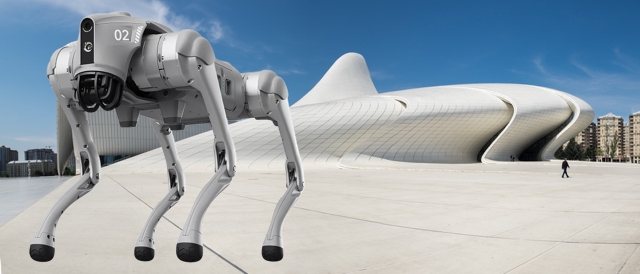
MirrorMe Black Panther II Quadruped Robot

Auf Lager
- MARKE:
- MIRRORME
- MODELL:
- Black Panther II
- AVAILABILITY:
- SUBJECT TO AVAILABILITY
- SKU:
- MirrorMe-Black-Panther-II
MirrorMe Black Panther II Quadruped Robot
Few machines have reset expectations for legged robots as quickly as the MirrorMe Black Panther II. The 38-kilogram, 0.63-metre quadruped hit 10.3 metres per second in a televised demonstration, matching top human sprinters and breaking the speed record held by Boston Dynamics' WildCat. Built by MirrorMe Technology on years of university research into high-speed locomotion, it is the company's flagship platform for education, research and high-mobility field work.
Also known as Black Panther 2.0, the robot pairs an animal-inspired lightweight body with AI-driven gait control. It is a platform for people who study speed, push dynamic control to its limits, or need a quadruped that covers ground faster than anything else on four legs.
Background and Development
The Black Panther has been in development since 2018, and early prototypes topped out at six metres per second. The commercial programme moved to MirrorMe Technology, founded in May 2024 and based in Shanghai, with a team drawn from Zhejiang University. Founder and CEO Wang Hongtao holds doctorates from Tsinghua University and Harvard and is a professor at Zhejiang University.
The robot was unveiled in January 2025 with a peak stride frequency of five steps per second. In a live broadcast on China Central Television, it then ran 100 metres from a standing start in 13.17 seconds on an athletics track in Wuhan, an unofficial record. Development has continued since: MirrorMe reports that iterative upgrades have pushed the Black Panther II's peak velocity to 13.4 metres per second. The robot also raced a world champion sprinter in a MrBeast video, losing by a negligible margin.
Design and Engineering
The Black Panther II's speed comes from many engineering decisions working together rather than a single breakthrough.
Animal-Inspired Legs
The design draws on the paws and joints of jerboas and black panthers to improve power, adaptability, fluidity and precision at high speed. Its carbon-fibre shins, modelled on the jerboa, raise stiffness by 135 percent while adding only 16 percent to weight. A later upgrade merged three separate carbon-fibre lower-leg parts into one piece, increasing overall strength.
Energy-Storing Knee Springs
Springs added between the knee joints cushion impacts on the structure and improve energy transmission. The effect resembles a tendon: energy from each footfall is stored and returned into the next stride.
Traction and Control
Rubber feet modelled on its biological namesake improve grip, while compact high-performance motors and AI-controlled running motion deliver the speed. Machine learning lets the robot adjust its gait efficiently, moving it closer to the fluid movement of real animals. Underpinning the work, MirrorMe developed its own legged-robot design software, which supported the Black Panther II's launch.
Technical Specifications
| Specification | Black Panther II |
|---|---|
| Manufacturer | MirrorMe Technology |
| Type | High-speed quadruped robot |
| Weight | 38 kg |
| Height | 0.63 m |
| Peak stride frequency | 5 steps per second |
| Tested top speed | 10.3–10.4 m/s (televised and treadmill demonstrations) |
| Reported peak speed | 13.4 m/s (manufacturer figure) |
| 100 m sprint | 13.17 s from a standing start |
| Leg construction | Single-piece carbon-fibre lower legs |
| Knee design | Integrated springs for shock absorption and energy return |
| Feet | Rubber, panther-inspired |
| Control | AI and machine-learning gait adaptation |
| Primary market | Education, research and high-mobility applications |
Who is the MirrorMe Black Panther II for?
The Black Panther II suits universities and research laboratories studying dynamic locomotion, high-speed control and bio-inspired mechanics, where a platform already operating at the edge of quadruped performance is the most valuable test bed. It fits engineering faculties and robotics programmes that want students working on a world-record machine, and corporate R&D teams benchmarking actuators, control policies or materials against the current state of the art. Science centres, exhibitions and brand activations can use its record-setting speed as a crowd-drawing demonstration. Emergency-response and special-operations groups exploring rapid ground coverage are also prospective users: the Black Panther 2.0 is being tested for some special operations and emergency rescue work.
What is the MirrorMe Black Panther II used for?
- Locomotion research: high-speed gait, balance and control studies on a record-setting platform.
- Robotics education: hands-on teaching in dynamics, actuation and machine learning.
- Benchmarking: a reference point for speed, efficiency and stride performance in legged robots.
- Emergency response trials: potential use in disaster relief and logistics, such as moving quickly across earthquake debris.
- Demonstrations and events: sprint showcases at exhibitions, science festivals and media events.
- Bio-inspired engineering: testing animal-derived leg, joint and foot designs.
Pricing and Availability
The MirrorMe Black Panther II is available for purchase and international delivery through this page, for single research units, teaching laboratories and multi-unit programmes. Price and cost depend on configuration, software and development access, training scope, spare parts and quantity, so buyers should request a current quotation for their application. Delivery, customs clearance and after-sales support are arranged worldwide. Purchase enquiries, datasheets and availability details for the Black Panther II are available on this page.
Frequently Asked Questions
How fast is the MirrorMe Black Panther II?
It has been clocked at 10.3 to 10.4 metres per second in televised and treadmill demonstrations, ran 100 metres from a standing start in 13.17 seconds, and MirrorMe reports a peak of 13.4 metres per second following later upgrades.
Is the Black Panther II the fastest robot dog in the world?
It surpassed the long-standing record of Boston Dynamics' WildCat and is widely described as the world's fastest quadruped robot, though its sprint records have been set in demonstrations rather than ratified through an official record body.
Are Black Panther II and Black Panther 2.0 the same robot?
Yes. Both names refer to the same MirrorMe quadruped, which has been refined through several iterations since its January 2025 unveiling.
How much does the Black Panther II weigh?
It weighs 38 kilograms and stands 0.63 metres tall, with carbon-fibre construction keeping mass low for speed.
What makes it so fast?
A combination of jerboa-inspired carbon-fibre legs, energy-storing knee springs, panther-inspired rubber feet, compact high-performance motors and AI-driven gait control that adapts its stride in real time.
Who makes the Black Panther II?
MirrorMe Technology, a Shanghai robotics company founded in 2024 by a team from Zhejiang University, which also develops industrial quadrupeds, consumer robots and the Bolt full-size humanoid.
Where can I buy the Black Panther II?
The Black Panther II is available for purchase through this page, with quotations, specifications and delivery arrangements provided on request.