RoboLingua - Universal Language Pack for Robots
In stock
- AVAILABILITY:
- USUALLY SHIPS IN 3-5 BUSINESS DAYS
- SKU:
- RoboLingua-Lanuage-Pack
RoboLingua Universal Language Pack for Robots
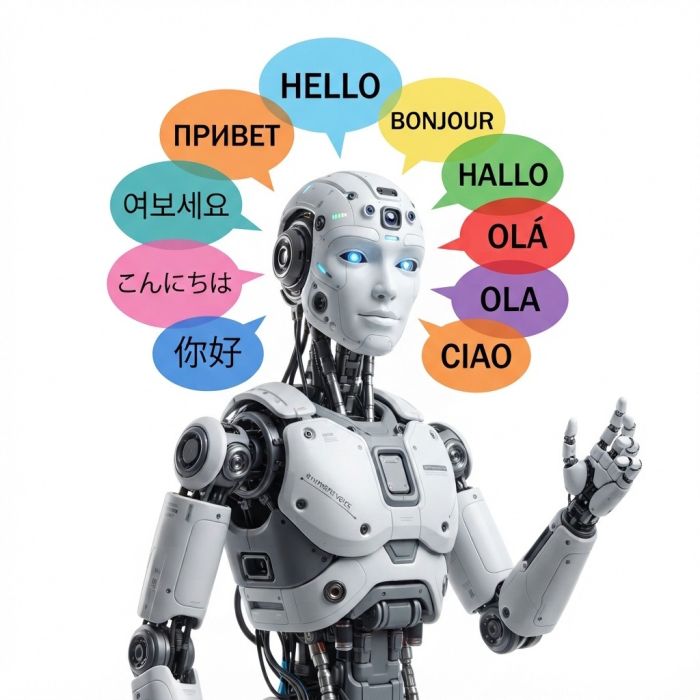
RoboLingua Universal Language Pack for Robots is a robot-agnostic software solution that enables humanoid robots to understand and communicate in the languages of your choice. Most commercially available robots ship with support for only one or two languages — typically English and Chinese — which limits their usefulness in multilingual regions such as the Gulf, Europe, and Southeast Asia. RoboLingua removes this barrier.
RoboLingua is sold as individual language modules: you select the specific language or languages your deployment needs — Arabic for a Dubai showroom, French and German for a European trade fair — and license each one separately. More than 50 languages are available, and additional modules can be activated on the same robot at any time as your audience grows.
Built on large language model (LLM) technology of the kind popularized by ChatGPT, RoboLingua allows any robot that supports secondary development (an open SDK or API layer) to hold natural conversations in each licensed language, while accompanying its speech with head nods and hand or arm gestures for a more lifelike, human-feeling interaction.
Design and Features
Per-Language Modular Licensing
RoboLingua's defining feature is its modular structure. Each language is a self-contained module:
- Choose only what you need — license a single language, or combine several for multilingual deployments.
- Add languages any time — new modules activate on the existing installation without reinstallation or downtime.
- Per-robot flexibility — different robots in the same fleet can carry different language sets, matched to their location or role.
Multilingual Speech and Understanding
Within its licensed languages, RoboLingua connects the robot's microphone and speaker systems to a cloud- or edge-based LLM pipeline, providing:
- Automatic language detection — with multiple modules installed, the robot identifies the speaker's language within the first sentence and responds in kind.
- Natural, conversational replies — powered by the same class of language models behind ChatGPT, rather than rigid pre-scripted phrases.
- Real-time switching — users can change between licensed languages mid-conversation without any reconfiguration.
Gesture and Motion Synchronization
Language alone does not make interaction feel natural. RoboLingua synchronizes speech output with physical expression:
- Head nodding during listening and affirmation, signaling attention and understanding.
- Hand and arm gestures timed to speech emphasis — pointing, open-palm welcomes, and conversational beats.
- Culturally aware motion profiles matched to each language module, so gestures remain appropriate across regions.
Robot-Agnostic Architecture
Because RoboLingua communicates through each robot's secondary development interface (SDK/API), it is not locked to any single manufacturer. If the robot exposes motor control and audio I/O for developers, the Universal Language Pack can run on it.
Technology and Specifications
Available Languages
Language modules are available for all major ChatGPT-supported languages, including:
Albanian, Amharic, Arabic, Armenian, Bengali, Bosnian, Bulgarian, Burmese, Catalan, Chinese (Simplified and Traditional), Croatian, Czech, Danish, Dutch, English, Estonian, Filipino (Tagalog), Finnish, French, Georgian, German, Greek, Gujarati, Hebrew, Hindi, Hungarian, Icelandic, Indonesian, Italian, Japanese, Kannada, Kazakh, Korean, Latvian, Lithuanian, Macedonian, Malay, Malayalam, Marathi, Mongolian, Nepali, Norwegian, Persian (Farsi), Polish, Portuguese, Punjabi, Romanian, Russian, Serbian, Slovak, Slovenian, Somali, Spanish, Swahili, Swedish, Tamil, Telugu, Thai, Turkish, Ukrainian, Urdu, Vietnamese.
Voice quality and speech-recognition accuracy are highest in widely spoken languages, with continuous improvements delivered through software updates to all licensed modules.
Compatible Robots (Secondary Development Supported)
RoboLingua is compatible with any robot that offers open secondary development. The list below covers the most widely deployed platforms; additional models are added regularly.
Full-Size Humanoid Robots
- Unitree H1 / H1-2 — full-size humanoid with open development platform
- Unitree G1 / G1 EDU — full SDK access for motion and voice integration
- Unitree R1 — lightweight developer-focused humanoid
- AgiBot A2 — full-size interactive service humanoid
- AgiBot X2 series (including X2 Ultra) — open development framework
- AgiBot G2 / G2 Air — SDK-supported interactive humanoid
- UBTECH Walker S1 / S2 — industrial humanoid with developer interfaces
- UBTECH / UWORLD U1 series (including female variants) — education and service deployments
- Fourier GR-1 / GR-2 / GR-3 — research-grade humanoids with open APIs
- Fourier N1 — open-source humanoid platform
- Kepler Forerunner series — industrial humanoid with SDK support
- EngineAI PM01 / SE01 — open SDK humanoids
- Booster T1 / K1 — developer humanoid platforms
- Leju Kuavo — open-platform bipedal humanoid
- OpenLoong (Qinglong) — open-source full-size humanoid
- MagicLab MagicBot — developer-accessible humanoid platform
- Galbot G1 — wheeled dual-arm humanoid with developer API
- Dobot Atom — dexterous humanoid with development interface
Compact and Education Humanoids
- SoftBank NAO — the most widely used education humanoid, full SDK
- SoftBank Pepper — service humanoid with open developer tools
- ROBOTIS OP3 — open-source research humanoid
- Noetix N2 / Bumi — compact developer humanoids
- PAL Robotics ARI / TIAGo — research and service platforms with ROS support
- Unitree Go2 / B2 (quadrupeds with voice interaction modules) — SDK-enabled
Wheeled Service and Reception Robots
- Orion Star reception robots — SDK-enabled service platforms
- Pudu service robots (SDK-enabled models) — hospitality and delivery
- Promobot V.4 — customizable reception humanoid
As a general rule, if the manufacturer documents a developer SDK, open API, or ROS-compatible interface, the robot can be supported by RoboLingua. Robots without secondary development access (fully closed systems) are not compatible. Contact us to confirm compatibility for any model not listed here.
System Requirements
- Robot with documented SDK/API (secondary development enabled)
- Stable internet connection for cloud LLM mode, or on-board compute for edge mode
- Microphone and speaker hardware (standard on all listed humanoids)
Applications and Use Cases
Retail and Hospitality
Hotels, malls, and airports in multilingual markets can equip a robot greeter with exactly the language modules their visitor mix requires — Arabic, English, Hindi, and Russian for a Dubai property, for example — a decisive advantage in international hubs.
Education
Schools and universities license the languages relevant to their curriculum and student body, using RoboLingua-equipped robots for language learning, STEM demonstrations, and inclusive teaching environments.
Exhibitions and Events
Trade shows and product launches can license event-specific languages for the duration of a campaign, letting robots present, answer questions, and gesture naturally for international audiences without hiring multilingual staff.
Healthcare and Public Services
Reception and wayfinding robots in hospitals and government service centers can be configured with the community's most-spoken languages, improving accessibility and reducing staff workload.
Research and Development
Universities and labs studying human-robot interaction (HRI) gain a ready-made multilingual interaction layer with RoboLingua, licensing individual languages as research needs evolve.
Advantages / Benefits
- Pay only for the languages you need — per-language licensing keeps entry costs low and scales with your deployment, rather than forcing an all-or-nothing purchase.
- Grow without reinstalling — start with one language and add modules as your audience expands.
- Natural, human-feeling interaction — synchronized nods and gestures make conversations engaging rather than mechanical.
- Robot-agnostic — protects your hardware investment; the same Universal Language Pack works across Unitree, AgiBot, UBTECH, Fourier, and other SDK-enabled platforms.
- Future-proof — language models improve continuously, and updates flow to every licensed module without hardware changes.
- Flexible licensing — included free with robots purchased from us; available as a paid add-on for robots purchased elsewhere.
For buyers researching where to buy RoboLingua, or comparing the RoboLingua price and cost per language against hiring multilingual staff or purchasing region-specific robot variants, the economics strongly favor the modular software approach: one robot plus the language modules you actually need replaces multiple localized deployments.
FAQ
What is RoboLingua Universal Language Pack for Robots?
RoboLingua is a software add-on, sold as individual language modules, that enables any humanoid robot with secondary development support to understand and speak the languages you license, accompanied by natural head nods and arm gestures during conversation.
How does RoboLingua work?
RoboLingua connects to the robot's SDK, routing speech input through large language model technology (the same class of AI behind ChatGPT). It detects the speaker's language among your licensed modules, generates a natural reply, and synchronizes the robot's head and arm movements with its speech.
How is RoboLingua sold?
RoboLingua is licensed per language. You purchase a module for each language you need — for example, Arabic only, or Arabic plus English plus Hindi — and can add further language modules to the same robot at any time.
Which robots are compatible with RoboLingua?
Any robot that supports secondary development is compatible, including humanoids from Unitree (G1, H1, R1), AgiBot (X2, G2, A2), UBTECH (Walker, U1 series), Fourier (GR series, N1), Booster, EngineAI, Kepler, and Leju, as well as education platforms like SoftBank NAO and Pepper, and SDK-enabled service robots.
Why is RoboLingua important?
Most robots ship with only one or two languages, which limits deployment in multilingual regions. RoboLingua allows speakers of any licensed language to interact with a robot naturally, dramatically expanding where and how robots can be used.
What are the benefits of RoboLingua?
Key benefits include per-language licensing that scales with your needs, automatic language detection across licensed modules, natural gesture-synchronized interaction, compatibility across major humanoid robot brands, and continuous improvement through software updates.
Is RoboLingua for sale separately from a robot?
Yes. RoboLingua is included free of charge with any compatible robot purchased from us, and language modules are available as a paid add-on for robots purchased from other suppliers. Contact us for current per-language pricing and licensing details.
Summary
RoboLingua Universal Language Pack for Robots solves one of the most persistent limitations in commercial robotics: language. Sold as flexible per-language modules and built on LLM-driven conversation with synchronized head nods and arm gestures, it turns any SDK-enabled humanoid robot — from the Unitree G1 to the AgiBot X2 — into a natural, engaging communicator in exactly the languages your customers speak. Whether deployed in retail, education, hospitality, healthcare, or research, RoboLingua lets organizations start with one language and scale to fifty. For those looking to buy RoboLingua or evaluate its cost per language against multilingual staffing, it represents one of the highest-value upgrades available in humanoid robotics today.