
Agibot A Series
A Series chez Robots International : sélection française pour comparer les solutions, préparer un devis et organiser l’approvisionnement international.
A Series
La catégorie A Series de Robots International regroupe des offres liées à solutions robotiques pour les clients qui comparent des solutions robotiques disponibles à l’achat, à la location ou sur devis international.
Chemin catalogue : Catalogue > AgiBot > A Series. Cette page française sert de point d’entrée pour examiner les modèles, marques, accessoires ou ressources correspondants sans modifier les spécifications techniques publiées sur les fiches produits.
Évaluation et intégration
Avant une commande, Robots International peut aider à vérifier l’usage prévu, l’environnement d’exploitation, les contraintes de sécurité, les options de configuration, la compatibilité avec les accessoires et les besoins de formation ou de maintenance.
Approvisionnement international
Pour les projets professionnels, les demandes de prix peuvent inclure disponibilité, délais, transport, documents d’importation, exigences de conformité et accompagnement logistique vers le pays de destination.
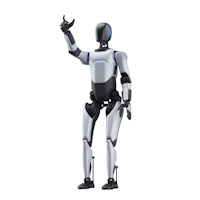
What is the AgiBot A Series? The AgiBot A Series is the flagship humanoid robot product line from AgiBot (Zhiyuan Robotics), a Shanghai-based robotics company. It includes four generations: the RAISE A1 (2023), the Expedition A2 and its variants A2-Max, A2-W, and A2 Ultra (2024-2025), and the Expedition A3 (2026). Each model is a full-size, bipedal or wheeled general-purpose humanoid robot powered by AgiBot's proprietary AI software stack, including the GO-1 foundation model and the WorkGPT multimodal engine.
How does the AgiBot A2 robot work? The AgiBot A2 processes sensory input from onboard cameras, LiDAR, and microphones through its WorkGPT AI engine, which runs at 200 TOPS on local hardware without requiring cloud connectivity. The GO-1 foundation model interprets the robot's environment, understands natural-language instructions, plans multi-step actions, and sends commands to the robot's PowerFlow joint motors and SkillHand dexterous hands. The system supports voice commands, face recognition, obstacle avoidance, and fine-manipulation tasks like threading a needle — all through onboard edge inference.
What are the differences between the AgiBot A2, A2-Max, A2-W, and A2 Ultra? The standard A2 is a general-purpose bipedal humanoid for commercial and industrial use. The A2-Max is a heavy-duty variant with a 40-kilogram payload and 67 degrees of freedom for demanding industrial work. The A2-W is a wheeled version with dual force-controlled arms for repeatable factory assembly tasks at sub-millimeter accuracy. The A2 Ultra is a refined service-oriented model with 40 degrees of freedom, triple-market certification (China, US, EU), up to 1,300 hours of validated continuous walking endurance, and software customization tools for commercial deployments.
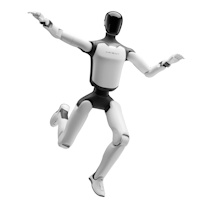
What is the AgiBot Expedition A3 robot? The Expedition A3 is AgiBot's third-generation full-size humanoid, unveiled in February 2026. It is designed for high-interaction environments like retail, entertainment, and live events. The A3 features a flexible waist with human-like range of motion, lightweight exoskeleton legs for agility, an eight-hour battery life via a dual-battery torso system, fast battery-swapping, and an end-to-end AI model for wake-word-free conversation. It gained widespread attention for performing aerial flying kicks, consecutive airborne strikes, and cyclone kicks in demonstrations filmed without CGI.
What industries use the AgiBot A Series? The A Series is deployed across automotive manufacturing, electronics assembly, logistics and warehousing, commercial reception and guided tour services, retail and brand activation, research and education, entertainment and live events, and trade show exhibitions. AgiBot has identified industrial manufacturing as the primary near-term revenue driver, with commercial service and household applications projected to grow over the next five to eight years.
How does the AgiBot A2 compare to Tesla Optimus? Both are full-size bipedal humanoid robots designed for general-purpose industrial and commercial tasks. The A2 is available for enterprise purchase today at $100,000 to $190,000, with over 5,000 units shipped in 2025 and triple-market certification. Tesla Optimus was still in limited production as of early 2026 with no public purchase availability, though Tesla has projected an eventual retail price of approximately $20,000 to $30,000 once scale is reached. The competitive dynamics between the two programs will become clearer as Optimus moves toward broader deployment in 2026 and beyond.