Dobot Atom D
In stock
- BRAND:
- DOBOT
- PART #:
- Dobot Atom D
- ORIGIN:
- China
- AVAILABILITY:
- SUBJECT TO AVAILABILITY
- SKU:
- Dobot-Atom-D
Dobot Atom D
This positioning is important because it shows that Dobot is not presenting the Atom line as a single humanoid robot with one universal configuration. Instead, the company is segmenting the platform by workflow: the Atom Max for advanced research and industrial applications, the Atom Trainer for embodied AI training, and the Atom D for large-scale data collection. That product structure reflects Dobot’s broader shift from collaborative robot arms into embodied AI and humanoid robotics.

Within Dobot’s public robotics portfolio, the Atom D belongs to the company’s newer humanoid category rather than its established cobot and education lines. Dobot’s products page identifies DOBOT Atom as the company’s first humanoid robot, while separate official materials continue to place collaborative arms, desktop robots, and smart cameras in other product families.
Design and Features
Built for large-scale data collection
The most defining feature of the Dobot Atom D is its stated role as a data-collection platform. Dobot’s official wording says the Atom D is “optimized for large-scale data tasks,” which strongly suggests a robot intended to gather multimodal operational data for training, evaluation, and embodied AI development rather than simply to perform finished end-user tasks.
Dual-arm humanoid upper body
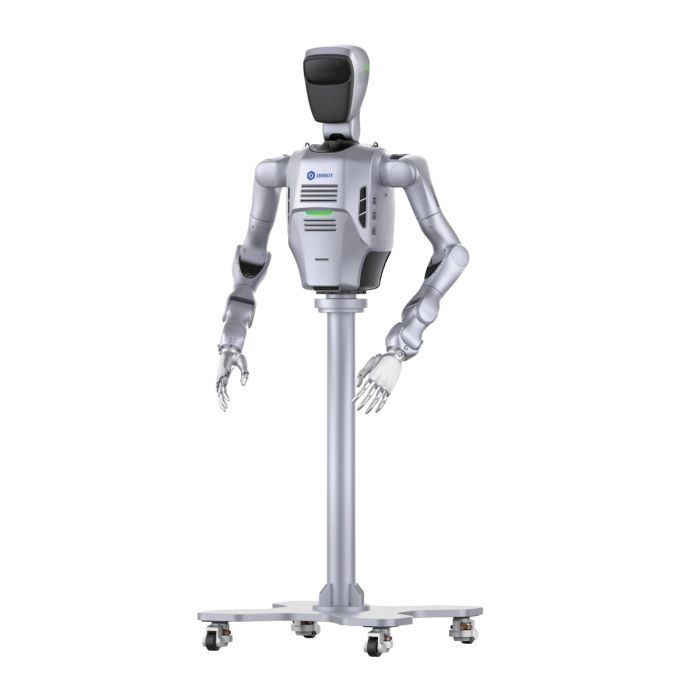
Dobot says the Atom D features dual 7-DoF arms and a 2-DoF head. This configuration gives the robot a recognizable humanoid upper-body structure with enough articulation for bilateral manipulation, camera-based observation, and viewpoint control during demonstrations or collection sessions. In practical terms, dual 7-DoF arms provide a flexible basis for recording two-handed actions, grasp strategies, object handling, and coordinated movement patterns.
Customizable end-effectors
The official product page states that the Atom D supports customizable end-effectors, including dexterous hands, grippers, and wrist cameras. That flexibility is significant because different data-collection tasks call for different hardware. A dexterous hand may be appropriate for fine manipulation datasets, while a gripper may be better for structured industrial pick-and-place or simpler repetitive capture routines. Wrist cameras also improve close-range visual context during manipulation.
Human-like visual acquisition
Dobot says the Atom D uses a 60 fps Full HD binocular camera and notes that the system is designed to minimize VR and MR motion sickness while maintaining high-quality imaging. That statement suggests the robot is built not only for passive sensing, but also for human-in-the-loop collection workflows where an operator may use immersive control interfaces to demonstrate tasks or supervise actions.
Technology and Specifications
Arm and head degrees of freedom
The clearest published Atom D specifications on Dobot’s official page are its dual 7-DoF arms and 2-DoF head. Dobot does not present a full-body DoF total for Atom D in the same snippet, but the published arm-head configuration already makes clear that the robot is meant for directional sensing and articulated upper-body data capture rather than for being a static station.
Vision and depth-sensing stack
Dobot states that the Atom D integrates an Intel RealSense D455 depth camera with a 6 m range, alongside the 60 fps Full HD binocular camera. This combination matters because embodied AI data collection often requires more than RGB video. Depth data adds spatial structure, scene geometry, object distance, and motion context that can be critical for imitation learning, policy training, 3D understanding, and manipulation model development.
Wrist-camera support
The official page’s mention of wrist cameras is one of the Atom D’s most practical technical details. In robot learning systems, wrist-mounted cameras are often highly valuable because they provide a close-range, task-centered view of the hand, tool, or object during interaction. This can improve dataset richness and make the system more useful for learning grasp sequences, insertion operations, or action-conditioned visual models. The official source confirms that wrist cameras are part of the customizable end-effector configuration.
External data workflows
Dobot also says the Atom D supports Ethernet connectivity for efficient external data collection and processing. That is a particularly important line because it points directly to the robot’s role in larger data pipelines. Rather than positioning Atom D as a self-contained consumer robot, Dobot is describing it as a node in a broader system for capture, transmission, storage, or model-development workflows.
Place within the Atom Series
The broader Atom Series context also helps interpret Atom D technically. On the same official page, Dobot describes the Atom Trainer as a 29-DoF embodied AI training platform with 1500 TOPS edge computing, 360° LiDAR, RealSense D455 sensing, and teleoperation modes, while the Atom Max is described as a 41-DoF humanoid for advanced research and industrial applications. This suggests that Atom D is not the “max capability” version, but a more focused configuration optimized for the specific problem of collecting high-quality embodied data at scale.
Applications and Use Cases
The Atom D’s most direct use case is large-scale embodied AI data collection. Dobot’s official wording is unusually explicit on this point, so the primary application is not a guess. The robot is intended for scenarios where organizations need to gather action data, visual streams, depth information, and manipulation examples that can support training and evaluation of robot intelligence systems.
A second major use case is teleoperation-driven demonstration capture. Because Dobot says the binocular camera design reduces VR and MR motion sickness, it is reasonable to infer that the Atom D is well suited to immersive operator-led collection sessions where a human demonstrates tasks through remote control or embodied interfaces. This interpretation is closely supported by the product’s emphasis on human-eye-baseline vision and data collection rather than by general speculation.
The Atom D is also relevant to robotics research and industrial AI development more broadly. Dobot’s June 2025 announcement about global mass production and delivery of the DOBOT Atom humanoid line framed Atom as part of the evolution of embodied intelligence, which places Atom D within a commercial and research context larger than a one-off experimental platform.
Finally, the Atom D fits naturally into workflows that require structured dataset generation for perception and manipulation models. The combination of dual arms, binocular vision, depth sensing, wrist cameras, and Ethernet-based external processing makes it especially suited to organizations building training corpora for bimanual action, object interaction, and robot control experiments. That is an inference from the product’s published hardware and connectivity emphasis.
Advantages / Benefits
One of the clearest advantages of the Dobot Atom D is specialization. Many humanoid robots are presented as broadly capable platforms, but Dobot is more specific here: Atom D is built for data collection. That clarity can be valuable for research labs, AI teams, and industrial R&D groups that do not need a general marketing robot or a finished service machine, but a platform suited to building datasets and improving models.
Another advantage is the robot’s sensor mix. The combination of binocular imaging, RealSense depth sensing, and optional wrist cameras gives the Atom D a practical multimodal foundation for modern embodied AI pipelines. Because high-quality dataset design often depends on viewpoint diversity and synchronized sensing, this configuration is more useful than a simple monocular camera setup for many research workflows.
A third advantage is integration into external processing systems. Dobot’s explicit reference to Ethernet connectivity for efficient external data collection and processing suggests that the Atom D is meant to fit into broader compute and storage infrastructure. For teams building large datasets or running centralized training pipelines, that can be more important than consumer-style onboard convenience.
The Atom D also benefits from existing corporate context. Dobot is an established robotics company founded in 2015 and publicly describes itself as a global provider of collaborative robots and desktop robotic arms, with in-house technologies spanning AI, intelligent sensing, and system integration. That background matters because it suggests the Atom D comes from a company with an existing automation and robotics ecosystem rather than from a concept-only startup.
FAQ Section
What is Dobot Atom D?
Dobot Atom D is a humanoid robot variant in the DOBOT Atom Series that Dobot says is optimized for large-scale data tasks. It features dual 7-DoF arms, a 2-DoF head, customizable end-effectors, binocular vision, and depth sensing.
How does Dobot Atom D work?
It works by combining articulated dual arms, head movement, a binocular Full HD camera, an Intel RealSense D455 depth camera, optional wrist cameras, and Ethernet connectivity for external data collection and processing. Dobot positions it specifically for large-scale data workflows.
Why is Dobot Atom D important?
It is important because it gives the Atom Series a dedicated data-collection platform for embodied AI development. Rather than treating data generation as a side feature, Dobot explicitly defines Atom D around that purpose.
What are the benefits of Dobot Atom D?
Its main benefits include specialization for large-scale embodied AI data tasks, dual-arm articulation, customizable hands or grippers, binocular and depth imaging, wrist-camera support, and Ethernet-based external data workflows.
How is Dobot Atom D different from Atom Trainer?
According to Dobot’s official Atom page, Atom D is optimized for large-scale data tasks, while Atom Trainer is positioned as a 29-DoF platform for embodied AI training. Both belong to the same Atom family, but their published purposes are different.
Summary
The Dobot Atom D is a specialized humanoid platform within the DOBOT Atom Series, built for large-scale data collection rather than generic humanoid deployment. Dobot’s official materials describe a robot with dual 7-DoF arms, a 2-DoF head, customizable end-effectors, Full HD binocular vision, Intel RealSense D455 depth sensing, and Ethernet-based external data workflows. For organizations focused on embodied AI, imitation learning, teleoperation datasets, and structured robot-training pipelines, Atom D stands out as a purpose-built data platform rather than a broad one-size-fits-all humanoid.
Specifications
| PART # | Dobot Atom D |
|---|---|
| BRAND | DOBOT |