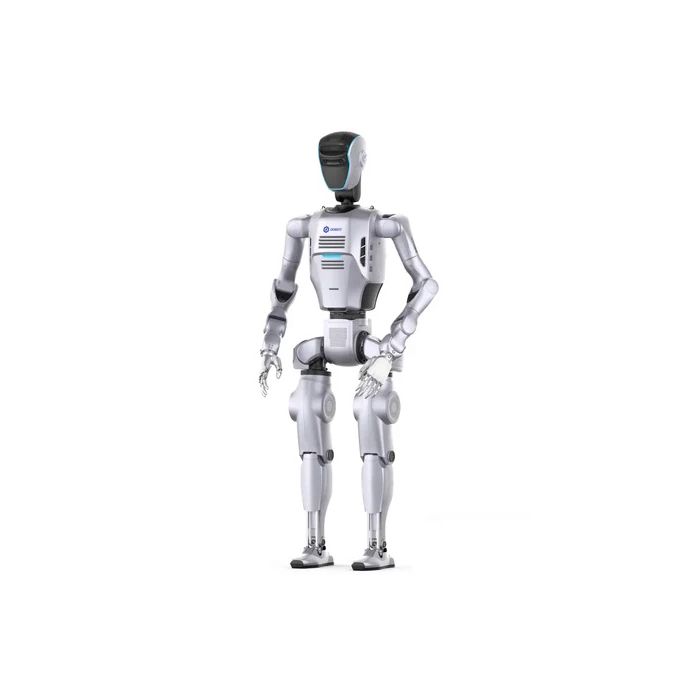
Dobot Atom Trainer

The Dobot Atom Trainer is a research-oriented humanoid robotics platform within the DOBOT Atom Series, positioned specifically for embodied AI training rather than for general commercial service deployment. On Dobot’s official Atom product page, the company presents the Atom Trainer alongside the Atom Max and Atom D, indicating that the Atom family is not a single robot but a small lineup of related humanoid platforms optimized for different development and deployment needs.

In stock

BRAND:
DOBOT
PART #:
Atom Trainer
ORIGIN:
China
AVAILABILITY:
SUBJECT TO AVAILABILITY
SKU:
Dobot-Atom-Trainer

Dobot Atom Trainer

In Dobot’s own wording, the Atom Trainer is a 29-degree-of-freedom robotics platform for embodied AI training. The company highlights optional dexterous hands or grippers, high-performance edge AI computing, binocular vision, depth sensing, and dual-mode teleoperation. This positioning makes the Atom Trainer especially relevant to robotics researchers, AI developers, and industrial teams working on data-driven manipulation, perception, and task-learning systems.

Dobot Atom – Max

The Atom Trainer also reflects Dobot’s broader strategic expansion beyond collaborative robot arms and education hardware into humanoid robotics. Dobot publicly announced the global mass production and delivery of the broader DOBOT Atom humanoid line in June 2025, framing Atom as a milestone in embodied intelligence and next-generation automation. Within that context, the Atom Trainer can be understood as the training and experimentation branch of the Atom platform family.

Design and Features

Built for embodied AI development

The clearest defining feature of the Atom Trainer is its explicit focus on embodied AI training. Dobot does not describe it as a hospitality robot, a consumer humanoid, or a factory cobot replacement. Instead, the official product page emphasizes training, task expansion, and rapid deployment of custom AI operation models. That distinction matters because it places the Atom Trainer in the growing category of robots designed as AI development platforms, where learning, data collection, and model iteration are as important as the underlying mechanics.


Humanoid upper-body platform with configurable end effectors

Dobot says the Atom Trainer has 29 degrees of freedom and supports optional 6-DoF dexterous hands or grippers. This configuration suggests a platform designed to balance manipulation capability with practical research usability. A robot built for training often needs enough articulation to support realistic tasks, but not necessarily every mechanical feature of a flagship full-scale humanoid. The option to choose between dexterous hands and grippers also suggests Dobot is accommodating different research priorities, from fine manipulation to more structured industrial grasping experiments.

Vision system designed around human-like perception

The official page highlights human-eye-baseline Full HD binocular cameras, a detail that is especially notable for teleoperation and embodied AI research. Dobot says this design supports accurate vision while helping reduce motion sickness in VR and MR operation. That indicates the Atom Trainer is meant not only to run autonomous models but also to support human-in-the-loop control and demonstration workflows, which are common in robot learning pipelines.

Multi-camera spatial awareness

Beyond binocular vision, Dobot says the Atom Trainer includes dual wrist cameras for precision work and waist cameras for obstacle detection. This layered camera setup suggests a design philosophy centered on task-specific perception: head-level cameras for general scene understanding, wrist cameras for close manipulation, and lower-body cameras for safe movement in shared spaces. In robotics training, this kind of sensor diversity is valuable because it helps support imitation learning, teleoperation, and multimodal data collection.

Technology and Specifications

Degrees of freedom and manipulation options

Dobot’s official Atom Series page lists the Atom Trainer at 29 DoF. That places it below the 41-DoF Atom Max, which Dobot reserves for more advanced research and industrial applications, but still gives the Trainer substantial articulation for complex experimental tasks. Its optional 6-DoF dexterous hands or grippers further reinforce that the platform is intended to be adapted to different training or manipulation scenarios rather than locked into a single tool configuration.

AI computing and real-time processing

One of the most important published specifications is the Atom Trainer’s 1500 TOPS edge computing capability. Dobot says this onboard AI processing power supports real-time AI tasks, which is critical for embodied robotics, where perception, motion generation, control, and feedback must often happen at low latency on the robot itself. For users developing robot policy models or perception-action pipelines, onboard compute can materially affect deployment speed and experimental practicality.

Environmental perception stack

Dobot states that the Atom Trainer integrates an Intel RealSense D455 with a 6-meter range and 360° LiDAR for environmental awareness. Combined with the binocular cameras and additional wrist and waist cameras, this gives the Trainer a relatively rich perception stack for mapping, scene understanding, and task execution. In practical terms, that makes the robot suitable for experiments that require more than isolated tabletop motion, including spatial navigation, obstacle-aware manipulation, and full-scene teleoperation.

Teleoperation and control modes

The official page says the Atom Trainer supports dual-mode teleoperation control, specifically full-body and segmented modes. This is a significant feature for embodied AI workflows because teleoperation is often used to generate demonstration data, validate task strategies, and test control approaches before moving toward greater autonomy. The presence of both full-body and segmented modes suggests the system can be used for whole-robot control as well as more focused manipulation tasks.

Built-in model deployment workflow

Dobot also says the Atom Trainer has a built-in end-to-end operation model, and that users can quickly feed new datasets into the system and deploy their own AI operation models. This claim is especially important because it points to a software stack designed not just for mechanical control, but for iterative AI experimentation. In other words, Dobot is presenting the Atom Trainer as a robot that fits into a model-training loop, not just as a humanoid body with sensors attached.

Applications and Use Cases

The most obvious use case for the Dobot Atom Trainer is embodied AI research. Dobot explicitly frames it as a platform for training and task expansion in research and industrial applications. That positioning aligns it with labs, advanced development teams, robotics startups, universities, and industrial R&D groups exploring manipulation models, teleoperation systems, robot learning, and multimodal control.

A second major use case is teleoperated data generation. Because the Atom Trainer combines binocular vision, depth sensing, LiDAR, wrist cameras, and dual-mode teleoperation, it is well suited to workflows where a human operator demonstrates tasks that are then used for learning or refinement. This places it conceptually near Dobot’s X-Trainer, another official Dobot training robot designed for AI data collection and AGI research, though the Atom Trainer is clearly part of the humanoid Atom family rather than a dual-arm workstation robot.

The platform also appears relevant to industrial experimentation where teams want to develop or validate new AI-driven operations before pursuing broader deployment. Dobot’s public materials say the Atom Trainer is suitable for industrial applications, while the broader Atom line is tied to high-precision work and embodied intelligence. That makes the Trainer a plausible intermediate system for testing how learned models behave in realistic robotic settings.

Advantages / Benefits

A major strength of the Atom Trainer is that it appears to be built specifically for robot learning workflows, not retrofitted for them. Many robots can be used for AI research, but fewer are explicitly marketed as embodied AI training platforms with teleoperation modes, configurable end effectors, rich perception, and built-in model deployment logic. Dobot’s own description of the Trainer makes this training-first identity unusually clear.

Another advantage is its balance between capability and accessibility within the Atom lineup. Dobot positions the Atom Max as the higher-end research and industrial platform with more degrees of freedom, while the Atom Trainer offers a somewhat leaner 29-DoF configuration still backed by the same 1500 TOPS compute class and strong perception hardware. This suggests the Trainer may serve as a more approachable entry point for embodied AI work inside the Atom Series.

The robot also benefits from Dobot’s broader commercial and technical ecosystem. Dobot has public training infrastructure through its Dobot Academy, where it offers video tutorials, online sessions, and onsite training to help customers master Dobot robots and optimize automation workflows. While the Academy page is not Atom-Trainer-specific, it strengthens the case that Dobot supports its products through structured education rather than shipping hardware alone.

FAQ Section

What is Dobot Atom Trainer?

The Dobot Atom Trainer is a 29-DoF robotics platform for embodied AI training in the DOBOT Atom Series. Dobot says it is designed for research and industrial applications, with optional dexterous hands or grippers, rich perception hardware, and dual-mode teleoperation.

How does Dobot Atom Trainer work?

It works by combining a humanoid robotic body, binocular vision, Intel RealSense D455 depth sensing, 360° LiDAR, wrist and waist cameras, and 1500 TOPS edge computing. Dobot also says it supports full-body and segmented teleoperation, plus built-in end-to-end operation model deployment using new datasets.

Why is Dobot Atom Trainer important?

It is important because it is explicitly positioned as an embodied AI training robot, not just a humanoid for display or fixed automation. That makes it relevant to teams building and testing real-world robot learning systems, teleoperation pipelines, and AI-driven task execution.

What are the benefits of Dobot Atom Trainer?

Its main benefits include a research-focused 29-DoF design, configurable hands or grippers, strong perception hardware, high onboard AI compute, teleoperation support, and fast iteration for custom AI operation models.

How is Dobot Atom Trainer different from Atom Max?

The Atom Max is the more advanced 41-DoF humanoid in the Atom Series, aimed at advanced robotics research and industrial applications, while the Atom Trainer is a 29-DoF platform positioned more specifically for embodied AI training and task expansion.

Summary

The Dobot Atom Trainer is a specialized humanoid robotics platform built for embodied AI training, data-driven task learning, and teleoperated research workflows. Dobot’s official materials position it as a 29-DoF member of the Atom Series, equipped with configurable end effectors, a rich multi-camera and depth-sensing stack, 1500 TOPS edge computing, and dual-mode teleoperation. For organizations seeking a factual overview of the Dobot Atom Trainer, the clearest conclusion is that it is not a general-purpose marketing humanoid but a purpose-built development platform for the next generation of AI-enabled robotics.

Specifications

PART # Atom Trainer
BRAND DOBOT

What's included

Dobot Dobot Atom Trainer (Dobot Atom Trainer)

Product Questions

Your Question:
Write a Review
You're reviewing: Dobot Atom Trainer
loader
Loading...

You submitted your review for moderation.