
Unitree G1 Basic Humanoid Robot
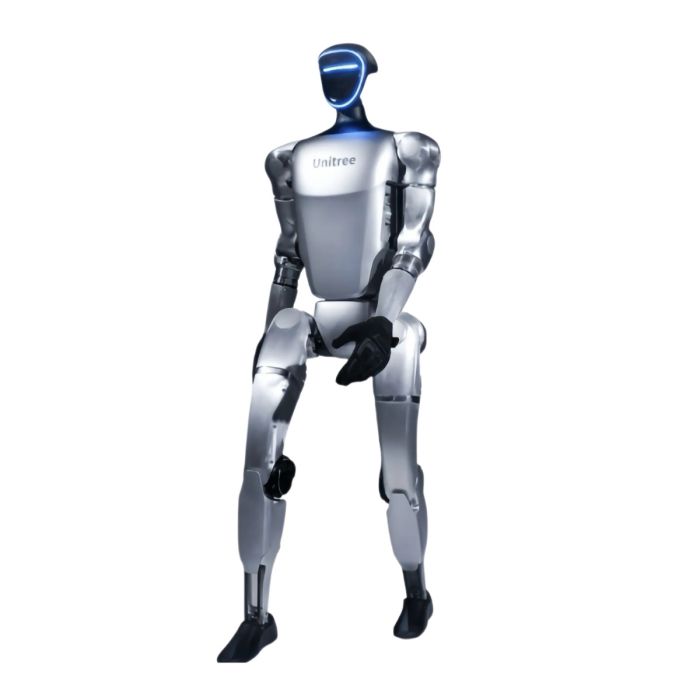
In stock
- BRAND:
- UNITREE ROBOTICS
- MODEL:
- G1 BASIC
- ORIGIN:
- China
- Warranty:
- 8 MONTHS
- AVAILABILITY:
- SUBJECT TO AVAILABILITY
- SKU:
- Unitree-G1-Basic
Buy now, pay later
Unitree G1 Basic Humanoid Robot
At the bottom of the G1 range sits the question most buyers should ask first: do you need a humanoid that manipulates things, or a humanoid that walks? The G1 Basic answers the second question and leaves the first alone — which is exactly why it costs a fraction of the configurations above it.
What it is
The G1 Basic is the entry configuration of Unitree's G1 humanoid: a complete walking, balancing, 23-degree-of-freedom robot with base arms and waist, 3D LiDAR and a depth camera, and no dexterous hands. It is the cheapest way to put a working humanoid on the floor.
What you give up
Two things, and you should be clear about both. First, hands: the Basic has no actuated dexterous hands, so manipulation research is out of scope until you fit them. Second, the EDU line's development access — if your work needs SDK-level control and documented interfaces, the G1 Edu Standard is the configuration to start from, not this one. Neither limit is permanent: hands can be fitted later and are sold separately.
Where this configuration sits
Unitree's G1 codes work on two axes, and almost every buying mistake comes from reading only one of them.
| Tier | Arms and waist | Total DOF | Codes |
|---|---|---|---|
| Standard / Plus | Base arms and waist | 23–29 | U1, U2 |
| Pro | Base arms and waist, upgraded compute | 35–37 | U9–U12, U14 |
| Ultimate | 7 DOF arms, 3 DOF waist | Up to 41 | U3–U8, U13 |
The tier decides how the body moves. The letter decides which hands it wears. A Pro robot with excellent hands still has base arms and waist; an Ultimate with plain hands has the better reach and torso. Decide the tier from the motion your work needs, then the hands from the manipulation it needs.
The Basic sits below the whole table. The G1 PRO is the same body with upgraded compute; the Edu Standard adds development access; the Pro and Ultimate tiers add hands, arms and waist freedom.
G1 Basic specifications
| Specification | Value |
|---|---|
| Height | About 1.32 m standing (1,320 × 450 × 200 mm) |
| Weight | About 35 kg |
| Degrees of freedom | 23 |
| Arms and waist | Base arms, base waist |
| Hands | None fitted — available separately |
| Development access | Not the EDU development package |
| Perception | 3D LiDAR and depth camera |
| Connectivity | Wi-Fi 6, Bluetooth 5.2 |
| Battery life | About 2 hours |
Figures follow published specifications for this configuration and vary by production batch. Confirm the exact build on your quotation before ordering.
Who buys it
- Schools and colleges teaching robotics with a real walking platform
- Science centres, museums and visitor attractions
- Companies wanting a humanoid for demonstrations and marketing
- Buyers evaluating the G1 platform before committing to an EDU configuration
- Anyone whose interest is locomotion, presence and movement rather than grasping
How to choose
Buy the Basic if you want a humanoid that walks and performs, at the lowest cost of entry. Move to the G1 PRO if you need more onboard compute. Move to the Edu Standard the moment your work involves writing your own control code. Compare the whole field in our humanoid robots category.
Safety and standards
The G1 is research, education and demonstration equipment. The industrial robot safety standards — ISO 10218 and the ANSI/RIA R15.06 family — and the mobile robot standard R15.08 do not cover it, so the duty of care sits with the operator. Define and mark a working area, keep untrained people outside it, keep a trained operator with the emergency stop within reach, use a support gantry while developing locomotion, and complete a written risk assessment before any public demonstration.
Lithium batteries are regulated dangerous goods in transit, which affects how spares ship and how quickly.
Deployment and running costs
Budget beyond the robot: a spare battery (runtime is about two hours), a support gantry for development, and a controller. The starter kit shows the usual bundle, and further parts are listed under robot accessories. International buyers should add duty and import charges. Current pricing is shown on the listing above; for quantities, grant purchases or bundles, request a written quotation.
Import and delivery
Units ship from the manufacturer and lead times follow production batches rather than a fixed schedule. Lithium batteries restrict some routes and add documentation. Tell us the destination country when you enquire and we will confirm delivered cost, a realistic lead time and the paperwork required before you commit.
Support before and after the sale
Before you buy, our team will confirm whether the Basic actually covers your intended work — the single most common mistake in this range is buying the entry configuration and then needing development access. After delivery, we help with training, set up and ongoing support. The specifics for your order are confirmed on your quotation.
Where to buy
This configuration is listed above with current price and availability, alongside the rest of the G1 range so you can compare before committing. Order directly, or contact our team for a formal quotation including delivery to your country. Universities and institutions buying against a purchase order should request a written quotation first.
Frequently asked questions
How much does a Unitree G1 Basic cost?
Current pricing is shown on the listing above. Request a quotation for delivered pricing or quantities.
Can I add hands to a G1 Basic later?
Yes. Dexterous hands are sold separately and can be fitted after purchase, though specifying at order saves cost and downtime.
Does the G1 Basic walk?
Yes. It is a complete walking, balancing humanoid with 23 degrees of freedom.
What is the difference between Basic and PRO?
The same body; the PRO adds upgraded onboard compute.
What is the difference between Basic and Edu Standard?
The Edu Standard is the development configuration, with SDK access and documented interfaces.
Is it suitable for research?
For locomotion demonstration and teaching, yes. For research needing your own control code, choose an EDU configuration.
How long does the battery last?
About two hours per charge. Plan at least one spare for a full working day.
Is it safe to demonstrate in public?
Only with a defined working area, a trained operator holding the emergency stop and a written risk assessment.
Do you ship internationally?
Yes. Lithium batteries affect routing and lead time, so confirm the destination country when you enquire.
Specifications
General
Physical
Mobility
Performance
Computing
Sensors
Connectivity
Software
Battery + Power
Shipping
Feature
| Height, width and thickness (standing): 1270x450x200mm |
| Height, width and thickness (folded): 690x450x300mm |
| Single-handed freedom: Dexterous hand and double-freedom wrist optional |
| Maximum arm load: 2kg |
| Calf + thigh length: 0.6m |
| Extra large joint movement space Lumbar Z-axis joint: ±155° |
| Knee joint: 0~165° |
| Hip joint: P±154°, R-30~+170°, Y±158°” |
| Full joint hollow internal alignment: Yes |
| Joint encoder: dual encoder |
| Heat dissipation system: localized air-cooled heat dissipation |
| Power supply: 13 series battery |
| Base Computing Power: 8-core high performance CPU |
| Sensor: Depth camera + 3D LIDAR |
| Stereo speakers and microphone array as standard |
| Intelligent OTA upgrade: support |
What's included
Unitree Unitree G1 Basic
Dummy Hands
Quick Release Smart Battery
Battery Charger
Handheld Remote Control