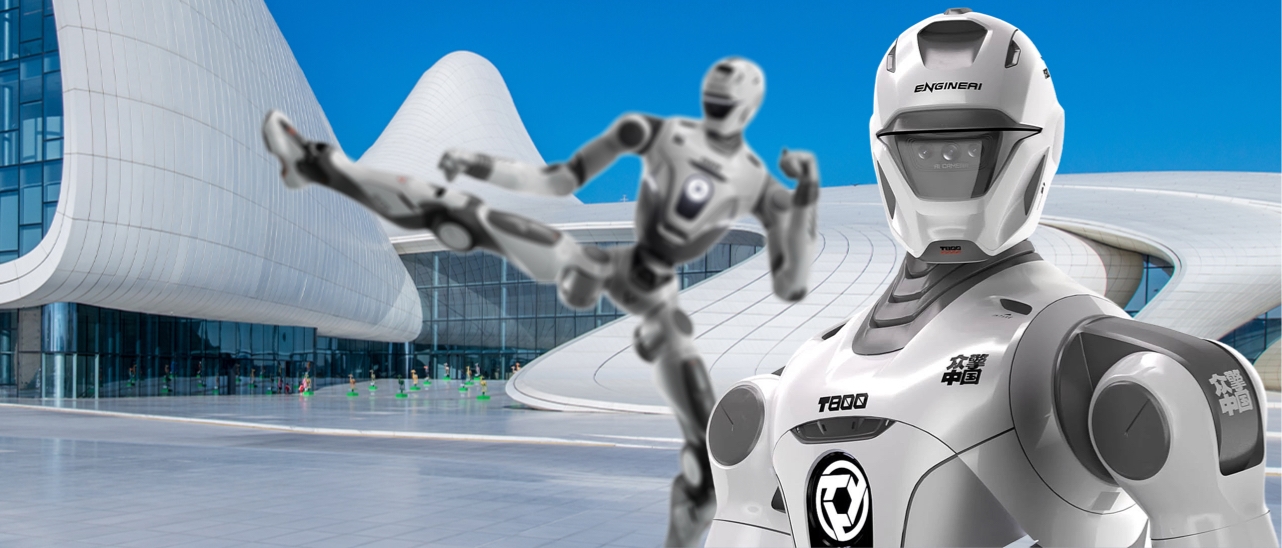
X-Humanoid
X-Humanoid (Beijing Innovation Center of Humanoid Robotics) is the state-backed powerhouse behind the Embodied Tien Kung platform — winner of the world's first humanoid marathon and the first fully autonomous Robot Warrior Challenge, the industry's first full-size humanoid with whole-body dynamic motion integrated with tactile interaction, and the first robot ever to link directly to a low-Earth-orbit satellite. This guide covers the Tien Kung lineup, technology, applications, and what buyers should know before purchasing.
X-Humanoid
Introduction / Overview
X-Humanoid (Beijing Innovation Center of Humanoid Robotics, founded November 2023) is Chinese humanoid robotics' institutional champion — and the platform that keeps winning the events the industry invents to test itself. Its Embodied Tien Kung robot took the world's first humanoid half-marathon in 2025, then in April 2026 won the inaugural Beijing Yizhuang Robot Warrior Challenge — completing a course of real-world high-risk tasks (pendulum traversal, barrier breaching, obstacle clearance) fully autonomously, as the only full-size robot in the field, outscoring the smaller, nimbler competition to take the Warrior Intelligent Mobility Award and become a dual-title champion. Between those wins came a world-first of a different order: in January 2026, a Tien Kung robot linked directly to a GalaxySpace low-Earth-orbit internet satellite — the first demonstration of its kind anywhere — streaming its visual data synchronously while simultaneously connected to a smartphone and computer terminal, receiving a document from an unmanned vehicle and delivering it: humanoid operation untethered from ground networks entirely.
The current platform is Embodied Tien Kung 3.0 (launched February 2026), and its positioning is deliberate: more open, more dexterous, more practical. Built on X-Humanoid's proprietary Wise KaiWu general-purpose embodied-AI platform, the 3.0 is the industry's first full-size humanoid to integrate whole-body, high-dynamic motion control with tactile interaction — upgraded balance, brain-cerebellum coordination, and fully autonomous operation on high-torque joints with millimeter-level calibration and a complete perception-decision-execution AI loop supporting multi-robot collaboration. Critically, it attacks the industry's compatibility problem head-on: accessible hardware and software interfaces, expansion ports, low-code development tools, mainstream protocols (ROS2, MQTT, TCP/IP), and open-sourced motion frameworks, AI models, and datasets — with university joint laboratories (Hunan University, Renmin University) already building on the open interface toward post-earthquake recovery, chemical operations, and firefighting deployments. Alongside, Tien Kung 2.0 hosts the World Robot Conference and runs fully autonomous guided tours at scale in unmanned exhibition halls with multilingual interaction and multi-agent fleet dispatch, while Tien Kung Ultra carries the marathon-champion athletic pedigree — both showcased at CES 2026. For developers, integrators, and high-risk-scenario buyers, X-Humanoid is the open, competition-proven, institutionally backed platform of record.
Design and Features
Embodied Tien Kung 3.0 — The Open Flagship
- The tactile-dynamic first — the industry's first full-size humanoid combining whole-body high-dynamic motion control with integrated tactile interaction: a robot that moves athletically and feels what it touches.
- Wise KaiWu inside — the proprietary embodied-AI platform delivering brain-cerebellum coordination: high-level cognition and reflexive motion control unified for fully autonomous operation.
- Industrial-grade mechanics — high-torque joints, millimeter-level calibration, and a closed perception-decision-execution loop enabling precision work and complex dynamic movement, with multi-robot collaboration built in.
- Radical openness — expansion interfaces, low-code development tools, ROS2/MQTT/TCP-IP support, and open-sourced motion frameworks, AI models, and datasets: development cost and technical barriers cut for the entire ecosystem, with reduced sim-to-real gap and ease of tuning cited by university partner teams.
The Competition Record — Proof by Ordeal
- 2025 humanoid marathon champion — the endurance-and-locomotion crown from the world's first such race.
- 2026 Robot Warrior champion — the first fully autonomous winner, clearing high-risk-scenario obstacles as the only full-size entrant: the leap from locomotion to operational capability, judged publicly.
- Validation with purpose — the Warrior campaign, run with four in-house teams plus university joint labs, generated repeatable development approaches for post-earthquake recovery, chemical operations, and firefighting deployment.
The Satellite First — Operation Without Networks
The GalaxySpace LEO trial proved something no other humanoid has: stable satellite connectivity with synchronous visual-data transmission, simultaneous multi-terminal linkage, and task completion (document relay from unmanned vehicle to destination) — unlocking autonomous humanoid operation in the remote, disaster-struck, and infrastructure-free environments where the high-risk mission set actually lives.
Tien Kung 2.0 and Ultra
- 2.0 — the service professional — host of the World Robot Conference 2025 and operator of one of the earliest fully autonomous guided-tour solutions at scale in unmanned exhibition halls: multilingual recognition and response, with an intelligent multi-agent dispatch system coordinating robot fleets — the foundation for consultation and guiding services.
- Ultra — the athlete — the marathon-winning performance variant, demonstrated live and fully autonomous at CES 2026.
Technology and Specifications
The Platform Family
| Model | Positioning | Signature |
|---|---|---|
| Tien Kung 3.0 | Open flagship platform | Tactile + high-dynamic first; open-sourced stack |
| Tien Kung 2.0 | Service and interaction | Autonomous tours at scale, fleet dispatch |
| Tien Kung Ultra | Performance variant | Marathon champion pedigree |
Detailed unit specifications are configuration-dependent; confirm current datasheets before specifying — datasheets are available on request.
Why Competition Wins Are Procurement Data
Marathon and Warrior victories aren't marketing — they're audited endurance, autonomy, and obstacle performance under rules X-Humanoid didn't control, against rivals motivated to win. For buyers evaluating high-risk deployment (rescue, chemical, fire), that public ordeal record is the closest thing the industry has to certification.
Position in the Market
Among your full-size platforms, X-Humanoid stakes the open-institutional pole: state-backed longevity, the field's most open full-size stack (a genuine alternative to closed commercial platforms), dual competition titles, and the satellite-operation capability no rival demonstrates — complementing Unitree's volume accessibility and the commercial brands' vertical focus.
Applications and Use Cases
High-Risk and Emergency Operations
The funded direction: post-earthquake recovery, chemical operations, and firefighting development on the 3.0's open interface — with satellite connectivity covering the infrastructure-destroyed environments those missions imply.
Exhibition, Tour, and Service Deployment
The 2.0's proven lane: autonomous multilingual guiding at scale, fleet-dispatched, in unmanned venues.
Research and Ecosystem Development
Open-sourced models, datasets, and frameworks plus low-code tooling: the university-lab platform of choice, validated by joint laboratories already publishing repeatable approaches.
Industrial and Commercial Integration
Millimeter-calibrated precision, protocol-standard interfaces, and multi-robot collaboration aimed at integrator deployments.
Remote and Off-Grid Operations
The satellite-link capability opening inspection, delivery, and response scenarios beyond ground networks — a category X-Humanoid currently owns alone.
Advantages / Benefits
- The trophy cabinet — the world's first humanoid marathon and first autonomous Warrior Challenge, both won.
- The tactile-dynamic first — whole-body athleticism with touch, unique at full size.
- The most open full-size stack — open-sourced frameworks, models, and datasets with low-code and ROS2 accessibility.
- Satellite-proven autonomy — the only humanoid demonstrated operating on LEO connectivity.
- Institutional foundations — Beijing's innovation-center backing with university joint laboratories multiplying development.
- Fleet-native intelligence — multi-agent dispatch and multi-robot collaboration shipping today.
For buyers researching where to buy X-Humanoid robots, or comparing Tien Kung 3.0, 2.0, and Ultra prices and costs against Unitree and other full-size humanoids, the evaluation should weigh competition-validated autonomy, ecosystem openness, tactile-dynamic capability, connectivity options, and institutional support — the dimensions where X-Humanoid's champion platform leads.
FAQ
What is X-Humanoid?
X-Humanoid (Beijing Innovation Center of Humanoid Robotics, founded November 2023) is a Beijing-based embodied-intelligence company behind the Embodied Tien Kung humanoid platform — winner of the world's first humanoid marathon (2025) and the first fully autonomous Robot Warrior Challenge (2026), and developer of the Wise KaiWu embodied-AI platform.
What is the Embodied Tien Kung 3.0?
The Tien Kung 3.0 is X-Humanoid's open flagship (February 2026): the industry's first full-size humanoid integrating whole-body high-dynamic motion control with tactile interaction — high-torque joints, millimeter-level calibration, fully autonomous operation, multi-robot collaboration, and an open ecosystem spanning ROS2/MQTT/TCP-IP, low-code tools, and open-sourced motion frameworks, AI models, and datasets.
What competitions has Tien Kung won?
The world's first humanoid half-marathon in 2025, and the inaugural Beijing Yizhuang Robot Warrior Challenge in April 2026 — completed fully autonomously as the only full-size entrant, clearing pendulum traversal, barrier breaching, and obstacle tasks modeled on real high-risk scenarios to take the highest overall score.
Did a Tien Kung robot really connect to a satellite?
Yes — in January 2026 a Tien Kung established a stable direct link with a GalaxySpace low-Earth-orbit internet satellite, synchronously transmitting its visual data while simultaneously connected to a smartphone and computer — the world's first such demonstration, enabling autonomous operation without ground networks.
What is the Tien Kung 2.0?
The 2.0 is the service-focused platform: host of the World Robot Conference 2025 and operator of one of the earliest at-scale fully autonomous guided-tour deployments in unmanned exhibition halls, with multilingual interaction and intelligent multi-agent fleet dispatch.
Is the Tien Kung platform open for development?
Exceptionally — accessible hardware/software interfaces, expansion ports, low-code tools, mainstream protocol support, and open-sourced key components, with university joint laboratories already building repeatable deployment approaches for rescue, chemical, and firefighting scenarios on it.
Why is X-Humanoid important?
X-Humanoid pairs the industry's strongest public proof record — two championship titles won under external rules — with its most open full-size platform and a satellite-connectivity first, all on institutional Beijing backing: the champion that shares its playbook.
How much do X-Humanoid robots cost?
The Tien Kung platforms occupy the professional full-size tier, with configurations for research, service, and high-risk development. Contact a distributor for current pricing, platform selection, datasheets, and delivery timelines for your region.
Summary
X-Humanoid built the humanoid that wins in public: marathon champion in 2025, autonomous Warrior champion in 2026 — the only full-size machine on the course — and, between trophies, the first robot in history to run on a satellite link, delivering documents with no ground network beneath it. The Tien Kung 3.0 converts that pedigree into a platform: the industry's first full-size fusion of whole-body dynamic motion and tactile interaction, opened wide with ROS2, low-code tools, and open-sourced models and datasets that university labs are already turning into earthquake-recovery and firefighting playbooks. For anyone looking to buy an Embodied Tien Kung 3.0, 2.0, or Ultra, compare their costs against Unitree and other full-size humanoids, or plan a research, service, or high-risk-operations deployment, this guide provides the essential foundation.