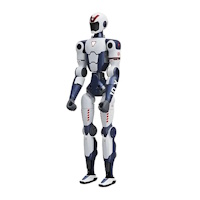
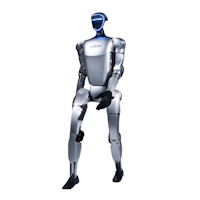
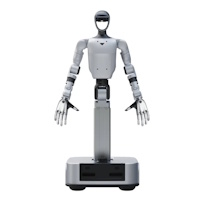
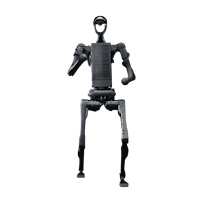
Unitree Humanoid Robots
Unitree humanoid robots span the R1 entry biped, the globally standard G1 research humanoid, the record setting H1 and the full size H2 family, developed by Hangzhou based Unitree Robotics, one of the world's two highest volume humanoid manufacturers, whose July 2026 STAR Market IPO approval made it China's first listed pure play legged robot company.
Unitree Humanoid Robots
Unitree humanoid robots are a family of bipedal and wheeled humanoid platforms developed by Unitree Robotics, a Hangzhou based Chinese robotics company founded in 2016 by engineer Wang Xingxing. The lineup spans the ultra light R1, the G1, widely regarded as the most common research humanoid in the world, the H1 and H1-2, which performed the world's first backflip by an electrically actuated humanoid and set a humanoid speed record of 3.3 meters per second, and the flagship H2 family, whose October 2025 "Destiny Awakening" debut drew global attention for motion fluid enough that viewers widely suspected computer graphics.
Together with AgiBot, Unitree is one of the world's two highest volume humanoid manufacturers: the two companies shipped more than 10,000 units combined in 2025, the year Chinese makers accounted for roughly 90 percent of global humanoid shipments, against approximately 150 units each from leading Western competitors. In July 2026, Unitree's initial public offering was approved for Shanghai's STAR Market, positioning it as China's first listed pure play humanoid and quadruped company. The company also leads the global quadruped market, and its self developed actuators, sensors and open sourced models anchor the largest developer ecosystem in legged robotics.
The full range of Unitree humanoid robots for sale, across the bipedal and wheeled lines with their accessories, can be explored through this page.
Background
Who founded Unitree, and why does it dominate legged robotics?
Wang Xingxing built his first low cost quadruped, XDog, as a master's student, and founded Unitree in Hangzhou in 2016 on a conviction the industry then rejected: that legged robots could be mass produced consumer priced products rather than laboratory treasures. The company's XDog derived quadrupeds, Laikago, AlienGo, the Go and B series, executed that conviction so thoroughly that Unitree robot dogs became the default legged platform of research labs and industry worldwide, appearing everywhere from broadcast galas, where troupes of over a hundred danced in synchrony, to substations and construction sites. Vertical integration is the recurring mechanism: Unitree designs and manufactures its own high torque density joint motors, reducers, controllers and increasingly its own LiDAR, the cost structure that repeatedly collapsed category prices without surrendering performance.
From robot dogs to humanoids
Unitree entered humanoids in 2023 with the H1, applying a decade of quadruped actuator and control experience to two legs. The H1 promptly rewrote the category's physical benchmarks, the 3.3 meter per second speed record and the world's first electric humanoid backflip, before the 2024 G1 did for humanoids what the Go series had done for quadrupeds: made them affordable, robust and ubiquitous in research. The 2025 R1 pushed the entry price lower still, and the H2 generation, spanning the base H2, the research editions and the wheeled H2-D, carried the line to full human scale with the company's first bionic face.
The Unitree Humanoid Lineup
Model Overview
| Specification | Unitree R1 | Unitree G1 | Unitree H2 |
|---|---|---|---|
| Height | ~1.21 m class | 1.32 m | 1.82 m |
| Weight | ~25 kg | ~35 kg | ~70 kg (with battery) |
| Degrees of Freedom | 24+ (configuration dependent) | 23–43 by configuration | 31 (plus hand options) |
| Peak Joint Torque | Lightweight class actuators | Up to 120 N·m (knee) | 360 N·m (legs), 120 N·m (arms) |
| Arm Payload | Light manipulation | Configuration dependent | ~7 kg rated, 15 kg peak |
| Battery / Runtime | Quick swap, ~1 h class | 9,000 mAh, ~2 h | 972 Wh (15 Ah), ~3 h |
| Compute | Onboard, dev expandable | 8 core CPU; Jetson Orin NX 100 TOPS option | Core i5/i7; Jetson AGX Thor 2,070 TOPS option |
| Primary Role | Entry, education, developers | Research standard, athletics | Flagship, research, service |
Values reflect manufacturer published figures where available; configuration options vary by edition, and exact specifications are confirmed at quotation.
Unitree R1
The R1, launched in 2025, is the most affordable humanoid from any major manufacturer: an ultra light biped around 25 kilograms that opened two legged robotics to individual developers, schools and small laboratories, the widest gate into the field yet built, and the base of Unitree's humanoid pyramid.
Unitree G1
The G1 is the platform on which more humanoid research happens than any other: a 1.32 meter biped with up to 43 degrees of freedom, dexterous force controlled options, and the dynamic athleticism, running, jumping, recovery, that made it the category's reference machine. Its editions ladder from standard through EDU tiers to the reinforced G1 EDU Combat boxing edition that anchors humanoid combat sport, while the wheeled G1-D extends the family into manipulation focused deployment.
Unitree H1 and H1-2
The H1 generation is the record book: the world's first electrically driven humanoid backflip and the standing 3.3 meter per second humanoid speed mark, the machines that established Unitree's humanoid credibility and whose successors inherited their actuation lineage.
The Unitree H2 Family
The H2 is the current flagship: 182 centimeters, 31 degrees of freedom, 360 newton meter legs and Unitree's first bionic face, sold as a six edition architecture, the sealed base model, the Commercial edition, the development open H2 EDU, the H2 Plus, which NVIDIA selected as the first Isaac GR00T reference humanoid with Sharpa Wave tactile hands and Jetson Thor computing, the application focused H2-A, and the wheeled dual arm H2-D for industrial mobile manipulation.
How do the Unitree humanoid models differ?
| Buyer profile | Recommended model | Reasoning |
|---|---|---|
| Schools, first time developers | R1 | Lowest cost of entry from a major maker, light and safe |
| University research labs | G1 / H2 EDU | Largest research community; full SDK and ROS 2 access |
| Frontier embodied AI programs | H2 Plus | Pre integrated GR00T reference design, tactile hands, 2,070 TOPS |
| Factories and warehouses | H2-D | Dual 7 kg arms, floor to 2 m workspace on a stable wheeled base |
| Customer facing deployment | H2-A / H2 | Bionic face and application ready configuration |
| Events, robot sport | G1 EDU Combat | Reinforced structure, combat algorithms, tournament pedigree |
The division of labor is deliberate: the R1 recruits the field, the G1 equips it, the H1 holds its records and the H2 family carries it to human scale, with wheeled variants answering the industrial floors where legs are optional and manipulation is not.
Technology
Actuation and manufacturing
Every Unitree humanoid runs on self developed low inertia joint motors with industrial grade crossed roller bearings and dual encoders, manufactured at a scale no humanoid competitor matches, the vertical integration behind both the machines' athletics and their prices, and the supply security now reinforced by public market financing.
Learning based control
Locomotion and recovery across the line are trained by reinforcement learning in simulation and transferred to hardware, producing the backflips, sprints, dances and shove recoveries that made Unitree machines the most watched robots on earth, with capabilities continuing to expand through software updates after purchase.
Open models and development stack
Unitree open sources aggressively: the UnifoLM-VLA-0 vision language action model demonstrates G1 and H2 class robots executing household tasks from visual and language input, while unitree_sdk2 in C++ and Python, DDS based communication and unitree_ros2 packages connect the EDU tiers to the field's standard toolchains, feeding the largest humanoid developer community in existence, supported by Unitree's support resources and accessories ecosystem.
What are Unitree humanoid robots used for?
- Research and embodied AI development: the G1 and H2 EDU/Plus tiers are the default hardware of humanoid research worldwide, from locomotion to manipulation learning.
- Education: R1, G1 and classroom programs across educational robotics, the platforms on which the field's next generation trains.
- Industrial and warehouse work: the H2-D and G1-D wheeled lines at the warehouse humanoid and industrial frontier.
- Events, entertainment and sport: gala performances, exhibition bookings and the humanoid boxing tournaments the G1 EDU Combat founded.
- Customer facing service: the H2 and H2-A's bionic faced presence across commercial reception and engagement.
- Data collection: teleoperated demonstration capture feeding the imitation learning pipelines of the embodied AI era.
Competitive context
Unitree's humanoids compete most directly with AgiBot's lineup, Omdia ranked AgiBot first in 2025 shipments at 5,168 units against the two companies' combined 10,000 plus, with UBTECH's industrially proven Walker series, and with Western programs from Tesla, Figure and Agility Robotics whose 2025 shipments remained in the low hundreds. Unitree's differentiation is structural: the lowest entry prices from any major maker, the largest installed research base, records the public has already seen, and the manufacturing depth of the quadruped business beneath it, advantages the humanoid category's newer entrants must build from scratch.
Pricing and Availability
Unitree humanoid robots are available for purchase worldwide, from single R1 and G1 units to H2 fleet programs, with the complete lineup and accessories browsable through the Unitree catalog on Robots International. Unitree humanoid price and cost vary widely by model, edition, configuration and destination, so buyers seeking Unitree humanoids for sale should request a current quotation for their requirements. Purchasing inquiries, specification sheets and availability details for those looking to buy Unitree humanoid robots can be found on this page.
Frequently Asked Questions
What are Unitree humanoid robots?
Unitree humanoid robots are the bipedal and wheeled humanoid family of Unitree Robotics: the entry R1, the research standard G1, the record holding H1 and H1-2 and the full size H2 family with its EDU, Plus, A and D editions.
How do Unitree humanoid robots work?
They combine Unitree's self developed high torque, low inertia joint motors with reinforcement learning trained whole body control, perceiving through LiDAR, depth and RGB camera systems, computing on options scaling to 2,070 TOPS of NVIDIA Jetson Thor, and developing through unitree_sdk2, ROS 2 packages and open sourced models like UnifoLM-VLA-0.
Why are Unitree humanoid robots important?
They made humanoids a global reality: category defining prices, the records the public remembers, the largest research installed base, one of the two highest shipment volumes in the world and, since July 2026, the backing of China's first pure play legged robotics listing, the combination on which much of the field now literally runs.
What are the benefits of Unitree humanoid robots?
Key benefits include the best price to capability ratios from any major maker, a model ladder from classroom to frontier research to industrial deployment, the field's deepest developer community and open model support, proven athletic robustness, quick swap battery endurance and the supply security of the volume and financing leader.
Which Unitree humanoid should a buyer choose?
Entry programs start with the R1, research standardizes on the G1 or H2 EDU, frontier embodied AI takes the H2 Plus, industrial manipulation the H2-D and customer facing deployment the H2-A, with the comparison table above mapping buyer profiles to models.
How many humanoid robots has Unitree shipped?
Unitree shipped on the order of 5,000 humanoids in 2025, making it one of the world's two highest volume manufacturers alongside AgiBot, whose 5,168 units Omdia ranked first; together the pair exceeded 10,000 units in a year when Chinese makers took roughly 90 percent of global humanoid shipments.
Where can I buy Unitree humanoid robots and what do they cost?
Unitree humanoids are for sale through Robots International, serving markets worldwide with delivery, customs clearance and support. Because cost varies enormously by model, edition and configuration, buyers should request a tailored quotation. Full purchasing details are available on this page.
Summary
Unitree humanoid robots trace a single strategy executed four times: take the machine everyone said must stay expensive, build the actuators yourself, train the control in simulation and ship it at a price that changes who can own one, first the R1's open door, then the G1's research conquest, the H1's records and the H2's human scale arrival, until the family spans classrooms, laboratories, factories, stages and boxing rings on two continents' worth of deployments. With one of the world's two largest humanoid volumes, the field's deepest ecosystem and a public listing behind its capacity, the Unitree humanoid line stands as the definitive reference point for the category it did most to create.
v3, August 8, 2026