Unitree AlienGo
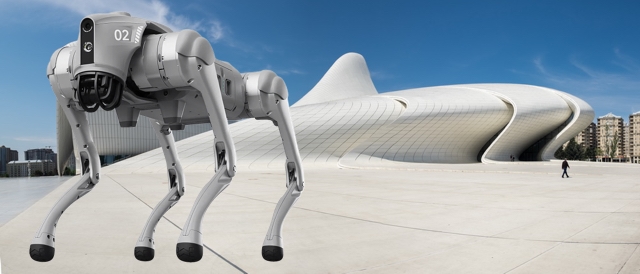
The Unitree AlienGo is the enduring mid size research quadruped of Unitree's lineup, a 2019 platform still sold today with twelve 40 newton meter servo joints, speeds beyond 1.5 meters per second, payloads of 10 to 13 kilograms, multi camera depth vision with posture and face recognition, gesture commanded person following and a swappable 317 watt hour battery running up to 4.6 hours.
Unitree AlienGo
Some robots are products; a few become apparatus, the machines a scientific field quietly standardizes on and keeps citing years after their launch. The Unitree AlienGo is quadruped robotics' clearest example: the 2019 platform that carried Unitree from viral novelty to research fixture, and that remains in the catalog today because laboratories keep specifying it, a mid size, twelve jointed, deeply documented robot whose name appears in the methods sections of legged robotics papers the way oscilloscope brands appear in physics, the field's citation hardware.
The AlienGo's endurance in the lineup rests on a balanced specification that laboratory work still rewards: twelve high performance servo joints at up to 40 newton meters with reducer and torque protection for the crash resilience research requires, walking speeds beyond 1.5 meters per second, payload capacity of 10 kilograms rated and up to 13 in configuration, enough for the LiDAR, compute boxes and experimental rigs labs actually bolt on, and runtime of 2.5 to 4.6 hours on the swappable 12,600 milliamp hour, 317 watt hour AL01-BT01 battery, session lengths that survive a real experiment day. Around it sits the sensing that made the machine famous in demonstrations: dual depth cameras with a visual odometry set for real time 3D mapping, and the deep learning recognition stack, human posture, faces, gesture commands, that lets an operator raise a hand and have the robot lock on and follow.
Between the compact education dogs and the industrial A2 and B series, the AlienGo holds the research middle. The Unitree AlienGo for sale, with full specifications, can be explored through this page.
Background
The machine that made Unitree famous
The AlienGo arrived in 2019 as the successor to Laikago and the robot through which most of the world first saw a Unitree machine move: agile, kick resistant, uncannily dog like, the demonstration footage that seeded the company's global reputation. It was designed explicitly as a research platform, and research adopted it at scale, locomotion studies, state estimation work, perception pipelines, whole graduate curricula, building the installed base and literature that still make it the known quantity a new lab can buy into.
Why a 2019 platform is still worth buying
Maturity is a specification laboratories price highly: the AlienGo offers half a decade of documentation, community solutions, published baselines and stable interfaces, C, C++, Python and ROS, meaning a new program inherits answers rather than pioneering problems. For controlled facility work, campus pilots, coursework fleets and algorithm research, that maturity, at pricing below the modern industrial tiers, keeps the veteran's order book alive alongside successors like the AS2 that outrun it on raw numbers.
Technical Specifications
| Specification | Unitree AlienGo |
|---|---|
| Standing Size | ~650 × 310 × 600 mm |
| Degrees of Freedom | 12 (three per leg) |
| Joint Actuation | 12 servo motors, up to 40 N·m, high resolution encoders, torque protection |
| Maximum Speed | >1.5 m/s |
| Payload | 10 kg rated; up to 13 kg by configuration |
| Slopes / Terrain | ~21–25° gradients, steps, uneven ground; stable under disturbance |
| Battery | AL01-BT01, 12,600 mAh (317 Wh), swappable |
| Runtime | 2.5–4.6 h by workload |
| Vision | Dual depth cameras (min depth ~0.11 m, up to 1280×720 depth) + visual odometry camera set; optional LiDAR |
| Recognition | Human posture recognition, face recognition, gesture commanded target following |
| Construction | Polymer plastic, carbon fiber, aviation aluminum; impact resistant fuselage |
| Interfaces | 2× Gigabit Ethernet, 2× USB 3.0, rich external I/O |
| Development | C / C++, Python, ROS; SDK and mature documentation |
| Included | Robot, battery, charger, remote controller |
| Motion Repertoire | Running, backward and lateral movement, in place turning, creeping, rollover, jumping, obstacle crossing and avoidance, self righting, slope and step traversal |
Figures follow published specifications; configurations and sensing options vary by build and are confirmed at quotation.
How does the AlienGo fit today's lineup?
By temperament. The Go2 is the consumer and entry research machine; the AS2 is the modern lightweight professional with double the dynamics; the A2 and B series own weather rated industrial duty; and the AlienGo remains the laboratory's mid size classic, more payload, runtime and I/O than the compact tiers, without industrial mass or industrial pricing, plus the maturity none of the newer machines can offer yet. It also anchors one of the catalog's classic combinations: paired with Unitree's Z1 robotic arm, the AlienGo becomes an accessible mobile manipulation research platform, the legged base with a reaching hand that manipulation labs built early literature on.
Technology
Joints built to be experimented on
The twelve servo architecture, 40 newton meters per joint with reducer wear and over torque protection, was engineered for research's defining workload: failure. Crash tolerant structure in carbon fiber and aviation aluminum, self righting after falls, stability under kicks and shoves, the robot as an instrument that survives the thousand bad controller iterations between publishable ones.
Sight, and the sense to use it
The multi view depth system, two depth cameras from 0.11 meters out plus visual odometry, feeds real time 3D mapping and navigation planning, while the deep learning stack reads people: posture recognition driving gesture interaction, face recognition, and the signature target following in which a raised hand among a crowd locks the robot to one person, the demonstration that made the AlienGo an event fixture and remains a genuine HRI research capability.
An open bench with legs
Dual Gigabit Ethernet, dual USB 3.0, generous mounting and 10 plus kilograms of payload budget make the AlienGo what its buyers treat it as: a mobile laboratory bench, carrying whatever sensor rig, compute stack or manipulator, the Z1 arm above all, the experiment requires, programmed through C, C++, Python and ROS against half a decade of documentation, within Unitree's support ecosystem and the cross brand mission software of the robot software catalog.
What is the Unitree AlienGo used for?
- Legged robotics research: locomotion, state estimation and control work across research robotics, on the platform the field's baselines were published on.
- University teaching fleets: graduate coursework and lab programs across educational robotics, maturity multiplied across benches.
- Mobile manipulation: the AlienGo plus Z1 arm combination, the accessible legged manipulation testbed.
- Controlled facility inspection pilots: campus and indoor site rounds across inspection robotics where industrial sealing is unnecessary.
- Events and STEM engagement: the gesture following crowd favorite of exhibition programs and demonstrations.
- Perception and HRI studies: posture, face and following research on the built in recognition stack, within the wider quadruped category.
Pricing and Availability
The Unitree AlienGo is available for purchase worldwide through official and distributor channels, from single laboratory units to teaching fleets, with batteries, spares and accessories supported, alongside the full Unitree catalog on Robots International. Unitree AlienGo price and cost vary by configuration, sensing options and destination, so buyers seeking the AlienGo for sale should request a current quotation for their requirements. Purchasing inquiries, specification sheets and availability details for those looking to buy the Unitree AlienGo can be found on this page.
Frequently Asked Questions
What is the Unitree AlienGo?
The AlienGo is Unitree's mid size research quadruped, launched in 2019 and still sold today: a twelve jointed, roughly 650 millimeter platform with 40 newton meter servo joints, speeds beyond 1.5 meters per second, 10 to 13 kilogram payloads, multi camera depth vision with recognition intelligence and a swappable 317 watt hour battery.
How does the Unitree AlienGo work?
The AlienGo moves on twelve protected servo joints through an athletic repertoire from running to self righting, perceives through dual depth cameras and visual odometry for real time 3D mapping, recognizes human posture and faces for gesture commanded following, and develops through C, C++, Python and ROS against dual Gigabit Ethernet and USB 3.0 interfaces.
Why is the Unitree AlienGo important?
It is the machine that made Unitree a research standard: the 2019 platform whose demonstrations introduced the company to the world and whose laboratory adoption produced the documentation, baselines and installed base that still make it legged robotics' citation hardware, and a rational purchase years on.
What are the benefits of the Unitree AlienGo?
Key benefits include a research proven, crash tolerant twelve joint architecture, 10 plus kilogram payload and rich I/O for experimental rigs, up to 4.6 hour swappable battery sessions, built in posture, face and following intelligence, half a decade of documentation and community solutions and value pricing beneath the industrial tiers.
Can the AlienGo carry a robotic arm?
Yes, famously: paired with Unitree's Z1 robotic arm within its payload budget, the AlienGo becomes an accessible mobile manipulation platform, the legged base plus manipulator combination on which early mobile manipulation research standardized, and a configuration quoted as a bundle.
How does the AlienGo compare to the AS2?
Era against maturity: the AS2 is the 2026 lightweight professional with double class dynamics, modern sensing and industrial temperature ratings, while the AlienGo offers more payload headroom, longer documented history, deeper community solutions and lower cost, the modern fieldwork machine against the laboratory's proven bench.
Where can I buy the Unitree AlienGo and what does it cost?
The AlienGo is for sale through Robots International, serving markets worldwide with delivery, customs clearance and support. Because cost varies by configuration and options, buyers should request a tailored quotation. Full purchasing details are available on this page.
Summary
The Unitree AlienGo is what happens when a robot outlives its launch cycle and becomes infrastructure: the 2019 machine that introduced the world to Unitree's dogs, then spent the following years accumulating the papers, baselines, curricula and community answers that make it the platform a new laboratory buys precisely because everyone else already did. Twelve crash tolerant joints, a payload bay that takes a Z1 arm, vision that follows a raised hand through a crowd, and sessions measured in real experiment hours, still in the catalog, still on the order forms. As legged robotics' enduring research classic, the Unitree AlienGo stands as the definitive citation hardware of its field.
v3, August 9, 2026