RobotEra Humanoid Robots
RobotEra humanoid robots span the L7 full-size bipedal flagship — holder of the humanoid running speed record — the Q5 wheeled service humanoid, and the M7 modular upper-body platform for research. Unified by RobotEra's ERA-42 embodied-AI stack, this guide compares every RobotEra humanoid model, their specifications and applications, and what buyers should know before purchasing.
-
Out of stock
RobotEra Humanoid Robots
Introduction / Overview
RobotEra humanoid robots form one of the most performance-focused humanoid lineups in the industry — a family unified by the "Hexa-Core" engineering philosophy of strength, agility, precision, stability, durability, and adaptability, and by the ERA-42 embodied-AI model that powers every platform. Developed by RobotEra (ROBOTERA), the Beijing-based company founded in 2023 and incubated by Tsinghua University's Institute for Interdisciplinary Information Sciences, the range has moved from academic spinout to over 600 units delivered across global exhibition, retail, and logistics deployments in under three years.
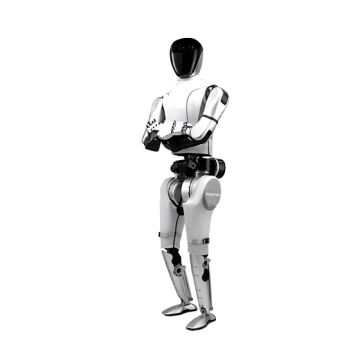
The lineup covers three complementary forms. The L7 is the full-size bipedal flagship — 171 cm, 55 degrees of freedom, and the first full-size humanoid in China to combine large-scale dynamic motion with fine manipulation, holding a humanoid running record of 14.4 km/h while carrying up to 20 kg with both arms. The Q5 is the wheeled service humanoid: 44 degrees of freedom of ultra-human-like presence built for reception, hospitality, and interaction. And the M7 is the modular upper-body platform, giving research and education buyers the RobotEra manipulation stack in a configurable format. The family's engineering lineage traces through the STAR1 industrial humanoid, whose 400 N·m joint architecture established the performance pedigree the current generation inherits — and every platform pairs natively with RobotEra's XHAND dexterous hand systems.
For buyers, the practical question is which RobotEra humanoid fits the mission — and this guide maps each model to its role.
Design and Features
L7 — Full-Size Bipedal Flagship
The L7 defines the range's athletic-industrial character:
- Human proportions, industrial capability — 171 cm tall, approximately 70 kg, 55 degrees of freedom, and up to 20 kg carried with both arms, with 12 waist-and-torso movement points for human-like bending and twisting.
- Record-setting dynamics — running up to 4 m/s outdoors with a 14.4 km/h record sprint, jumping, dancing, and 360° spins, proven in outdoor robustness tests including a widely reported Great Wall walk.
- Ultra-low-latency full-body teleoperation — demonstrated at CES 2026, enabling precise remote manipulation and the teleoperated data collection that modern robot learning depends on.
- Fine manipulation — human-scale reach and dexterity, extensible with XHAND1 hands, for factory tasks such as parcel packing and machine tending.
- Multi-robot collaboration — coordinated operation across multiple L7 units.
Q5 — Wheeled Service Humanoid
The Q5 brings the family's engineering to customer-facing service:
- 44 degrees of freedom across the body with 7-axis bionic arms lifting up to 10 kg — genuine physical capability behind the social presence.
- Natural physical interaction — squatting to pick up objects, waist twisting, handshaking, and expressive social gestures for receptionist, service-assistant, hospitality, and educational-companionship roles.
- XHAND Lite integration — RobotEra's integrated dexterous hand system gives the Q5 real object handling that typical service robots lack.
- Wheeled endurance — the mobile base suits flat-floor venues running long daily service hours.
M7 — Modular Research Platform
The M7 is a modular upper-body humanoid with high degrees of freedom, optimized for research, testing, and education — the RobotEra manipulation and perception stack in a configurable format that fits laboratory benches, mobile bases, and custom experimental setups without full-humanoid cost or complexity.
The STAR1 Heritage
The earlier STAR1 full-size industrial humanoid — 55 degrees of freedom, 400 N·m joint torque, joint speeds to 25 rad/s — established the actuation engineering that flows through the current generation, and remains a reference point for the family's performance-first design culture.
Unified Intelligence and Development
Every RobotEra humanoid runs on the ERA-42 end-to-end embodied-AI model — perception, manipulation, and task learning on one stack, improving through updates fleet-wide — with SDK and secondary development access across the range supporting research use, custom integration, and software extensions including multilingual interaction add-ons.
Technology and Specifications
Choosing Across the Range
| Model | Form | Primary Role |
|---|---|---|
| L7 | Full-size bipedal (171 cm, 55 DoF, 20 kg dual-arm) | Dynamic performance, industrial tasks, teleoperation, research |
| Q5 | Wheeled humanoid (44 DoF, 10 kg lift) | Reception, hospitality, service, education |
| M7 | Modular upper-body | Research, testing, education |
Representative Specifications — L7
Approximately 171 cm height and 70 kg weight; 55 degrees of freedom with human-like proportions; up to 20 kg dual-arm payload; outdoor running to 4 m/s (14.4 km/h record); 12 torso movement points; ultra-low-latency full-body teleoperation; XHAND1 compatibility; ERA-42 AI stack with SDK access. Exact configurations vary — current datasheets are available on request.
Engineering Foundation
RobotEra's Tsinghua lineage delivers a full self-developed stack: high-torque actuation descended from the STAR1's 400 N·m architecture, dense perception, model-based whole-body control, and the ERA-42 learning layer — the combination behind both the L7's record dynamics and the Q5's fluid social motion.
Delivery Evidence
With over 600 units delivered across global commercial environments and a majority-overseas order book, RobotEra humanoids carry real international deployment history — exhibition floors, retail venues, and logistics operations — rather than domestic pilots alone.
Applications and Use Cases
Exhibitions, Events, and Live Performance
The L7's running, dancing, and spinning repertoire makes it one of the most compelling demonstration humanoids in the world — headlining launches, venues, and experiential showcases where dynamic motion draws crowds nothing static can match.
Reception and Hospitality
The Q5 staffs front-of-house roles in hotels, showrooms, and public venues — greeting, guiding, and physically interacting with the human-like presence and object-handling ability that kiosks and conventional service robots lack.
Industrial and Logistics Tasks
L7 deployments extend into line-side handling, parcel packing, intelligent sorting, and machine tending — human-scaled work where the platform's strength, reach, and manipulation interface directly with existing tools and infrastructure.
Teleoperation and Data Collection
The L7's ultra-low-latency full-body teleoperation makes it a leading platform for teleoperated demonstration collection — the workflow feeding manipulation foundation models — and for precision remote-operation applications.
Research and Education
The M7's modularity, the Q5's accessible interaction platform, and the L7's frontier dynamics give universities a complete research ladder on one vendor's SDK — from bench-top manipulation studies to whole-body locomotion research.
Advantages / Benefits
- The performance benchmark — record-setting speed and outdoor-proven dynamics put the L7 at the athletic frontier of commercial humanoids.
- Service with real capability — the Q5 pairs human-like presence with 10 kg lifting and dexterous hands, not just a screen on wheels.
- A complete research ladder — M7, Q5, and L7 span bench to full-body research on one unified stack and SDK.
- Delivered internationally — 600+ units across global commercial deployments, with majority-overseas orders evidencing real export support.
- One AI stack fleet-wide — ERA-42 unifies capability and improvement across every form factor.
- Native dexterity path — XHAND1 and XHAND Lite integration gives every platform a manipulation upgrade route no bolt-on hand matches.
For buyers researching where to buy RobotEra humanoid robots, or comparing L7, Q5, and M7 prices and costs against competing humanoids, the evaluation should match form factor to mission, weigh dynamic-performance and manipulation requirements, and prioritize deployment evidence and regional support — the factors separating working platforms from demo units.
FAQ
What humanoid robots does RobotEra make?
RobotEra's humanoid lineup spans the L7 full-size bipedal flagship, the Q5 wheeled service humanoid, and the M7 modular upper-body research platform — with the STAR1 industrial humanoid as the family's engineering forerunner and XHAND dexterous hands integrated across the range.
Which RobotEra humanoid should I buy?
Choose the L7 for dynamic performance, industrial tasks, teleoperation, and full-body research; the Q5 for reception, hospitality, and service roles; and the M7 for modular manipulation research and education. A distributor can match the exact configuration to your use case.
What is the RobotEra L7?
The L7 is a full-size bipedal humanoid — 171 cm, 55 degrees of freedom, 20 kg dual-arm payload — holding the humanoid running record at 14.4 km/h while supporting ultra-low-latency full-body teleoperation and fine manipulation for industrial tasks.
What is the RobotEra Q5?
The Q5 is a wheeled service humanoid with 44 degrees of freedom and 7-axis bionic arms lifting up to 10 kg, capable of squatting, waist twisting, and natural social gestures — built for receptionist, hospitality, service, and educational roles with the XHAND Lite integrated hand system.
What is the RobotEra M7?
The M7 is a modular upper-body humanoid with high degrees of freedom, optimized for research, testing, and education — delivering RobotEra's manipulation and perception stack in a configurable format without full-humanoid cost.
Can RobotEra humanoids be used for research and development?
Yes. SDK access spans the range, the L7's teleoperation supports data-collection research, the M7 is purpose-built for laboratory work, and RobotEra hardware is already used by leading institutions worldwide.
What are the benefits of RobotEra humanoid robots?
Key benefits include record-setting dynamic performance, genuine manipulation capability across all forms, a unified ERA-42 AI stack, native XHAND dexterity integration, 600+ international deliveries, and open secondary development throughout.
How much does a RobotEra humanoid robot cost?
Pricing varies across the range — from the M7 research platform through the Q5 service humanoid to the L7 flagship. Contact a distributor for current pricing, model guidance, datasheets, and delivery timelines for your region.
Summary
RobotEra humanoid robots put engineering proof where the industry puts promises: the L7 holds the humanoid speed record while carrying 20 kg and packing parcels, the Q5 brings real lifting and dexterous hands to reception work, and the M7 hands researchers the same stack in modular form — all unified by ERA-42 intelligence, XHAND dexterity, and 600+ deliveries across global commercial deployments. For anyone looking to buy a RobotEra humanoid, compare L7, Q5, and M7 costs, or plan a performance, service, or research deployment, this guide provides the essential foundation.