Security Robots
Security Robots: Types, Use Cases, Costs & Benefits (Complete Guide)
Security robots patrol building perimeters, monitor parking lots, guard corporate campuses, stream live video to operations centers, and respond to incidents 24 hours a day without overtime, shift premiums, or fatigue. The commercial security robot market has grown steadily since 2013, when Knightscope introduced its K5 patrol robot, and now encompasses indoor patrol, outdoor perimeter monitoring, access control support, and drone-based aerial surveillance.
The economic case is clear. Human security guards in the US cost $25-40/hour fully loaded for standard patrol roles - roles that require presence and observation more than complex judgment. Security robots perform these functions at $7-15/hour equivalent on service contracts, with the added benefits of continuous video recording, consistent patrol coverage, and anomaly detection that doesn't suffer from attention fatigue during long overnight shifts.
Types of Security Robots
Indoor Patrol Robots
Mobile ground robots designed for indoor environments: corporate lobbies, office buildings, shopping malls, data centers, and warehouses. Knightscope K3, Cobalt Robotics, and Ava Robotics platforms are common in this category. They navigate autonomously on programmed routes, stream live video, and alert operators to anomalies.
Outdoor Perimeter Patrol Robots
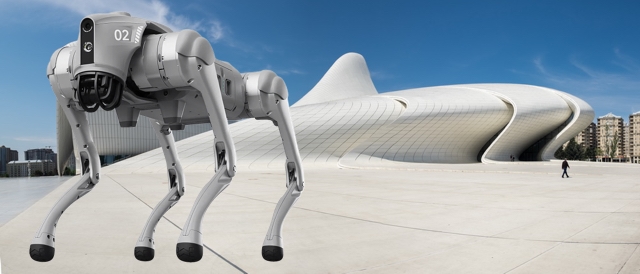
Ruggedized mobile robots built for outdoor operation: corporate campuses, parking lots, construction sites, ports, and critical infrastructure. Knightscope K5, Asylon Sentry, and Boston Dynamics Spot with security payloads operate in outdoor environments. These platforms handle weather, uneven terrain, and larger geographic coverage areas.
Security Drones
Autonomous unmanned aerial vehicles (UAVs) used for perimeter surveillance, aerial inspection, and incident response support. DJI Dock-based autonomous drone systems and dedicated security drone platforms (Percepto, Skydio) provide aerial coverage beyond ground robot capabilities.
Access Control Robots
Mobile robots integrated with building access systems that verify credentials, challenge unauthorized personnel, and manage visitor flow at entry points. These combine mobile patrol capability with access control functions.
Stationary Monitoring Robots
Fixed-position AI-powered surveillance systems with pan-tilt-zoom cameras, thermal imaging, and behavioral analytics. These are not mobile but use robotics-adjacent AI and automated response capabilities to classify them as security robots in many industry discussions.
Underwater Security Robots
ROVs (remotely operated vehicles) and autonomous underwater vehicles (AUVs) used for port security, offshore facility protection, and underwater infrastructure inspection. Used by navies, port authorities, and offshore energy operators.
Use Cases of Security Robots
Campus and Corporate Facility Patrol
The primary commercial deployment context. Security robots patrol building interiors and exterior campus areas on programmed schedules, covering routes that human guards would otherwise walk. They detect unusual activity (people in restricted areas after hours, vehicles stopped in unauthorized locations) and alert human operators or on-site guards who respond to exceptions.
In this hybrid model, robots handle continuous patrol coverage while human guards respond to robot-identified incidents - leveraging human judgment for response while automating the patrol function itself.
Parking Lot Security
Outdoor parking lot surveillance is one of the highest-value security robot deployments. Lots are large, poorly lit, and require continuous coverage. Knightscope K5 robots patrol parking facilities at universities, hospitals, and commercial properties, detecting trespassers, monitoring for vehicle break-ins, and providing a deterrent presence.
Critical Infrastructure Protection
Power plants, water treatment facilities, telecommunications installations, and data centers use security robots for perimeter monitoring and intrusion detection. The 24/7 requirement and high-security sensitivity of these facilities justify robot investment over human-only patrol.
Construction Site Security
Construction sites experience significant theft and vandalism. Temporary deployment of security robots provides cost-effective protection without long-term infrastructure investment. Robots can be redeployed as construction phases move.
Retail Loss Prevention
Large retail environments use security robots as a visible deterrent and supplementary monitoring platform. Knightscope and Cobalt platforms have been deployed in malls and large retailers. The robot's presence deters opportunistic theft; its cameras provide incident documentation.
Event Security Support
Temporary deployment of security robots at large public events provides supplementary surveillance coverage and crowd monitoring capability in areas difficult to staff continuously with human guards.
Port and Maritime Security
Port security robots monitor dock areas, container yards, and vessel access points. Underwater ROVs inspect hull integrity and detect potential hull-attached devices at secured marine facilities.
Industries That Use Security Robots
Corporate Real Estate and Campuses
Technology companies, financial institutions, and large corporate campuses are the core commercial robot security market. Knightscope's customer base includes major technology and financial companies.
Healthcare Facilities
Hospitals and healthcare campuses use security robots for parking lot patrol, after-hours interior monitoring, and access control support.
Higher Education
University campuses - large, open-access, with significant after-hours activity - are strong security robot deployment environments. Several US universities use Knightscope K5 robots for campus patrol.
Retail and Shopping Centers
Malls, shopping centers, and large-format retailers use security robots for deterrence and surveillance in common areas.
Critical Infrastructure
Power utilities, water authorities, and telecommunications operators use security robots for perimeter protection of critical infrastructure.
Government and Defense
Government facilities, military installations, and border security operations use both commercial and specialized military-grade security robots.
Ports and Logistics
Commercial ports, container terminals, and logistics facilities use security robots for perimeter and yard monitoring.
Benefits of Security Robots
Cost Reduction vs. Human Guards
The clearest commercial benefit. Knightscope's KAAS (Knightscope as a Service) model prices at approximately $7-9/hour per robot for outdoor units - well below the $25-40/hour cost of a human security guard including benefits, training, supervision, and turnover costs. For facilities requiring 24/7 patrol coverage, the annual cost difference is substantial.
Continuous, Consistent Coverage
Robots don't experience attention fatigue, boredom, or distraction during long overnight patrols. They execute the same patrol route at the same time with the same consistency at 3 AM as at 3 PM. Human guard attention and performance vary with shift length, workload, and individual variation.
Comprehensive Documentation
Security robots generate continuous video records of their patrol routes with timestamps and GPS coordinates. This documentation supports incident investigation, insurance claims, and liability defense in ways that human patrol logs cannot. The evidentiary value of continuous video coverage is a significant operational benefit.
Deterrence Value
The visible presence of a patrol robot deters opportunistic crime. Anecdotal reports from Knightscope customers consistently cite reduced incidents in robot patrol areas compared to areas covered only by static cameras or human guards. The robot's mobility - unlike fixed cameras - creates uncertainty about where it will appear and when.
Anomaly Detection
AI-powered security robots detect anomalies that human observers might miss during long patrols: vehicles parked in unusual positions, people in restricted areas, doors left open, temperature anomalies. Systematic anomaly detection supplements human observation capabilities.
Rapid Alert Notification
When robots detect anomalies, they immediately alert human operators who can review live video and dispatch response teams. The alert-to-response time is faster than a guard noticing an anomaly mid-patrol and radioing it in.
Challenges & Limitations of Security Robots
Response Capability
Security robots detect and document incidents - they don't intervene. They cannot detain suspects, provide physical assistance to victims, or take direct action in emergency situations. Human guards or law enforcement must respond to robot-identified incidents. The response model requires human backup at all times.
Navigation in Dynamic Environments
Outdoor security robots navigate in weather, on uneven terrain, and around obstacles that change daily (parked cars, construction equipment, debris). Navigation reliability in complex outdoor environments is less consistent than in controlled indoor settings.
Public and Employee Perception
Security robots generate mixed reactions. Some employees and visitors find robot patrols reassuring; others find them surveillance-invasive or unsettling. Clear communication about robot capabilities and data handling practices is important for stakeholder management.
Limited Terrain Capability
Ground-based security robots struggle with stairs, steep grades, mud, snow, and flooding. Coverage maps must account for areas the robot physically cannot access. Supplementary human patrol or static cameras remain necessary for inaccessible zones.
Data Privacy Compliance
Security robots that continuously record video in areas frequented by employees, customers, or the general public are subject to privacy regulations. GDPR in the EU, CCPA in California, and BIPA in Illinois create compliance requirements for biometric data, facial recognition, and video retention that must be addressed before deployment.
Cybersecurity Exposure
Network-connected security robots are potential attack vectors. A compromised security robot could be manipulated to provide false patrol data, disable alerts, or leak camera footage. Cybersecurity protocols, network segmentation, and secure firmware update processes are essential.
Cost & ROI of Security Robots
For up-to-date prices, browse and buy security robots for sale here.
Knightscope KAAS pricing: approximately $7/hour for K3 (indoor), $9/hour for K5 (outdoor). On a 24/7 deployment basis, this represents approximately $60,000-$80,000 per robot per year.
Cobalt Robotics: subscription pricing in the $5,000-$10,000/month range depending on configuration and contract length.
Comparable human guard cost: $25-35/hour including benefits, training, and supervision overhead. 24/7 coverage requires 4-5 FTEs ($200,000-$350,000/year for continuous coverage of one post).
ROI case: A single Knightscope K5 at $9/hour ($80,000/year) replacing 24/7 human patrol ($200,000-$350,000/year) saves $120,000-$270,000 annually per post. Actual deployments typically use robots to cover additional area or extend hours rather than direct 1:1 guard replacement, but the economics are compelling in either case.
Security drones on dock-based autonomous systems: $50,000-$200,000 for hardware plus subscription software fees.
Key Technologies Behind Security Robots
LiDAR SLAM provides precise indoor navigation and mapping, allowing robots to patrol programmed routes and detect obstacles in real time.
360-degree camera arrays and PTZ cameras provide comprehensive visual coverage. High-dynamic-range imaging handles the contrast between lit and dark areas common in outdoor nighttime patrol.
Thermal imaging cameras detect body heat through darkness, foliage, and light fog - enabling detection that visible-light cameras miss in low-visibility conditions.
License plate recognition (LPR) systems on outdoor patrol robots automatically scan and log vehicle plates in parking areas, comparing against authorized vehicle databases.
AI-based behavioral analytics classify normal vs. anomalous activity patterns, reducing false alerts by distinguishing routine movement from genuine intrusions.
Encrypted wireless communication and secure cloud infrastructure protect video streams and operational data from interception.
How to Implement Security Robots
-
Security assessment. Map current patrol coverage, documented incidents by location and time, and guard cost by post. Identify the highest-value robot deployment locations.
-
Environment survey. Assess terrain, weather exposure, WiFi coverage, and physical obstacles for outdoor deployments. Map floor plans and access control infrastructure for indoor deployment.
-
Vendor selection. Evaluate Knightscope, Cobalt, and alternatives based on deployment environment, scale, and integration requirements. Request references from comparable facilities.
-
Integration planning. Define integration with existing access control systems, CCTV infrastructure, and security operations center workflows.
-
Data policy development. Establish video retention policies, privacy notices, and data handling procedures compliant with applicable law.
-
Staff training. Train security operations staff on robot monitoring dashboards, alert response procedures, and exception handling.
-
Stakeholder communication. Communicate the deployment to employees, tenants, or the public with clear information about robot purpose and capabilities.
-
Pilot deployment. Deploy for 60-90 days with close monitoring before full operational commitment.
-
Measure and optimize. Track incidents by area before and after deployment, robot uptime, alert volume, and false positive rates.
Security Robot Safety & Regulations
ISO 3691-4 applies to mobile robots operating in shared human environments. Speed limiting, obstacle detection, and emergency stop capability are baseline requirements.
Privacy law compliance is the primary regulatory concern for security robots. GDPR Article 6 requires a lawful basis for video capture. BIPA (Illinois) prohibits collecting biometric identifiers without consent. CCPA requires disclosure of data collection practices. EU AI Act provisions applicable to security AI systems are entering into force through 2026.
Some jurisdictions require disclosure notices when an area is patrolled or monitored by robots. Legal review of planned deployments is advisable in regulated industries or EU jurisdictions.
Armed security robots are subject to weapons regulations in applicable jurisdictions. Most commercial security robots are unarmed observation platforms; any armed variant would require significant additional regulatory review.
Top Security Robot Brands / Companies
|
Company |
Key Platform |
Security Application |
|
Knightscope |
K3, K5 |
Indoor/outdoor patrol |
|
Cobalt Robotics |
Cobalt |
Indoor patrol and monitoring |
|
Boston Dynamics |
Spot + security payload |
Industrial/outdoor patrol |
|
Asylon |
DroneCore, SentryCore |
Drone/ground patrol |
|
Percepto |
Sparrow |
Autonomous drone security |
|
Skydio |
X10D |
Security and inspection drone |
|
Ava Robotics |
Ava |
Indoor patrol/telepresence |
|
SMP Robotics |
S5.2 |
Outdoor patrol |
|
Sharp Electronics |
CE-BT02 |
Indoor security (Japan) |
|
Quinetic |
Various |
Maritime/port security |
Overview of the Security Robotics Market
The global security robot market was valued at approximately $2-3 billion in 2024 and is projected to grow at 15-20% CAGR through 2030. Ground patrol robots, security drones, and AI-enabled surveillance systems are the three major segments.
Knightscope, as the most visible US commercial security robot company, has deployed more than 80+ robots across dozens of customers by 2024 and trades publicly on NASDAQ. The company's KAAS model has established the commercial benchmark for security robot pricing and service models.
The security drone segment is growing rapidly as dock-based autonomous drone systems from Percepto and Skydio enable persistent aerial surveillance without human pilots. Regulatory frameworks for beyond-visual-line-of-sight (BVLOS) drone operations are maturing in the US and EU, which will expand operational scope significantly.
The hybrid human-robot security model - where robots handle patrol coverage and humans handle response - is establishing itself as the industry-standard deployment approach, replacing debates about whether robots would replace guards with a practical partnership model that delivers cost savings while maintaining human judgment for response decisions.
Frequently Asked Questions
What are security robots?
Security robots are autonomous or semi-autonomous machines that patrol facilities, monitor environments for intrusions and anomalies, stream video to human operators, and provide deterrence presence as part of a commercial or institutional security program.
What is Knightscope?
Knightscope is the leading US commercial security robot company, founded in 2013 and publicly traded on NASDAQ. Their K3 (indoor) and K5 (outdoor) robots patrol corporate campuses, parking lots, hospitals, malls, and government facilities. They offer robots via a subscription service model (KAAS) rather than direct sale.
How much does a security robot cost?
Knightscope's service pricing is approximately $7-9/hour per robot. Cobalt Robotics subscriptions run $5,000-$10,000/month. Security drones on autonomous dock systems cost $50,000-$200,000+ for hardware. Compared to 24/7 human guard coverage at $200,000-$350,000/year per post, the economics favor robots for pure patrol functions.
Can security robots detain suspects?
No. Commercial security robots are observation and detection platforms - they cannot physically intervene, detain, or use force. Human security personnel or law enforcement must respond to incidents identified by robots. Arming security robots raises significant legal, ethical, and regulatory issues and is not a commercial practice in current deployments.
What technology do security robots use?
Security robots typically use LiDAR navigation, 360-degree camera arrays, thermal imaging, license plate recognition, AI behavioral analytics, and encrypted wireless communication. Higher-end platforms also include environmental sensors (air quality, temperature, sound), speaker systems, and two-way communication capability.
Do security robots work outdoors?
Outdoor-rated security robots (Knightscope K5, SMP Robotics S5.2, Boston Dynamics Spot) operate in parking lots, campuses, and exterior facility areas. They handle weather and uneven terrain but have limitations in extreme conditions. Drones provide aerial coverage beyond ground robot range.
Are security robots used by police?
Some law enforcement agencies use security robot platforms for surveillance in specific contexts. Military and law enforcement use more specialized platforms than commercial security robots. The use of autonomous robots in policing contexts remains controversial and subject to significant public policy debate.
What happens when a security robot encounters an intruder?
Most commercial security robots respond to an intruder by broadcasting an alert message, activating lights, streaming live video to the security operations center, and notifying human operators. Human guards or law enforcement then decide on the appropriate response. The robot tracks and follows the individual within its operational area while maintaining contact with operators.
Are security robots effective at preventing crime?
Evidence from deployments suggests robots reduce opportunistic crime through deterrence. The visible presence of a patrol robot introduces uncertainty for potential offenders about where monitoring is occurring. Knightscope customer testimonials and incident data consistently report crime reduction in patrol areas, though controlled study data is limited.
What is the difference between a security robot and a CCTV camera?
A CCTV camera is fixed - it covers only the area within its fixed field of view. A security robot is mobile - it patrols a defined area, covers changing perspectives, and can respond to alerts by moving to investigate specific locations. The mobility and AI analytical capability of robots extends the coverage and intelligence of security monitoring beyond what fixed cameras alone provide.