
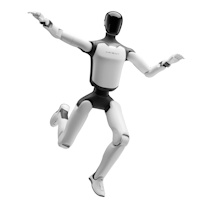
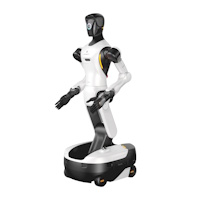
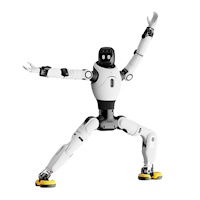
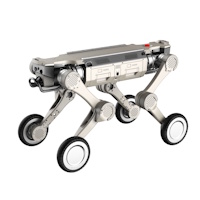
AgiBot (Chinese: 智元机器人; pinyin: Zhìyuán Jīqìrén; also known as Zhiyuan Robotics) is a Chinese robotics company headquartered in Shanghai, China. Founded in February 2023 by former Huawei engineers Deng Taihua and Peng Zhihui, the company designs, manufactures, and deploys general-purpose humanoid robots and embodied artificial intelligence systems for industrial, commercial, and service applications.
AgiBot
AgiBot: The World's Leading Humanoid Robot Company (2025–2026)
AgiBot (Chinese: 智元机器人; pinyin: Zhìyuán Jīqìrén; also known as Zhiyuan Robotics) is a Shanghai-based Chinese robotics company founded in 2023 that develops and manufactures general-purpose humanoid robots for industrial, commercial, and service applications. In fewer than three years since its founding, AgiBot has achieved what few robotics companies have accomplished in decades: it became the world's largest humanoid robot producer by shipment volume, delivering more than 5,100 units in 2025 — approximately 39% of the global humanoid market — according to analyst firm Omdia. By March 2026, the company had shipped its 10,000th humanoid robot, marking the fastest production ramp-up in the history of the humanoid robotics industry.
According to Omdia, AgiBot was the No. 1 shipper of humanoids in 2025, and IDC ranked AGIBOT first in total shipment volume and leading in entertainment, research and education, exhibition and reception, and manufacturing.
AgiBot's product portfolio spans a comprehensive range of embodied AI platforms: the A-Series full-size bipedal humanoids for service and light industrial applications, the G-Series wheeled humanoids for precision industrial manufacturing, the X-Series compact interactive humanoids for education and research, and the D-Series quadruped robots for logistics and patrol. The company received multiple Best of CES 2026 awards at its US debut in January 2026, and was named an NVIDIA Isaac GR00T ecosystem partner at GTC 2026 — placing it alongside Boston Dynamics, Figure AI, and Agility Robotics as a globally recognized leader in embodied AI.
2. Background and Founding
Founding Team and Origins
AgiBot is a Chinese robotics company headquartered in Shanghai, founded in 2023 by former Huawei engineers Deng Taihua and Peng Zhihui, who develop humanoid robots for industrial and service applications.
Peng Zhihui — widely known in Chinese technology circles as a prodigy engineer — joined Huawei in 2020 through its elite "Top Minds" talent acquisition program after gaining public attention for posting inventions on Chinese social media, including an Iron Man-inspired robotic arm and a self-driving system. Peng Zhihui left Huawei in December 2022 to start his entrepreneurial journey. In February 2023, he established Sangpeng (Shanghai) Technology, which later invested in AgiBot. Founded in February 2023, AgiBot is a robot brand based in Shanghai, focusing on the innovative integration of AI and robotics to develop and produce general-purpose humanoid robots.
Rapid Early Milestones
AgiBot's development trajectory has been extraordinary by industry standards:
The company progressed rapidly, completing angel round funding in March 2023, followed by Series A, A+, and A++ rounds in April and August of the same year. In August 2023, they officially released the Expedition A1 intelligent robot.
| Date | Milestone |
|---|---|
| February 2023 | AgiBot founded in Shanghai |
| March 2023 | Angel funding round completed |
| August 2023 | RAISE A1 (Expedition A1) first humanoid robot released |
| August 2024 | Five new robot models unveiled (A2, A2-Max, A2-W, X1, X1-W) |
| December 2024 | Mass production begins; 962 units produced as of December 15 |
| January 2025 | 1,000th robot milestone achieved |
| March 2025 | GO-1 generalist embodied foundation model released |
| April 2025 | Demonstrated robots to Chinese President Xi Jinping during his Shanghai visit |
| May 2025 | A2 achieves China, US, and EU triple-market safety certification |
| August 2025 | Partnership with Fulin Precision Engineering for ~100 robot deployment |
| October 2025 | LinkCraft zero-code platform launched; A2 Guinness World Record attempt |
| November 2025 | A2 walks 106.286 km from Suzhou to Shanghai in 3 days, entering Guinness World Records |
| January 2026 | US debut at CES 2026; multiple Best of CES awards; 5,000th unit milestone announced |
| March 2026 | Named NVIDIA Isaac GR00T ecosystem partner at GTC 2026; 10,000th unit shipped |
National Recognition
In April 2025, during CCP General Secretary Xi Jinping's visit to Shanghai, AgiBot demonstrated its robots to him. He jokingly inquired whether robots would one day be able to play for the China national football team. This nationally televised demonstration placed AgiBot at the center of China's national narrative around advanced manufacturing and AI leadership.
3. Robot Product Portfolio
AgiBot operates one of the broadest humanoid and embodied robot portfolios of any company in its founding-year class, spanning five product families and over a dozen distinct models.
A-Series: Full-Size Bipedal Humanoids
The A-Series (Yuanzheng / Expedition series) is AgiBot's flagship lineup of full-size, bipedal humanoid robots designed for commercial service, exhibition, and light manufacturing applications.
- Height: 169 cm (5'7")
- Weight: 55–69 kg (model dependent)
- Degrees of Freedom: 40+
- Arm Payload: 15 kg per arm
- AI Compute: 200 TOPS
- Battery: 700 Wh (standard) / 2,000 Wh (A2-W industrial variant)
- Safety Certification: China, USA, EU (May 2025)
- Record: Guinness World Record holder for longest distance walked by a humanoid robot (106.286 km)
Variants: Standard, Max (enhanced payload), Ultra, and A2-W (industrial, 2 kWh extended battery)
- Full-size bipedal humanoid
- Highlights: Martial arts-capable dynamic motion (aerial flying kicks, mid-air maneuvers); flexible waist joint; 8-hour continuous runtime; dual-battery system
- AI: WorkGPT multimodal model; no-wake-word voice interaction; shoulder-tap physical activation
- Target environments: Retail showrooms, live entertainment, brand activations, exhibition halls
G-Series: Industrial Wheeled Humanoids
The G-Series (G2) is AgiBot's industrial-grade wheeled humanoid, purpose-built for precision manufacturing and factory-floor operations requiring sub-millimeter manipulation accuracy.
The AgiBot G2 is an industrial-grade wheeled humanoid robot featuring 26 active degrees of freedom with 7-DOF force-controlled arms per side, supporting 5 kg arm payloads and sub-millimeter accuracy through torque sensors. Omnidirectional chassis mobility reaches 1.5 m/s, complemented by 360° perception via 3D LiDAR, multiple RGB-D and stereo cameras. Powered by dual hot-swappable batteries offering 4 hours runtime, it integrates NVIDIA Jetson T5000 compute (2,070 TFLOPS FP4) for on-device AI.
Key G2 specifications:
- Active DOF: 26 (7-DOF arms, force-controlled)
- Arm Payload: 5 kg per arm
- Manipulation Accuracy: Sub-millimeter (0.5N force control)
- Mobility: Omnidirectional wheeled base, 1.5 m/s
- Perception: 3D LiDAR + RGB-D cameras + stereo cameras (360°)
- Compute: NVIDIA Jetson T5000 (2,070 TFLOPS FP4)
- Battery: Dual hot-swappable, 4-hour runtime
- Weather Rating: IP42 (indoor industrial)
- Operating Temperature: −15°C to +50°C; automotive-grade components
X-Series: Compact Interactive Humanoids
The X-Series (Lingxi series) encompasses compact half-size humanoids designed for education, research, entertainment, and interactive deployment scenarios.
- X1 / X1-W: Original compact humanoid; open-source design with publicly released design materials and code to support developer ecosystem growth
- X2 / X2-W: Enhanced compact humanoid for household tasks, entertainment, and research; demonstrated capabilities including laundry and tidying
AgiBot's highest-profile collaboration so far is with Pepsi, which appointed a customized A2 humanoid as its first robotic brand ambassador. The robot, named "Fizzbot," debuted during a presentation featuring David Beckham. Pepsi-branded AgiBot humanoids could be seen serving soft drinks to guests at events like the 2025 World Artificial Intelligence Conference (WAIC) in Shanghai.
D-Series: Quadruped Robots
The D-Series (D1) consists of quadruped robots designed for logistics, patrol, and data collection applications in structured and semi-structured environments. The D1 provides an alternative deployment form factor for use cases where bipedal locomotion is unnecessary and four-legged stability is preferred.
C-Series and OmniHand
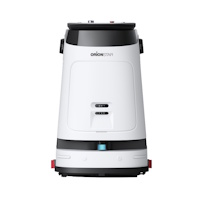
The C5 is AgiBot's autonomous cleaning solution for commercial spaces — an AI-guided floor care robot designed for large-area facilities including airports, shopping malls, and event venues.
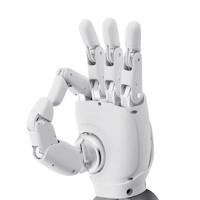
OmniHand is a standalone high-dexterity robotic limb system enabling human-like manipulation across both service and industrial applications, available as an independent hardware platform for integration with existing automation infrastructure.
4. Design and Build Philosophy
AgiBot's engineering philosophy centers on what the company calls "One Robotic Body, Three Intelligences" — a unified design principle that integrates three distinct capability layers into every robot platform:
- Motion Intelligence: Dynamic locomotion, balance control, and whole-body coordination enabling fluid, human-comparable movement
- Interaction Intelligence: Natural multimodal communication through speech (no wake-word required), visual recognition, and physical touch sensing
- Task Intelligence: Autonomous planning, execution, and anomaly recovery for real-world operational tasks
This philosophy produces robots that are engineered not for single-purpose demonstrations but for general-purpose deployment across multiple scenarios without hardware reconfiguration — a key differentiator from narrow-application robots.
Human-Scale Anthropomorphic Design
AgiBot's A-Series robots are designed at human proportions (approximately 169–175 cm height) to operate in environments built for humans — standard doorways, workstations, retail floors, and factory aisles — without requiring infrastructure modification. The A3 model extends this philosophy with a flexible waist joint that mirrors human torso rotational range, enabling the robot to perform movements — including complex martial arts maneuvers — that rigid-torso humanoid designs cannot achieve.
Industrial-Grade Construction
The G2's automotive-grade component supply chain undergoes 130+ component validation tests and extreme-condition trials from −15°C to +50°C, reflecting the rigorous reliability standards demanded by automotive and electronics manufacturing customers. This level of validation is unusual for a company of AgiBot's age and represents a direct inheritance from the industrial engineering culture of its Huawei-trained founding team.
5. Technical Specifications
AgiBot A2 (Flagship Bipedal Humanoid) — Full Specification
| Parameter | Specification |
|---|---|
| Height | 169 cm (5'7") |
| Weight | 55 kg (base) / 69 kg (with extended configuration) |
| Degrees of Freedom | 40+ |
| Arm Payload | 15 kg per arm |
| Manipulation Precision | Sub-millimeter (demonstrated: threading a needle) |
| AI Compute | 200 TOPS |
| Battery | 700 Wh (standard) / 2,000 Wh (A2-W industrial variant) |
| AI Models | GO-1 foundation model, WorkGPT multimodal AI |
| Face Recognition | 99% wake-up rate |
| Multimodal Accuracy | 96% (WorkGPT: text, audio, visual) |
| Safety | PLd-level, 3-layer architecture, 360° perception |
| Certifications | China, US, EU (May 2025) |
| Record | Guinness World Record: 106.286 km walked |
AgiBot G2 (Industrial Wheeled Humanoid) — Full Specification
| Parameter | Specification |
|---|---|
| Active DOF | 26 |
| Arm Configuration | 7-DOF per side, force-controlled |
| Arm Payload | 5 kg per arm |
| Manipulation Accuracy | Sub-millimeter (0.5N force control) |
| Mobility Speed | 1.5 m/s (omnidirectional) |
| Perception | 3D LiDAR + RGB-D + stereo cameras (360°) |
| Compute | NVIDIA Jetson T5000 (2,070 TFLOPS FP4) |
| Battery | Dual hot-swappable, 4-hour runtime |
| IP Rating | IP42 (indoor industrial) |
| Operating Temperature | −15°C to +50°C |
| Production Line Speed | Up to 310 units/hour throughput |
| Cycle Time | ~19–20 seconds per task |
| Task Success Rate | >99.9% (reported, Longcheer deployment) |
6. AI Platform: GO-1, WorkGPT, and Genie Sim 3.0
AgiBot's technology differentiation extends beyond hardware into a sophisticated, proprietary AI software stack that the company describes as an "Embodied Intelligent Brain" architecture.
GO-1: Generalist Embodied Foundation Model
GO-1 leverages latent action representations to maximize data utilization from both human and robot data, giving robots revolutionary learning capabilities that generalize across diverse environments and objects. Policies pre-trained on the AgiBot World dataset show an average performance improvement of 30% over those trained on Open X-Embodiment, with GO-1 achieving over 60% success rates on complex tasks and outperforming the previous state-of-the-art policy RDT by 32%.
Released in March 2025, GO-1 is AgiBot's first generalist embodied foundation model — a single AI system trained across diverse physical tasks and environments that can generalize learned behaviors to new situations without task-specific retraining. This is analogous to how large language models (LLMs) like GPT-4 generalize across language tasks; GO-1 applies the same principle to physical robot action.
WorkGPT: Multimodal Interaction AI
WorkGPT is AgiBot's proprietary multimodal AI model, responsible for the robot's natural-language interaction, visual understanding, and audio processing capabilities. It achieves:
- 96% accuracy across text, audio, and visual inputs in combined multimodal tasks
- 99% face wake-up rate for reliable identity-triggered activation
- No-wake-word speech interaction, enabling natural conversational engagement without scripted commands
- Predictive task planning based on contextual environmental understanding
Genie Sim 3.0: Simulation Platform
At CES 2026, AGIBOT introduced Genie Sim 3.0, a robot simulation platform powered by NVIDIA Isaac Sim. The platform brings together digital asset generation, scene generalization, data collection, automated evaluation, and physics-based simulation in a single toolchain.
Genie Sim 3.0 enables AgiBot and third-party developers to train robot behaviors in simulation before deployment — dramatically reducing real-world trial time, lowering the risk of hardware damage during training, and enabling generalization testing across thousands of synthetic environments. As an NVIDIA Isaac Sim-powered platform, it integrates with the broader NVIDIA robotics ecosystem used by Boston Dynamics, Figure AI, and other leading humanoid developers.
AimRT: Custom Middleware Runtime
AimRT is AgiBot's proprietary C++20 robot middleware runtime, developed as a high-performance alternative to ROS2 (Robot Operating System 2). Independent benchmarks indicate AimRT outperforms ROS2 in latency-critical robotics applications, providing the real-time communication layer between AgiBot's AI models and the physical servo actuators that execute robot movements.
SOP Framework: Distributed Online Learning
AgiBot Research introduced the SOP (scalable online post-training) framework, designed to enable online updates of vision-language-action (VLA) models across robot fleets. The framework shifts the learning paradigm from offline to distributed online training and can lead to significant performance improvements on the path toward general-purpose robots.
The SOP framework means that as deployed AgiBot robots encounter new situations in real environments, they can contribute learning data back to the shared model — creating a continuously improving fleet intelligence system where each robot's experience benefits every other robot in the network.
LinkCraft: Zero-Code Robot Programming
In October 2025, AgiBot introduced LinkCraft, a zero-code platform for robot content creation that converts videos of human motion into precise humanoid robot actions, allowing users without programming skills to design and control robot performances by uploading simple videos.
LinkCraft democratizes robot choreography and task programming by enabling non-technical users to teach robots through video demonstration rather than traditional programming — a capability critical for expanding adoption beyond robotics engineers into entertainment, retail, and event industries.
7. AgiBot World: The Embodied AI Dataset
GO-1 is built upon AgiBot World Colosseo, a large-scale platform comprising over 1 million trajectories covering 217 tasks across five deployment scenarios. Unlike previous datasets, AgiBot World focuses on real-world scenarios involving dual-arm manipulation, dexterous hands, and collaborative tasks, going beyond basic tabletop tasks.
AgiBot World is the company's open embodied AI dataset — a large-scale repository of robot interaction data that AgiBot made publicly accessible to enable unified standards and reduce duplicated effort in the global embodied AI research community. AgiBot claimed AgiBot World to be larger and of higher quality than Google's Open X-Embodiment, which is the open-source equivalent.
According to Reuters, Shanghai authorities supported the establishment of an AgiBot data-collection site where hundreds of robots are tele-operated to generate training data for embodied AI models. This state-supported data infrastructure gives AgiBot a structural data advantage over competitors — enabling continuous improvement of GO-1 at a scale that most independent robotics companies cannot replicate.
In 2026, AgiBot is hosting the AgiBot World Challenge at ICRA 2026 in Vienna — an international robotics research competition that further integrates the company into the global academic robotics community while generating additional high-quality training data.
8. Manufacturing and Production Scale
AgiBot's production ramp-up speed is unprecedented in humanoid robotics history:
AGIBOT said it took nearly two years to reach its first 1,000 units, followed by about a year to scale from 1,000 to 5,000 robots. In just three months, AGIBOT said it went from 5,000 to 10,000 units shipped. It credited the rapid growth to its maturing supply chain, continuous improvement in manufacturing efficiency, and accelerating production of its complex hardware.
The company's primary manufacturing facility is located in Liuzhou, southern China, with operations also based in its Shanghai headquarters. The production line itself has been partly roboticized — a self-referential validation of AgiBot's technology where robots are used to manufacture robots.
AgiBot became the world's largest humanoid robot producer in 2025 by shipping 5,168+ units — more than Tesla, Figure, and Agility Robotics combined.
By the product breakdown announced in December 2025, AgiBot had manufactured:
- 1,742 units of the A-Series (full-size bipedal humanoids)
- 1,846 units of the X-Series (compact interactive humanoids)
- 1,412 units of the G-Series (wheeled industrial manipulators)
AgiBot also noted that deployments of its humanoids are growing beyond the Chinese market, from Europe and North America to Japan, South Korea, Southeast Asia, and the Middle East.
9. Applications and Use Cases
Industrial Manufacturing and Precision Assembly
AGIBOT has deployed G2 humanoid robots into a live consumer electronics manufacturing line at Longcheer Technology's tablet production facility, where robots operate at Multimedia Integrated Testing (MMIT) stations — handling precision tasks such as picking up devices, placing them into testing fixtures, and sorting finished or defective units. Reported performance includes throughput of up to 310 units per hour, cycle times of around 19–20 seconds per task, and a success rate exceeding 99.9%. Production line integration was completed within 36 hours.
The company plans to scale deployments to 100 robots by Q3 2026 and expand into sectors such as automotive, semiconductors, and energy, pushing embodied AI deeper into industrial environments.
Brand Ambassador and Commercial Service
AgiBot's A2 humanoid has been customized for brand ambassador roles at the highest levels of corporate marketing. The robot named "Fizzbot" — a Pepsi-branded A2 — debuted alongside David Beckham and has been deployed serving beverages and greeting guests at major events including the 2025 World Artificial Intelligence Conference (WAIC) in Shanghai.
Exhibition, Reception, and Guided Interaction
IDC ranked AGIBOT first in the entertainment, research and education, exhibition and reception, and manufacturing categories. In hotel lobbies, museum exhibitions, trade show booths, and corporate headquarters, AgiBot humanoids serve as autonomous reception agents, guided tour hosts, and interactive brand experiences — capable of natural conversation in multiple languages, facial recognition of returning visitors, and contextually appropriate task escalation.
Education and Research
The X1's open-source design — with publicly released design files and code — has established AgiBot as a preferred platform for university robotics laboratories, AI researchers, and robotics education programs seeking an affordable, hackable humanoid platform for research in locomotion, manipulation, and embodied AI.
Logistics, Security, and Facility Operations
The D-Series quadruped robots serve logistics and patrol functions, while the C5 provides AI-guided autonomous cleaning for large commercial spaces. Together with humanoid platforms, these products position AgiBot as a comprehensive facility automation ecosystem capable of addressing multiple operational functions within a single corporate robotics deployment.
Data Collection Infrastructure
Shanghai authorities supported the establishment of an AgiBot data-collection site where hundreds of robots are tele-operated to generate training data for embodied AI models. This positions AgiBot uniquely as both a robotics hardware company and a data infrastructure company — generating proprietary training data at scale that feeds back into GO-1 model improvements, creating a compounding competitive advantage.
10. Advantages and Benefits
World's Largest Production Volume
With 10,000 units shipped by March 2026 — a figure no other humanoid robotics company has approached — AgiBot offers prospective buyers the validation of a proven, production-scale manufacturing operation with a demonstrated supply chain, quality control system, and post-sales support infrastructure.
Triple-Market Safety Certification
The A2's simultaneous China, US, and EU safety certification (achieved May 2025) is rare among humanoid robots and critical for buyers evaluating platforms for deployment in regulated industrial and commercial environments across multiple geographies.
Broadest Product Portfolio in Its Class
AgiBot's portfolio includes the A2 Series full-sized humanoids, the X2 Series compact humanoids, the G2 wheeled humanoids, the D1 Series quadruped robots, and the C5 autonomous cleaning solution — complemented by OmniHand, a high-dexterity robotic limb enabling human-like manipulation. This breadth enables customers to source multiple robot types from a single vendor with a unified AI platform — reducing integration complexity and software training overhead.
World-Class AI Performance
GO-1's 30% improvement over Open X-Embodiment and 32% outperformance of the state-of-the-art RDT policy on complex manipulation tasks represent a technically verified AI capability advantage. The SOP distributed learning framework further ensures that AgiBot's robot fleet improves continuously in deployment, rather than requiring periodic manual model updates.
NVIDIA Ecosystem Integration
AGIBOT was named an NVIDIA Isaac GR00T ecosystem partner at GTC 2026 (announced March 16–17, 2026). Alongside 1X, Agility, Boston Dynamics, Figure, Hexagon Robotics, and NEURA Robotics, AGIBOT is adopting GR00T N models to accelerate industrial deployments. The G2 wheeled humanoid runs on the NVIDIA Jetson Thor computing platform, delivering up to 2,070 TFLOPS of AI compute.
Robot-as-a-Service (RaaS) Accessibility
At MWC 2026, AGIBOT introduced its Robot-as-a-Service (RaaS) platform — a flexible leasing model designed to make advanced embodied AI accessible to a broader audience. By shifting from ownership to a rental-based approach, AGIBOT effectively lowers the barrier to entry, enabling humanoid robots to be deployed across diverse scenarios.
11. Comparison with Global Competitors
| Feature | AgiBot A2/G2 | Tesla Optimus Gen 2 | UBTECH Walker S2 | Figure 02 | Agility Digit |
|---|---|---|---|---|---|
| Founded | 2023 | 2021 (robotics) | 2012 | 2022 | 2015 |
| 2025 Shipments | 5,168 units | Limited | ~1,000 units | <200 units | <200 units |
| Height | 169 cm | ~173 cm | 176 cm | ~167 cm | ~175 cm |
| Arm Payload | 15 kg (A2) | ~20 kg | 15 kg | ~20 kg | ~16 kg |
| Safety Certs | China + US + EU | Limited | China | Limited | US |
| AI Platform | GO-1 + WorkGPT | Tesla FSD-derived | BrainNet 2.0 | Figure AI | AWS Bedrock |
| Foundation Model | GO-1 | Proprietary | Co-Agent | Figure n1 | Not disclosed |
| NVIDIA Partnership | Yes (GR00T) | No | No | Yes | No |
| CES 2026 Award | Yes (multiple) | No | No | No | No |
| RaaS Model | Yes | No | No | No | Limited |
| Approx. Price | Contact sales | ~$20K–$30K (projected) | ~$68K–$120K | Contact sales | ~$250K |
In Omdia's technical evaluation of general-purpose embodied robots, AGIBOT received advanced ratings across most key categories, including mobility, manipulation, AI learning, and scalability. Omdia places AGIBOT in the global first tier of humanoid robot developers, alongside companies like Unitree and Tesla, all of which are pushing toward more adaptable, general-purpose robotic intelligence.
AgiBot's primary advantage over Tesla Optimus is current production reality — while Optimus projects a lower eventual price, it remains in limited deployment. AgiBot's advantage over UBTECH Walker S2 and Agility Digit is breadth of portfolio and production volume. Its advantage over Figure 02 is price accessibility and regulatory certification. The key area where AgiBot faces ongoing competitive pressure is Tesla's projected long-term price target of $20,000–$30,000 per unit — a price point that, if achieved at scale, would significantly alter the competitive landscape.
12. Funding, Investors, and IPO
Funding History
AgiBot has raised $83.8 million in funding across multiple rounds. Its first funding round was on September 13, 2023.
AgiBot's backers include Tencent, HongShan Capital (formerly Sequoia China), BYD, Hillhouse Investment, LG Electronics, Mirae Asset, Baidu, and Warburg Pincus. The company has raised approximately $83.8 million across multiple funding rounds, with a valuation exceeding $1 billion by mid-2025.
The investor roster reflects AgiBot's positioning as a convergence of AI software, robotics hardware, and manufacturing — attracting capital from technology giants (Tencent, Baidu), automotive and industrial leaders (BYD), global electronics companies (LG Electronics), and premier global financial institutions (Warburg Pincus, Hillhouse).
Planned Hong Kong IPO
AgiBot is reportedly targeting a valuation between HK$40 billion and HK$50 billion (approximately US$5.1–6.4 billion). The company plans to sell 15–25% of its shares, potentially raising more than US$1 billion. China International Capital Corp (CICC), CITIC Securities, and Morgan Stanley have been appointed as joint sponsors and underwriters.
AgiBot was valued at $2.07 billion as of March 2025, according to PitchBook. The targeted IPO valuation of up to $6.4 billion represents more than triple growth in just over a year, underscoring investor enthusiasm for China's humanoid robotics sector and AgiBot's rapid technological advancement.
If the IPO proceeds at its targeted valuation, it would be one of the largest technology IPOs from China in recent years and would provide AgiBot with the capital needed to aggressively scale production toward its stated target of tens of thousands of units annually in 2026 and beyond.
13. Pricing and Availability
AgiBot does not publicly list fixed retail prices for most of its industrial and enterprise robot platforms. The following pricing guidance reflects available public and reseller information:
| Product | Pricing |
|---|---|
| AgiBot A2 (Standard) | Enterprise quote — estimated mid-to-high five figures USD |
| AgiBot A2-W (Industrial) | Enterprise quote |
| AgiBot G2 (Industrial Wheeled) | Enterprise quote (hundreds of thousands yuan per unit) |
| AgiBot X1 (Open Source) | Research/academic pricing — significantly lower than enterprise |
| AgiBot A3 | Quote-based (enterprise) |
| Robot-as-a-Service (RaaS) | Available via AgiBot's rental platform |
Where to Buy
At MWC 2026, AGIBOT's online store (store.agibot.com) officially commenced global operations. This flagship platform serves as a centralized hub for the AGIBOT core portfolio, including the A Series universal humanoids, X Series interactive robots, and D Series quadruped robots, offering global customers a streamlined gateway for both direct purchasing and flexible leasing. The site provides a comprehensive portal for official product information, business inquiries, and bespoke customization services.
14. Frequently Asked Questions
What is AgiBot?
AgiBot (Chinese: 智元机器人, also known as Zhiyuan Robotics) is a Shanghai-based Chinese robotics company founded in 2023 by former Huawei engineers Deng Taihua and Peng Zhihui. It develops general-purpose humanoid and embodied AI robots for industrial, commercial, and service applications. In 2025, AgiBot became the world's largest humanoid robot producer by shipment volume, shipping more than 5,100 units — approximately 39% of the global market — according to analyst firm Omdia. By March 2026, the company had shipped its 10,000th humanoid robot.
How does AgiBot's AI platform work?
AgiBot's AI architecture is built around three integrated systems. The GO-1 foundation model provides generalist physical intelligence — trained on over 1 million robot interaction trajectories across 217 tasks — enabling robots to adapt learned behaviors to new environments without task-specific retraining. WorkGPT is AgiBot's multimodal AI achieving 96% accuracy across text, audio, and visual inputs, enabling natural human-robot interaction. Genie Sim 3.0 is a simulation platform built on NVIDIA Isaac Sim that enables training in virtual environments before real-world deployment. Together, these systems are coordinated by AimRT, AgiBot's proprietary C++20 middleware that outperforms ROS2 in real-time robotics applications.
Why is AgiBot important for the future of robotics?
AgiBot is important because it has demonstrated — at unprecedented speed — that general-purpose humanoid robots can be manufactured and deployed at industrial scale in real commercial environments, not just demonstrated in laboratories. Its 10,000-unit production milestone, achieved less than three years after founding, provides a proof of concept for the mass commercialization of humanoid robots. Its GO-1 foundation model, AgiBot World dataset, NVIDIA GR00T integration, and distributed SOP learning framework represent genuine technical advances in embodied AI that other companies in the field reference and compete against. The company's triple-market certification (China, US, EU) and globally expanding deployment footprint further validate its technology's readiness for enterprise adoption.
What are the key benefits of AgiBot robots over competitors?
AgiBot offers five verified advantages over competing humanoid platforms. First, production scale: with 10,000 units shipped by March 2026 — more than any competitor — AgiBot provides the manufacturing maturity and supply chain reliability that enterprise buyers require. Second, triple-market certification: the A2's simultaneous China, US, and EU safety certification (May 2025) is rare among humanoid robots. Third, AI performance: GO-1 outperforms Google's Open X-Embodiment-trained policies by 30% and beats the state-of-the-art RDT policy by 32% on complex tasks. Fourth, breadth: with five product families from compact X-Series research robots to industrial G2 wheeled humanoids, AgiBot provides a single-vendor solution across multiple deployment scenarios. Fifth, accessibility: the RaaS rental model lowers the capital barrier to humanoid robot adoption significantly below the purchase price of competing enterprise platforms.
What is AgiBot's Guinness World Record?
In November 2025, AgiBot's A2 humanoid robot walked 106.286 kilometers from Suzhou to Shanghai over three consecutive days, earning a Guinness World Record for the longest distance walked by a humanoid robot. This achievement demonstrated the A2's mechanical reliability, energy system endurance, and locomotion stability across extended real-world deployment — functioning both as a technical validation and as a globally recognized public demonstration of humanoid robot capability.
Is AgiBot going public?
AgiBot is reportedly planning a Hong Kong Stock Exchange IPO in 2026, targeting a valuation of HK$40–50 billion (approximately $5.1–6.4 billion USD). China International Capital Corp (CICC), CITIC Securities, and Morgan Stanley have been appointed as joint sponsors and underwriters. The company was valued at $2.07 billion as of March 2025, making the target IPO valuation more than triple that figure in approximately one year. Proceeds from the IPO are expected to fund large-scale production expansion and international market development.
15. Summary
AgiBot has achieved in under three years what most robotics companies spend a decade attempting: the transition from prototype to profitable, production-scale, globally deployed humanoid robots. As the world's number one humanoid robot manufacturer by shipment volume — with more than 10,000 units delivered as of early 2026, triple-market safety certification, a generalist foundation model outperforming Google's benchmark dataset, partnerships with NVIDIA and global enterprises from Pepsi to Longcheer Technology, and a Hong Kong IPO targeting a $5–6 billion valuation — AgiBot has positioned itself not merely as a Chinese robotics success story, but as a genuinely global contender in the race to define the future of embodied AI. For industrial operators, researchers, technology investors, and enterprise buyers evaluating the humanoid robot landscape in 2025 and beyond, AgiBot represents the clearest proof of concept for what mass-market humanoid robotics looks like when manufacturing velocity, software depth, and commercial ambition converge at a single company.
Frequently Asked Questions (FAQ)
What is AgiBot? AgiBot, also known as Zhiyuan Robotics (智元机器人), is a Chinese humanoid robotics company founded in February 2023 and headquartered in Shanghai, China. The company designs and manufactures general-purpose humanoid robots and develops embodied artificial intelligence software, including the GO-1 foundation model and the AgiBot World dataset. As of early 2026, it is the world's highest-volume humanoid robot manufacturer by units shipped.
How does AgiBot's humanoid robot work? AgiBot's humanoid robots combine onboard AI processing, multimodal sensors (cameras, LiDAR, microphones, and tactile sensors), and dexterous robotic hands with high degrees of freedom to perceive and interact with physical environments. The robots run on AgiBot's proprietary software stack, including the WorkGPT multimodal AI engine, the GO-1 generalist foundation model, and the AimRT communication middleware. The GO-1 model uses a Vision-Language-Latent-Action (ViLLA) framework that allows robots to understand scenes, plan actions, and execute fine-grained manipulation tasks — and can generalize to new environments from minimal training examples.
Who founded AgiBot and why is it significant? AgiBot was founded by Deng Taihua and Peng Zhihui, both former senior engineers at Huawei. The company is significant because it achieved mass production of humanoid robots faster than any comparable company globally, shipping over 5,000 units in 2025 and crossing the 10,000-unit cumulative production milestone in March 2026. Its GO-1 AI model and AgiBot World dataset represent meaningful contributions to open embodied AI research, and the company's trajectory has placed it at the center of China's national strategy for robotics and advanced manufacturing.
What are the benefits of AgiBot humanoid robots? AgiBot robots offer several practical advantages for industrial and commercial customers. They combine general-purpose adaptability with production-scale availability, meaning buyers can procure multiple units at competitive price points. The onboard edge computing architecture allows the A2 to operate without cloud connectivity, reducing latency and improving reliability in manufacturing environments. The open GO-1 foundation model and AgiBot World dataset enable rapid customization and fine-tuning by enterprise customers and research teams. The robots have received triple-market certification from China, the United States, and the European Union, facilitating cross-border deployment.
How does AgiBot compare to Tesla Optimus? AgiBot has explicitly positioned its A2 as a commercial competitor to Tesla's Optimus robot. The key distinction as of early 2026 is production volume: AgiBot had shipped over 10,000 cumulative units and achieved revenues exceeding one billion yuan in 2025, while Tesla Optimus remained in limited production. AgiBot's robots are currently priced in the $100,000 to $190,000 range, while Tesla has indicated Optimus could eventually cost around $20,000 — suggesting pricing will be an important competitive dimension once Tesla reaches volume production. Industry analysts generally characterize Chinese humanoid companies as leading in mass production and motion control, while US firms maintain advantages in semiconductor supply chains and certain AI capabilities.
What is the AgiBot World dataset? AgiBot World is a large-scale open robotics learning dataset released by AgiBot at the end of 2024. The full version (AgiBot World Beta) contains over one million robot action trajectories collected from 100 robots across more than 100 real-world scenarios in five application domains. It is the largest publicly available humanoid manipulation dataset in the world, developed in collaboration with OpenDriveLab at the University of Hong Kong and the Shanghai AI Lab. The dataset is freely available for non-commercial research use on GitHub and Hugging Face, and it forms the training foundation for AgiBot's GO-1 foundation model.