OrionStar
OrionStar Robotics is a Beijing service-robot leader born from Cheetah Mobile's AI ecosystem, building the LuckiBot restaurant delivery family, GreetingBot reception robots, CarryBot warehouse platforms, and the industry-first Robotic Agent Operating System — deployed across restaurants, hotels, retail, and factories worldwide. This guide covers the OrionStar lineup, technology, applications, and what buyers should know before purchasing.
-
 $70.18
Out of stock
OrionStar
Introduction / Overview
OrionStar Robotics builds service robots the way a voice-AI company would — because that's what it is. Born from the Cheetah Mobile ecosystem with deep roots in speech interaction, computer vision, and cloud AI, the Beijing company declared its mission plainly — "born for truly useful robots" — and backed it with a full-stack approach: proprietary chassis and navigation, its own Robot OS, and now the industry-first Robotic Agent Operating System, bringing LLM-era agentic intelligence to commercial service fleets. The result is one of the most widely deployed service-robot brands in the world, working 20+ scenarios across restaurants, retail, warehouses, factories, hotels, and showrooms.
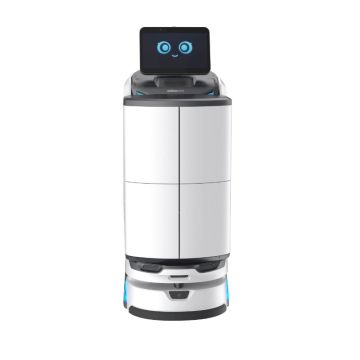
The catalog centers on two celebrated families. The LuckiBot line owns restaurant delivery: the standard LuckiBot carries up to 40 kg across 3–4 adjustable tiers, serving around four tables per trip and up to 400 dishes per day, with a 6-microphone array for 360° voice recognition, multiple operating modes (delivery, greeting, guidance, cruise, promotion, collection), multi-robot cooperation, and up to 10 hours of battery life. The flagship LuckiBot Pro raises everything: 240-degree 3D obstacle recognition with depth camera, a first-in-class torsion-bar suspension on a high-passability quasi-circular chassis, 15 kg per layer loading (~50% improved), a 14-inch 1080P display with 92% more viewable area, 97% voice-recognition accuracy even at 75 dB of noise, proactive visitor greeting, and a modular design with universal data/power interfaces plus an SDK of hundreds of APIs — with an Autodoor variant adding automated compartment doors. Alongside: the GreetingBot Nova and Mini reception-and-guidance robots welcoming visitors in malls, hotels, and corporate lobbies; the OrionStar CarryBot for warehouse transport; and distribution of the UFactory xArm collaborative arm. For hospitality, retail, and facility buyers, OrionStar pairs proven delivery hardware with the strongest voice-AI pedigree in the category.
Design and Features
LuckiBot — The Restaurant Workhorse
- Real serving economics — 40 kg across 3–4 spacious adjustable tiers (0.18 m² each): roughly four tables per trip, up to 400 dishes per day, against the annual cost of the human food-runner labor it supplements.
- Voice-first interaction — the 6-mic array hears across 360°, letting guests and staff talk to the robot naturally in dining-room noise — the Cheetah-lineage differentiator.
- Six modes in one machine — delivery, greeting, guidance, cruise (roaming promotion), promotion display, and dish collection: a full front-of-house toolkit, not a tray on wheels.
- Fleet-native — multi-robot cooperation with path negotiation between units, plus 4G resilience when WiFi drops; ~10-hour endurance covers full service days.
LuckiBot Pro — The Flagship
- Perception upgraded — 240° 3D all-around obstacle recognition plus depth camera and refined ground perception, adapting to more demanding floors and layouts.
- Suspension that smooths service — the category's first torsion-bar suspension on a quasi-circular high-passability chassis: drinks arrive unspilled across thresholds and uneven flooring.
- Heavier, clearer, louder-proof — 15 kg per layer across up to 4 layers (trays removable for heavy-duty conversion); a 14-inch 1080P display with 92% more viewable area; 97% voice accuracy at 75 dB.
- Proactively social — full-perception visitor identification lets the Pro spot and welcome guests before they ask.
- Developer-open — modular design, universal data and power interfaces, and the RobotOS SDK's hundreds of APIs for custom applications; the Autodoor edition seals deliveries behind automatic doors for hygiene- and security-sensitive missions.
GreetingBot Nova and Mini
The reception specialists: welcoming, informing, and physically escorting visitors to destinations across shopping centers, hotels, and company buildings — Nova at full presence, Mini in a compact footprint — carrying OrionStar's voice interaction into the lobby.
CarryBot and the xArm
The OrionStar CarryBot extends the navigation stack into warehouse transport, while OrionStar's offering of the UFactory xArm collaborative arm rounds the portfolio into light manipulation.
The Software Spine
- Robot OS — OrionStar's customized operating system (Android-based) underlying the fleet, with cloud services, data storage, and OTA evolution.
- The Robotic Agent Operating System — the industry-first agentic OS: LLM-driven task understanding and orchestration positioning OrionStar's installed base for the AI-agent era.
- Solution-provider ecosystem — partner tooling (including no-code programming through partners) making customization accessible to non-developers.
Technology and Specifications
Choosing Within the Range
| Model | Class | Key Figures | Primary Role |
|---|---|---|---|
| LuckiBot | Delivery robot | 40 kg, 3–4 tiers, 6-mic, ~10 h | Restaurants, cafés, hotels |
| LuckiBot Pro | Flagship delivery | 15 kg/layer, 240° 3D, torsion suspension | Demanding venues, heavy service |
| LuckiBot Pro Autodoor | Enclosed delivery | Automatic doors | Hygiene/secure delivery |
| GreetingBot Nova / Mini | Reception robots | Voice guidance, escorting | Lobbies, malls, showrooms |
| CarryBot | Warehouse transport | Facility logistics | Warehouses, factories |
Confirm current datasheets before specifying — configurations evolve, and datasheets are available on request.
Why Voice Pedigree Matters in Service Robotics
Delivery is half the job; the other half is being spoken to — by guests mid-meal, staff mid-rush, visitors mid-lobby. OrionStar's AI lineage shows exactly here: 97% recognition through restaurant noise, 360° pickup, and now agentic task orchestration — the interaction layer where hardware-first rivals retrofit and OrionStar was born.
Position in the Market
Against Keenon's shipment leadership and Pudu's breadth in your catalog, OrionStar competes on interaction intelligence (the voice stack and agent OS), the Pro's suspension-and-perception hardware edge, and developer openness — the natural pick where guest experience and customization weigh heaviest.
Applications and Use Cases
Restaurants and Cafés
The core: LuckiBot fleets running delivery, collection, and promotion through full service days — easing labor shortage with measurable per-trip economics.
Hotels
Delivery, luggage transport, and lobby guidance combining LuckiBot and GreetingBot roles across the guest journey.
Retail and Showrooms
Cruise-mode promotion, guidance, and greeting turning robots into ambient brand staff.
Warehouses and Factories
CarryBot transport plus heavy-duty LuckiBot Pro conversions moving materials through facilities.
Corporate and Public Buildings
GreetingBot reception across offices, exhibitions, and institutions.
Advantages / Benefits
- The voice-AI advantage — 360° hearing, 97% accuracy at 75 dB, and the industry's first agentic OS: interaction no service rival matches.
- Engineering that protects the payload — first-in-category torsion-bar suspension and 240° 3D perception on the Pro.
- Six modes per robot — delivery through promotion in one purchase.
- Fleet intelligence — multi-robot cooperation with 4G-resilient autonomy.
- Developer freedom — hundreds of SDK APIs, modular interfaces, and partner no-code tooling.
- Full-portfolio coverage — delivery, reception, warehouse, and cobot arms from one vendor with global support.
For buyers researching where to buy OrionStar robots, or comparing LuckiBot, LuckiBot Pro, and GreetingBot prices and costs against Keenon, Pudu, and other service-robot brands, the evaluation should weigh interaction intelligence, suspension and perception hardware, mode versatility, customization openness, and support — the dimensions where OrionStar's AI-native construction leads.
FAQ
What is OrionStar Robotics?
OrionStar Robotics is a Beijing service-robot company from the Cheetah Mobile AI ecosystem, producing the LuckiBot delivery family, GreetingBot reception robots, CarryBot warehouse platform, and the industry-first Robotic Agent Operating System — deployed across 20+ commercial scenarios worldwide.
What is the LuckiBot?
The LuckiBot is OrionStar's restaurant delivery robot: up to 40 kg across 3–4 adjustable tiers, roughly four tables per trip and 400 dishes per day, with 360° six-microphone voice interaction, six operating modes, multi-robot cooperation, and around 10 hours of battery life.
What is the difference between LuckiBot and LuckiBot Pro?
The Pro upgrades everything: 240° 3D obstacle recognition with depth camera, the category's first torsion-bar suspension, 15 kg per layer (about 50% more capacity, trays convertible for heavy duty), a 92%-larger 14-inch 1080P display, 97% voice accuracy at 75 dB, proactive guest greeting, and full SDK-level developer access — with an Autodoor variant adding enclosed compartments.
What are the GreetingBot Nova and Mini?
OrionStar's reception robots: AI-voiced welcoming, information, and physical guidance escorting visitors to destinations across malls, hotels, and corporate buildings — Nova full-size, Mini compact.
Can OrionStar robots be customized?
Extensively — the RobotOS platform exposes an SDK with hundreds of API interfaces on modular hardware with universal data/power ports, and partner ecosystems add no-code programming for non-developers.
How do OrionStar robots handle noisy restaurants?
Through the 6-microphone array and OrionStar's voice-AI heritage: 360° pickup with recognition accuracy up to 97% even in 75 dB environments — reliable spoken interaction through dinner-rush noise.
Why is OrionStar important?
OrionStar brought genuine AI-company DNA to service robotics — voice interaction, cloud intelligence, and now the first agentic robot OS — wrapped around delivery hardware whose suspension and perception engineering leads its class.
How much do OrionStar robots cost?
The LuckiBot line anchors the accessible commercial-delivery tier, with the Pro and Autodoor above it and GreetingBots priced by configuration. Contact a distributor for current pricing, fleet planning, datasheets, and delivery timelines for your region.
Summary
OrionStar built the service robot that listens: LuckiBots hearing orders across 360 degrees of dining-room noise while hauling forty kilograms of dishes through ten-hour shifts; the Pro gliding drinks over thresholds on the category's first torsion-bar suspension with 240-degree 3D eyes; GreetingBots escorting visitors through lobbies; CarryBots working the warehouse — all running toward an agentic future on the industry's first Robotic Agent Operating System, with hundreds of APIs open to whoever wants to build on it. For anyone looking to buy an OrionStar LuckiBot, LuckiBot Pro, GreetingBot Nova or Mini, or CarryBot, compare their costs against Keenon, Pudu, and other service-robot brands, or plan a restaurant, hotel, retail, or warehouse deployment, this guide provides the essential foundation.