Fourier Robotics
Fourier is the Shanghai humanoid pioneer that grew out of a decade of medical rehabilitation robotics deployed across 2,000+ institutions — maker of the GRx series spanning the GR-1, the high-torque GR-2, and the GR-3 "Care-bot" with full-body tactile sensing and emotional interaction, plus the open-source N1. This guide covers Fourier's history, complete lineup, technology, and what buyers should know before purchasing.
-
Free Shipping
Out of stock
Fourier
Introduction / Overview
Fourier (formerly Fourier Intelligence) took the road into humanoids that no competitor can retrace: through the hospital. Founded in Shanghai in 2015, the company spent nearly a decade building medical rehabilitation robotics — exoskeletons and therapy systems helping patients with neurological impairments stand and walk again — deployed across more than 2,000 medical institutions. That lineage taught Fourier what most humanoid makers are only now discovering: robots working around vulnerable people must be reliable, safe, gentle, and accepted. When Fourier launched its GRx (General Robotics) humanoid series, that clinical DNA came with it — and it culminates in the platform that made the company's CES 2026 debut a headline event: the GR-3 "Care-bot", the industry's first full-size humanoid explicitly engineered for care, companionship, and emotional interaction.
The generational arc is rapid. The GR-1 (2023) was marketed as the world's first mass-produced humanoid. The GR-2 (2024) scaled the platform to 175 cm and 63 kg with 53 independently controllable joints, 380 N·m peak torque, and 12-DoF dexterous hands, doubling battery life. In early 2025 Fourier released the N1 — China's first verified open-source humanoid — and closed a Series E round of nearly 800 million yuan (~$110M) backed by Guoxin Investment and Prosperity7. Then came the GR-3 (August 2025): 165 cm, 55 degrees of freedom, wrapped in a soft-touch shell with Morandi warm tones and supercar-grade upholstery, carrying a Full-Perception Multimodal Interaction System — visual recognition, sound-source localization, and full-body tactile sensing — with dual-path emotional responsiveness and dual hot-swappable batteries sustaining 3 hours of continuous runtime without powering down. For buyers in eldercare, healthcare, education, and human-facing service, Fourier is the humanoid maker whose entire history is human-centered.
Design and Features
GR-3 — The Care-bot
Fourier's flagship redefines what a humanoid should feel like:
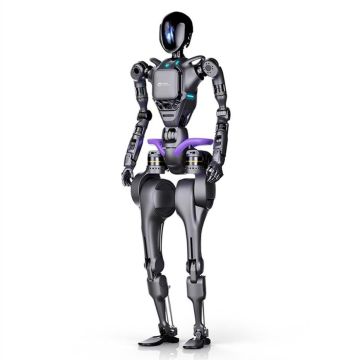
- Designed to be touched — a soft-touch shell, warm Morandi color palette, and premium eco-lined upholstery replace cold mechanical surfaces, making the 165 cm robot approachable in homes, care settings, and public spaces.
- Full-Perception Multimodal Interaction — integrated visual recognition, sound-source localization, and full-body tactile sensing: the GR-3 localizes a voice calling it, tracks the person's movement, and recognizes subtle touch — responding appropriately to each.
- Dual-path emotional intelligence — quick reflexive responses for simple cues (turning its head when called) run alongside large-AI-model-driven contextual responses for nuanced, repeated interaction — the architecture of natural companionship.
- 55 degrees of freedom — flexible whole-body posture and high-precision task capability in a compact modular design.
- Continuous-care endurance — dual hot-swappable batteries deliver up to 3 hours of runtime with battery changes that never power the robot down: essential in settings where a companion switching off matters.
- Developer-ready framework — a redesigned server-client architecture serving industrial and academic developers, enabling deployment across eldercare, rehabilitation training, guided tours, and assistance — with the GR-3C variant emphasizing functional task performance alongside the interactive flagship.
GR-2 — The High-Performance Platform
The 175 cm, 63 kg GR-2 remains Fourier's engineering benchmark: 53 independently controllable joints with 380 N·m peak torque, 12-DoF dexterous hands, serial joint configurations with internal wiring for maintainability and modularity, and doubled battery life over the GR-1 — the enterprise platform for institutions requiring full-scale humanoid capability with healthcare-grade pedigree.
GR-1 — The Mass-Production First
The 2023 original established the GRx architecture and Fourier's claim to the first mass-produced humanoid — the foundation generation whose lessons every successor inherits.
N1 — The Open-Source Contribution
China's first verified open-source humanoid, the N1 opens Fourier's platform engineering to the research and developer community — an academic on-ramp into the ecosystem and a statement of the company's development philosophy.
The Rehabilitation Inheritance
Fourier's decade in medical robotics shapes everything: force control refined on patients' limbs, safety engineering proven in therapy sessions, and — after the company's reorganization into Fourier (humanoids) and Fourier Rehab — a continuing clinical business feeding real-world human-interaction data back into the humanoid line.
Technology and Specifications
Choosing Across the Range
| Model | Form | Primary Role |
|---|---|---|
| GR-3 / GR-3C | 165 cm, 55 DoF Care-bot | Eldercare, companionship, wellness, service |
| GR-2 | 175 cm, 53 DoF, 380 N·m | Enterprise, healthcare institutions, research |
| GR-1 | Foundation generation | Established deployments, research |
| N1 | Open-source humanoid | Academic and developer community |
Representative Specifications — GR-3
Height ~165 cm; 55 degrees of freedom; soft-touch exterior with premium upholstery; Full-Perception Multimodal Interaction System (visual recognition, sound-source localization, full-body tactile sensing); dual-path reflexive + LLM-driven response architecture; dual hot-swappable batteries, up to 3 hours continuous runtime; server-client development framework. GR-2: 175 cm, 63 kg, 53 DoF, 380 N·m peak torque, 12-DoF hands. Confirm current datasheets before specifying — configurations evolve.
Why the Care Category Is Fourier's to Lead
Care robotics fails on trust before it fails on capability: a robot assisting an older adult must be soft where others are hard, perceptive where others are scripted, and continuously present where others power down to charge. The GR-3's tactile skin, emotional dual-path responses, and hot-swap endurance are answers to those requirements — and Fourier's 2,000-institution clinical history is the only résumé in humanoids that matches the category.
Position in the Market
Against general-purpose humanoids (Unitree's H-series, industrial platforms), Fourier competes not on torque theater but on the human-facing dimension the industry underserves: it is effectively the only humanoid maker with a genuine clinical install base, and the GR-3 defines the care-companion category it now leads.
Applications and Use Cases
Eldercare and Assisted Living
The defining market: companionship, monitoring support, and interactive presence for older adults — with the approachability, tactile awareness, and never-off endurance the setting demands.
Healthcare and Rehabilitation
Fourier's home turf: rehabilitation-training support, patient interaction, and clinical assistance built on the company's decade of therapy-robotics deployment.
Education and Childhood Interaction
The GR-3's warm design and emotional responsiveness serve educational engagement and child-facing programs, demonstrated in Fourier's companion-interaction showcases.
Guided Tours and Public Service
Reception, wayfinding, and public engagement in venues where a humanoid's approachability determines its usefulness.
Research and Development
The N1's open-source platform, the GR-2's full-scale capability, and the GR-3's server-client framework serve academic and industrial developers across the interaction-robotics frontier.
Advantages / Benefits
- The only clinical pedigree in humanoids — a decade and 2,000+ medical institutions of human-safe robotics behind every design decision.
- The care category's defining product — the GR-3's soft body, full-body tactile skin, and emotional dual-path AI created the Care-bot class.
- Endurance built for presence — hot-swappable dual batteries mean the companion never switches off mid-shift.
- A complete generational range — from open-source N1 through the GR-2's enterprise muscle to the GR-3's warmth.
- Serious backing — ~$110M Series E from top-tier investors funding the roadmap.
- Developer accessibility — open-source contributions and a modern development framework across industrial and academic use.
For buyers researching where to buy Fourier humanoid robots, or comparing GR-3 and GR-2 prices and costs against Unitree and other humanoids, the evaluation should weigh human-interaction engineering, clinical heritage, endurance architecture, and category fit — the dimensions where Fourier's care-first design leads.
FAQ
What is Fourier?
Fourier (formerly Fourier Intelligence) is a Shanghai robotics company founded in 2015, which built medical rehabilitation robots deployed across 2,000+ institutions before launching the GRx humanoid series — the GR-1, GR-2, and GR-3 Care-bot — plus the open-source N1, backed by a ~$110M Series E.
What is the Fourier GR-3?
The GR-3 is Fourier's care-focused humanoid: 165 cm with 55 degrees of freedom, a soft-touch upholstered body, full-perception interaction combining visual recognition, sound-source localization, and full-body tactile sensing, dual-path emotional AI responses, and dual hot-swappable batteries for 3 hours of continuous runtime.
What is the Fourier GR-2?
The GR-2 is Fourier's full-scale enterprise humanoid: 175 cm and 63 kg with 53 independently controllable joints, 380 N·m peak torque, and 12-DoF dexterous hands — the high-performance platform for institutions and research.
What is a "Care-bot"?
Fourier's category term for humanoids engineered for human-centered care: approachable soft-material design, tactile and emotional responsiveness, and continuous availability — serving companionship, eldercare, wellness monitoring, and assistive interaction rather than industrial labor.
What is the Fourier N1?
The N1 is China's first verified open-source humanoid robot, released by Fourier in early 2025 — opening the company's platform engineering to researchers and developers as an accessible entry into the ecosystem.
Why does Fourier's rehabilitation background matter?
A decade of therapy robotics across 2,000+ medical institutions taught Fourier human-safe force control, clinical reliability, and acceptance-driven design — the exact competencies care humanoids require and general-purpose robot makers lack.
How does the GR-3 interact with people?
Through its Full-Perception system: it localizes voices calling it, visually tracks people, and senses touch across its body — responding via quick reflexes for simple cues and large-AI-model reasoning for contextual, repeated interactions.
How much do Fourier robots cost?
The GR-3 is priced in the accessible care-humanoid tier, with the GR-2 in the enterprise class above it. Contact a distributor for current pricing, variant guidance (GR-3 vs GR-3C), datasheets, and delivery timelines for your region.
Summary
Fourier came to humanoids from a decade of holding patients upright — and it shows: the GR-3 Care-bot is soft where the industry is hard, perceptive across its entire body where rivals sense at cameras alone, emotionally responsive through dual-path AI, and never off thanks to hot-swappable power — the first humanoid engineered around being wanted in a room. With the GR-2's full-scale enterprise muscle, the open-source N1, 2,000+ medical institutions of clinical heritage, and $110 million of fresh backing, Fourier owns the human-centered category the rest of the industry is only beginning to notice. For anyone looking to buy a Fourier GR-3, GR-2, or N1, compare their costs against Unitree and other humanoids, or plan an eldercare, healthcare, education, or service deployment, this guide provides the essential foundation.