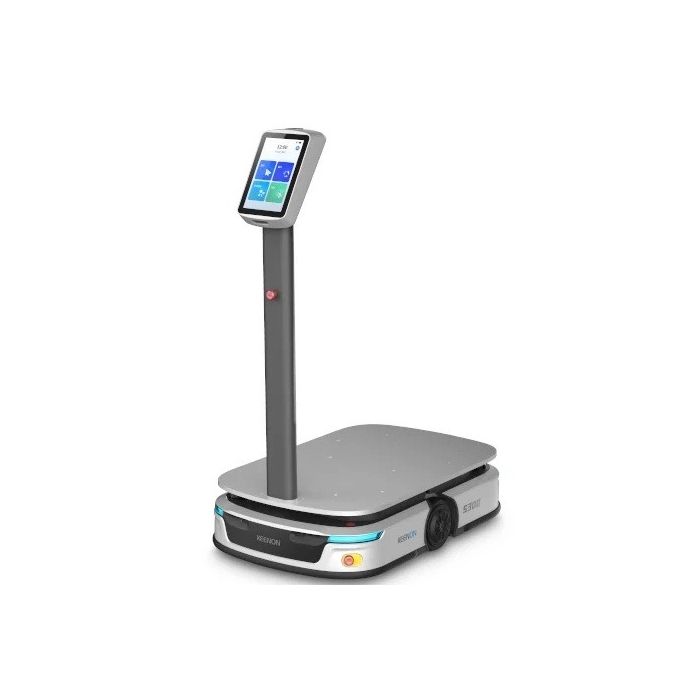
KEENON S300 Heavy-Load Intelligent Warehouse Delivery Robot with 5 Year Warranty
In stock
- BRAND:
- KEENON
- MODEL:
- S300
- ORIGIN:
- China
- Warranty:
- 60 MONTHS
- AVAILABILITY:
- ALLOW 2-4 WEEKS FOR DELIVERY
- SKU:
- KEENON-S300
KEENON S300: The 300-Kilogram Heavy-Load Intelligent Delivery Robot
The S300 complements Keenon's better-known food service robots by extending the same autonomous navigation and fleet management expertise into the most demanding logistics and industrial applications, where the task is not delivering meals between a kitchen and a dining table but moving raw materials, components, finished goods, and bulk supplies between facilities, floors, and workstations in environments designed for human and heavy equipment operation rather than consumer service.
The Industrial Material Handling Gap the S300 Addresses
Why 300 Kilograms Matters
The 300-kilogram payload distinction is commercially significant because it defines the boundary between the light-to-medium industrial logistics category, where the S100 and conventional service robots operate, and the heavy industrial and bulk supply logistics category where most autonomous mobile robots have not historically competed.
Consider the weight profiles of common industrial transport tasks: a full Eurostirrup container of steel components for automotive assembly can weigh 200 to 400 kilograms. A hospital's central supply delivery of linen, pharmaceutical stock, and medical equipment to a surgical department in a single trip regularly involves loads in the 150 to 300-kilogram range. A hotel's full laundry trolley with linens for 40 to 60 rooms weighs 150 to 250 kilograms. A manufacturing facility's raw material delivery to a production cell, including bagged granules, coiled wire, or component kits, can easily reach the 200 to 300-kilogram range per trip.
The S100's 100 to 120-kilogram capacity handles the lighter end of these categories. The S300's 300-kilogram capacity handles the full range of common industrial transport tasks in a single trip without requiring either load splitting across multiple robot runs or the manual forklift intervention that heavy loads currently require.
The One-Touch Operation Philosophy
Keenon's "A Single Touch Lifts 300kg Making Heavy Delivery Easy" marketing claim reflects the S300's operational design intent: the robot's interface is designed so that initiating a 300-kilogram load transport requires the same simple human interaction as initiating a 30-kilogram delivery. The mechanical and computational complexity of safely accelerating, decelerating, and navigating with a 300-kilogram load is handled by the robot's systems, not by the operator.
This simplicity is operationally significant in facilities where the workers who interact with the robot are production or logistics operators, not robotics specialists. A delivery robot that requires complex setup, extensive training, or IT-dependent operation creates adoption friction that undermines the productivity gains it is designed to deliver. The S300's one-touch operation and quick setup without "hassles," per Keenon's documentation, directly addresses this adoption barrier.
Design and Physical Characteristics
Structural Design for Heavy Payloads
The S300's structural engineering is driven by the requirement to safely carry and navigate with 300 kilograms of dynamic load. Industrial materials handling at this weight involves significantly different mechanical stresses than food delivery or light supply transport: acceleration and deceleration forces on a 300-kilogram payload generate substantial momentum that must be managed through the robot's chassis, braking, and load restraint systems to prevent load shifting that could create safety hazards or damage the transported goods.
The S300's industrial-grade chassis construction, described in Helping Hand Robotics' product documentation as built for "durability and long-hour usage across shifts and service cycles," uses heavy-duty structural components rated for the sustained weight and dynamic stress of repeated 300-kilogram load cycles. The design prioritizes mechanical reliability over the compact aesthetics of consumer-facing delivery robots, reflecting the industrial deployment contexts where the S300 operates.
Modular Cargo Box System
The S300 uses a modular cargo box system that can be configured for different load types and shapes. The modular design means the same S300 chassis can be equipped for different transport tasks within a single facility: a pharmaceutical box configuration for hospital supply deliveries, a flat platform configuration for component trays in manufacturing, or a deep bin configuration for bulk supply materials. This configurability extends the robot's operational versatility beyond single-task automation.
Helping Hand Robotics' product documentation confirms: "Equipped with a versatile modular cargo box that offers customizable shelving or compartments (as suggested by the visual adaptability for different tasks), ensuring secure and organized transport of various items."
Technology and Specifications
Navigation: SLAM and LiDAR Fusion
The S300 uses the same foundational navigation technology proven across Keenon's service robot product line: Simultaneous Localization and Mapping (SLAM) combined with LiDAR sensing. The LiDAR sensor emits 360-degree laser pulses, measuring distances to surrounding walls, equipment, and obstacles to build a real-time geometric map of the operating environment. SLAM continuously tracks the robot's position against this map, enabling autonomous navigation through factory floors, warehouse aisles, hospital corridors, and hotel service areas without GPS or external positioning infrastructure.
The GEROBOTICS German distributor product page specifically confirms "VSLAM-Navigation" for the S300, indicating that Visual SLAM supplements the laser-based positioning for environments where visual landmarks provide additional positioning accuracy. This VSLAM capability is relevant in environments like hospital corridors and hotel service areas where visual features such as doorways, wall markings, and architectural elements provide reliable positioning references beyond what laser geometry alone provides.
360° Safety Shield
The S300's "360° Safety Shield" is a comprehensive safety architecture that encompasses multiple sensing and response modalities:
Dual stereo vision sensors provide three-dimensional obstacle detection across the robot's full perimeter, detecting the size, shape, and depth of obstacles rather than only their presence or absence. This 3D detection enables more accurate safety zone calculation and allows the robot to distinguish between obstacles it can safely stop for, obstacles that require route replanning, and obstacles that require emergency halt.
Dynamic safety zones configure themselves adaptively based on the robot's current speed and load: at higher speeds or with heavier loads, the safety zone extends further ahead to provide the additional stopping distance that momentum requires. At lower speeds or stationary, safety zones contract to allow closer approach by people performing loading and unloading operations.
Emergency stop systems provide hardware-level immediate halt capability for situations where software safety responses are insufficient. The emergency stop bypasses the navigation software to directly cut motor power, ensuring a reliable safety backstop independent of the robot's computing systems.
This multi-layer safety approach enables the S300 to operate in shared workspaces where human workers, forklifts, pallet jacks, and other equipment are simultaneously active, which is the operational reality in most industrial facilities where AMR deployment is economically valuable.
Offline Control: Operation Without Network Dependency
Keenon specifically highlights "Offline Control, Uninterrupted Operation" as a key S300 capability, reflecting a practical consideration in industrial environments: factory floors, hospital basements, and warehouse interior areas frequently have variable or absent wireless network coverage. An autonomous robot that requires continuous network connectivity for its navigation and task management functions will fail or stop whenever network coverage drops, creating operational interruptions that undermine the reliability case for automation.
The S300's offline control capability means the robot continues to operate and complete its current tasks even when network connectivity is interrupted. Navigation decisions, obstacle avoidance, and task execution proceed using the robot's onboard systems and the locally stored facility map, with network connectivity used for fleet management, task assignment, and operational monitoring but not required for safe navigation and delivery execution.
This offline resilience is particularly important in facilities that are evaluating a first AMR deployment and where wireless infrastructure investment may lag the robot deployment timeline.
Dynamic Auto-Planning
The S300's dynamic auto-planning capability continuously recalculates optimal routes in response to environmental changes rather than following a fixed pre-programmed path. When a forklift, another robot, a mobile equipment cart, or a group of workers blocks the S300's planned route, the robot's path planning algorithm evaluates alternative routes and selects the optimal path to the destination given the current obstacle configuration. This replanning happens in real time without operator intervention, enabling the robot to maintain delivery progress in the dynamic obstacle environments characteristic of industrial operations.
This capability is directly relevant for the heavy-payload context of the S300: a 300-kilogram load cannot be safely stopped as quickly as a lighter payload due to momentum, making early obstacle detection and proactive route replanning more important than reactive emergency stopping for maintaining both safety and operational efficiency.
Applications and Use Cases
Manufacturing and Industrial Facilities
The S300's primary application domain is manufacturing and industrial facilities where heavy components, raw materials, and finished goods require regular transport between receiving areas, storage locations, production workstations, quality inspection stations, and dispatch staging areas. In automotive manufacturing, pharmaceutical production, electronics assembly, and food and beverage processing, these transport tasks represent a significant labor investment and, for heavy loads, a significant ergonomic injury risk.
The S300 handles the heavy load transport function autonomously, eliminating the ergonomic injury exposure from manual heavy lifting while maintaining the flexible routing and dynamic obstacle avoidance that conveyor belt and fixed automation systems cannot provide in mixed-use industrial environments.
MotionMiners' product analysis specifically describes the S300 in a Beat Robotics context, identifying it as addressing logistics automation in manufacturing environments where process intelligence and robotic transport work together to optimize material flow.
Hospital and Healthcare Logistics
Hospitals require regular bulk transport of pharmaceutical stock, sterile instrument sets, linen supplies, meals for in-patient service, and equipment between central supply, sterilization, pharmacy, laundry, kitchen, and clinical areas. These transport tasks are typically performed by dedicated transport staff or, in smaller facilities, by clinical staff redirecting time from patient care.
The S300's 300-kilogram payload handles the weight range of full-facility hospital supply deliveries that the S100's 100-kilogram limit cannot accommodate in a single trip. A single S300 trip from central supply to a large surgical department can transport the complete supply requirement that a human transport worker would require multiple trolley loads to complete, reducing both the number of trips and the associated human labor hours per shift.
Large Hotels and Hospitality Facilities
Hotels require heavy transport of linen, amenity supplies, food service equipment, and guest baggage between service areas, laundry facilities, housekeeping storage, and guest floors. Full linen trolleys for a large hotel property are among the heaviest items regularly transported by hotel staff, and the ergonomic injury risk from this task is well-documented in hospitality industry health and safety literature.
Hero LifeCare's hotel application documentation for Keenon's heavy-load platforms notes: "use the S100 in resorts to deliver bags to rooms with ease and impress your guests at the same time as you reduce labor costs." The S300 extends this application to the highest-weight hotel transport tasks, including full trolleys of room linen for a large hotel floor and heavy food service equipment transport between kitchen and banquet facilities.
Warehouses and Distribution Centers
Warehouse and distribution center applications are the most straightforward fit for the S300's capabilities. The movement of goods between receiving docks, storage locations, picking stations, and dispatch areas involves the full weight range that the S300 addresses, from light parcel pallets to heavy goods pallets. The S300's dynamic auto-planning is particularly valuable in warehouses where forklift activity, seasonal volume changes, and product variety create highly dynamic obstacle environments that fixed automation cannot accommodate.
Advantages and Benefits
300-kilogram payload covers the full range of common industrial transport weights: A single S300 can handle the complete payload requirements of hospital supply runs, automotive component deliveries, hotel linen transport, and bulk raw material movements that the S100 cannot carry in a single trip, reducing robot trip frequency and the number of units required for a given facility's transport volume.
Offline control for reliable operation in real industrial environments: The ability to operate without continuous network connectivity addresses the practical reality of factory and hospital environments where wireless coverage is variable, enabling reliable deployment without requiring network infrastructure investment ahead of robot deployment.
360° safety shield for safe shared-workspace operation: The multi-layer safety architecture, combining 3D obstacle detection, adaptive safety zones, and hardware emergency stop, enables S300 deployment in the industrial workspaces shared with people and other equipment where most of its commercial value is generated.
Dynamic auto-planning for operational continuity: Real-time route replanning in response to dynamic obstacles maintains delivery progress without operator intervention, which is the operational requirement for autonomous robots to deliver productivity gains rather than requiring dedicated human supervision.
Single-touch operation reduces operator training requirements: The simple human interface concealing the robot's navigational and mechanical complexity enables operation by production and logistics workers without specialist robotics training, accelerating deployment and adoption.
Backed by Keenon's global service infrastructure: Keenon's wholly-owned subsidiaries in the US, Germany, UAE, Japan, South Korea, and Hong Kong, combined with 60-plus country deployment experience, provide the global service infrastructure that industrial buyers require for long-term technology platform commitments.
Summary
The KEENON S300 extends Keenon Robotics' proven autonomous navigation and fleet management technology to the 300-kilogram heavy-load industrial delivery category, addressing the material handling tasks that the S100's 100-kilogram capacity cannot fulfill in a single trip. Its five-point value proposition, one-touch simplicity for 300-kilogram loads, dynamic auto-planning for real industrial environments, offline operation without network dependency, quick deployment without infrastructure modifications, and 360-degree safety shield for shared workspaces, directly addresses the practical adoption barriers that have historically limited heavy-load AMR deployment in industrial settings. Available through Keenon's global distribution network including GEROBOTICS in Germany and Helping Hand Robotics in North America, and backed by Keenon's 15-year experience as the world's leading commercial service robot manufacturer, the S300 is the most commercially accessible and globally supported 300-kilogram autonomous delivery robot available from an established manufacturer in 2026.
Frequently Asked Questions (FAQ)
What is the KEENON S300?
The KEENON S300 is a heavy-duty autonomous mobile robot (AMR) developed by KEENON Robotics Co., Ltd. for industrial material handling with a payload capacity of 300 kilograms (661 pounds). It uses SLAM and Visual SLAM (VSLAM) navigation for autonomous operation in factories, warehouses, hospitals, hotels, and large commercial facilities. Key features include dynamic auto-planning for real-time obstacle response, offline control capability for operation without continuous network connectivity, a 360-degree safety shield combining dual stereo vision, adaptive safety zones, and emergency stop systems, modular cargo box configurations for different load types, and single-touch operation for simple deployment by non-specialist operators.
How does the KEENON S300 navigate and carry 300-kilogram loads safely?
The S300 uses SLAM-based LiDAR navigation combined with Visual SLAM for real-time facility mapping and autonomous positioning. Its 360-degree safety architecture detects obstacles across the full robot perimeter using dual stereo vision sensors, adapts safety zones dynamically based on current speed and load (extending zones at higher speed for the longer stopping distance that 300-kilogram momentum requires), and maintains hardware emergency stop as a backup independent of software systems. Dynamic auto-planning continuously recalculates routes in response to environmental changes, enabling proactive obstacle avoidance rather than reactive stopping, which is more important for heavy loads where braking distance is longer.
Why is the KEENON S300 important for industrial facilities?
The S300 addresses the material handling weight range where manual human transport carries the highest ergonomic injury risk and where the S100's 100-kilogram limit requires multiple trips per delivery. A 300-kilogram capacity covers the complete payload of most common industrial transport tasks in a single autonomous trip: automotive components, bulk pharmaceutical supplies, hotel linen loads, and heavy raw materials. The offline control capability makes it deployable in factory and hospital environments with variable wireless coverage. And the single-touch operation enables deployment by production and logistics workers without specialist training, reducing the skills and organizational barriers to adoption.
What is the difference between the KEENON S100 and KEENON S300?
The S100 (100 to 120-kilogram payload) and S300 (300-kilogram payload) form Keenon's heavy-load robot family. Both use SLAM/LiDAR navigation, modular cargo systems, and industrial-grade construction. The S300's 300-kilogram payload capacity covers transport tasks that exceed the S100's limit, including full automotive component deliveries, bulk hospital supply runs in a single trip, complete hotel linen loads, and heavy raw material deliveries. For facilities where individual load weights stay consistently under 120 kilograms, the S100 is the appropriate choice. For facilities where loads regularly reach or exceed 120 kilograms, the S300 is required. Mixed facilities can deploy both models within a coordinated fleet managed through Keenon's fleet management platform.
Specifications
- Dimensions: 925×640×1282 mm (W × D × H)
- Weight: 115 kg (including battery)
- Compatible Shelf Dimensions: 1200 × 1200 mm (W × D)
- Max. Payload: 300 KG
- Loading Platform Dimensions: 860 × 600 mm (W × D)
- Charging Time: 3.5 h
- Chassis Ground Clearance: 230 mm
- Battery Life: 6 h
Keenon S300 300 kg heavy-load intelligent delivery robot
Official Keenon source highlights
- Supports direct, cyclic, multi-point and transportation task modes.
- 360-degree safety protection using stereo vision, two LiDARs, VSLAM and emergency stop buttons.
- Offline operation, app management, quick battery replacement and multi-robot scheduling up to 20 devices.
Source-backed specifications
| Robot dimensions | 925 x 620 x 1282 mm |
|---|---|
| Robot weight | 115 kg |
| Load capacity | 300 kg |
| Maximum movement speed | 1 m/s, no load |
| Runtime | Up to 6h at full load |
| Charging time | 3.5h from 0-100% |
| Battery capacity | DC48V 15Ah |
| Battery type | Ternary lithium battery |
| Chassis ground clearance | 23 cm |
| Slope angle | <=5 degrees |
| Operating temperature and humidity | 0-45°C, RH 5%-95% |
| Network | 4G/Wi-Fi |
Updated from the official Keenon Drive product materials supplied for this catalogue refresh.