Keenon DINERBOT T11 Marketing Expert in Narrow-Aisle Delivery Robot with 5 Year Warranty
In stock
- BRAND:
- KEENON
- MODEL:
- DINERBOT T11
- ORIGIN:
- China
- Warranty:
- 60 MONTHS
- AVAILABILITY:
- ALLOW 2-4 WEEKS FOR DELIVERY
- SKU:
- KEENON-T11
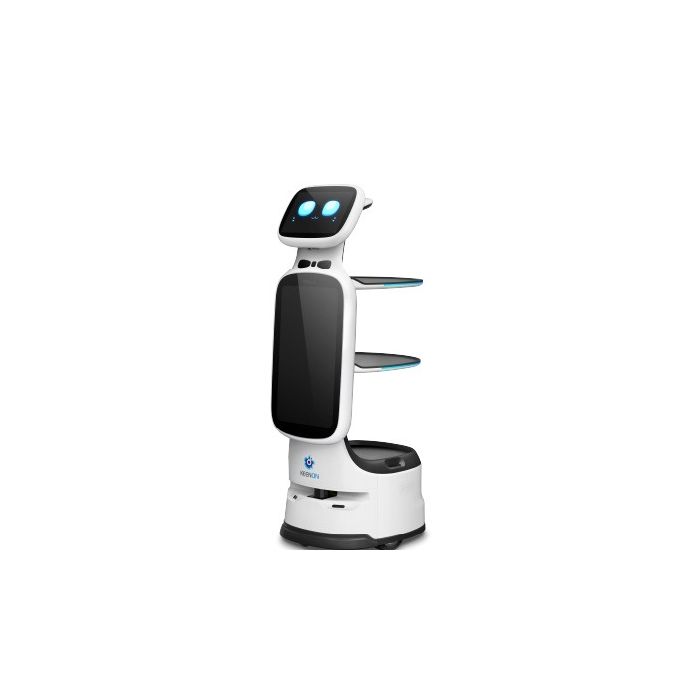
Keenon DINERBOT T11: The 49-Centimeter Narrow-Aisle Marketing and Delivery Robot
The T11's 49-centimeter minimum passage width meaningfully differentiates it from every other DINERBOT in the lineup. The T10's minimum passage is 59 centimeters. The T8's minimum passage is 55 centimeters. The T9's standard deployment requires approximately similar clearance to the T8. The T11's additional 6 to 10 centimeters of navigation compactness, compared to its immediate competitors, opens a specific category of venue that the T10 and T8 cannot reliably serve: the cafes, bistros, izakayas, and boutique retail venues that are built into historical European and Asian commercial buildings with aisle widths that fall between 49 and 55 centimeters.
OKMbot's German distributor documentation confirms the T11's positioning in this context explicitly: "Expert for precise deliveries in the bustling, narrow areas. The Keenon Dinerbot T11 is designed to be a safe and smooth Navigation, even with minimal passage widths of only 49 cm." Jobtorob's product analysis captures the T11's dual commercial role: "The marketing robot DINERBOT T11 sets a new standard as a marketing and delivery expert for narrow-aisle spaces. This autonomous robot redefines precision with collision-free navigation and seamless operation in environments as narrow as 49cm aisles."
The 49-Centimeter Navigation Threshold: Why It Matters
The Commercial Estate of Narrow Venues
The DINERBOT lineup's progressive improvement in minimum passage width, from the T9's approximately 60-centimeter requirement through the T8's 55-centimeter capability to the T11's 49 centimeters, reflects a deliberate engineering effort to access a segment of the commercial venue market that the majority of restaurant robots cannot enter.
The commercial estate of 49-centimeter aisles includes: cafes in historical European city centers where building structures date to periods before automotive traffic and building codes did not mandate wide corridor access; Japanese izakayas and ramen restaurants where narrow counter service with tight table spacing is the deliberate design language; boutique restaurants with 15 to 40 covers where intimate spacing is part of the value proposition; Korean barbeque venues where table arrangements create narrow service corridors between rows; and small commercial kitchens in airports, hospitals, and office buildings where service areas were designed for human single-file passage without equipment clearance.
A delivery robot that requires 55 or 60 centimeters of clear aisle width effectively excludes many of these venues from the economics of restaurant delivery automation: the robot physically cannot navigate the aisle, so the labor efficiency case cannot be made. The T11's 49-centimeter capability changes this calculation for the entire category of venues with aisles between 49 and 55 centimeters, which is a commercially meaningful population of establishments, particularly in Europe and Asia where the restaurant building stock skews older and narrower than in newer commercial districts.
The Six-Wheel Shock-Absorbing Chassis
Dominiondrones.com's product documentation specifically highlights the T11's "six-wheel shock-absorbing chassis prevents spills during sudden stops," a mechanical design detail that reflects the operating conditions of narrow-aisle navigation. In narrow aisles, the T11 encounters obstacles and course corrections more frequently than it would in open dining rooms, because the margin between the robot's body and the nearest obstacle is smaller. Each course correction and each stop-to-avoid-obstacle event creates a lateral force on the robot's cargo that a standard suspension system must absorb to prevent beverage spillage and food displacement.
The six-wheel chassis distributes this stabilization function across more contact points than a four-wheel design, providing more even shock distribution and greater resistance to the pitching and rolling motions that sudden stops create in narrow corridor navigation. For a robot carrying beverages in glasses through a 49-centimeter aisle where sudden stops for pedestrians and furniture legs are frequent, this chassis design is the mechanical prerequisite for spill-free delivery.
Design and Customization System
The Personality Customization Framework
The T11's most commercially distinctive feature compared to other DINERBOT models is its personality customization system. Dominiondrones.com's documentation confirms: "Customize its personality with interchangeable ears, expressions, and voices." OKMbot's description adds: "The Sensors can detect the environment in real time and allow for a gentle, autonomous control."
This customization depth, covering physical accessories (interchangeable ears), digital facial expression settings, and voice profile selection, enables restaurant and retail operators to configure the T11 as a brand-specific mascot character rather than a generic service robot. A restaurant with a rabbit-themed brand concept can equip the T11 with rabbit ears and a warm, energetic voice. A sleek modern café can remove accessories and set a minimalist expression profile for a more aesthetic-forward visual identity. A children's restaurant can configure a playful, high-energy expression and voice system that entertains young guests during the delivery interaction.
This customization addresses one of the documented friction points in restaurant robot adoption: the resistance of owners with strong design identities to introduce generic industrial hardware that conflicts with the aesthetic and brand language of their venue. The T11's personality system resolves this resistance by giving operators the tools to make the robot part of their brand rather than a visual foreign body within it.
The 18.5-Inch Advertising Display
The T11's 18.5-inch advertising display serves the same commercial function as the T10's 23.8-inch screen: generating in-venue marketing impressions throughout the robot's service shifts, creating promotional value alongside the labor cost substitution that all DINERBOT platforms deliver.
The T11's screen is smaller than the T10's at 18.5 versus 23.8 inches, reflecting the design trade-off between advertising display size and the narrow body profile that 49-centimeter navigation requires. The T11's compactness is the defining design constraint, and the advertising screen is sized to be effective within that constraint rather than maximizing screen size at the expense of the narrow navigation capability.
Jobtorob's documentation describes the advertising capability as a core commercial feature: "Designed as a marketing robot and an advertising robot, the DINERBOT T11 features a sleek 18.5" display to maximize customer engagement."
Technology and Specifications
Five Stereo Vision Sensors with VSLAM Fusion
The T11's navigation system uses five stereo vision sensors combined with VSLAM (Visual Simultaneous Localization and Mapping) fusion. Jobtorob's documentation confirms: "Equipped with advanced five stereo vision sensors with VSLAM fusion, this AI robot ensures maximum efficiency and agility."
The five-sensor array, compared to the T10's five sensors and four RGB cameras, and the T8's three stereo vision sensors plus LiDAR, provides the environmental sensing coverage needed for the T11's 49-centimeter narrow navigation challenge. In a 49-centimeter aisle, the lateral clearance between the robot's body and the aisle walls or furniture is measured in centimeters rather than tens of centimeters. This tight clearance requires the navigation system to detect and respond to lateral obstacles with more precision than open-aisle navigation demands.
The VSLAM component adds visual feature tracking to the stereo depth sensing, enabling the navigation system to maintain precise positional awareness in the visually rich environments of narrow dining spaces where distinctive wall features, furniture patterns, and lighting fixtures provide reliable visual landmarks for positioning.
OKMbot's documentation describes the navigation outcome: "Thanks to VSLAM-Fusion and five Stereo-Vision Sensors, the T11 navigates unerringly through very tight spaces. The Sensors can detect the environment in real time and allow for a gentle, autonomous control."
Millisecond-Level Decision Algorithms
The T11's obstacle avoidance system uses "multi-modal 3D vision combined with milliseconds-level decision algorithms," confirmed by both Jobtorob and OKMbot. The millisecond-level decision time is directly relevant for narrow-aisle navigation: when the robot is operating within centimeters of furniture and walls, the time between obstacle detection and course correction determines whether the robot avoids a contact or creates a collision.
In open dining rooms, a robot with longer decision latency can detect an obstacle farther ahead and change course with comfortable margin. In 49-centimeter aisles, obstacles appear closer before they are detectable by sensors at the robot's current speed, and the available response time is shorter. Millisecond-level decision algorithms compress the obstacle-to-response cycle to the minimum practical time, enabling the T11 to navigate its tight operating environment without the precautionary speed reduction that would be required to compensate for slower decision processing.
AI-Powered Self-Pickup with 99% Tray Detection Accuracy
Dominiondrones.com's documentation highlights: "AI-powered self-pickup (over 99% tray detection accuracy) and continuous self-learning." The 99-plus percent tray detection accuracy means the T11 correctly identifies when a customer has collected their order from the tray in more than 99 of 100 delivery encounters, enabling it to confirm delivery completion and proceed to the next task without requiring staff confirmation or manual input.
The "continuous self-learning" component of this system means the tray detection model improves its accuracy through operational data collected during service: each delivery creates training data that refines the model's understanding of the visual and sensor patterns associated with tray collection. Over an extended deployment, the T11's tray detection accuracy improves as the model accumulates experience with the specific tray types, lighting conditions, and customer interaction patterns of the deployment venue.
Applications and Use Cases
European Bistros and Historical Venue Restaurants
The T11's 49-centimeter minimum passage is specifically relevant for European cities where restaurant and café spaces occupy historical buildings with floor plans dating to centuries before automotive infrastructure created expectations for wide commercial corridors. In Paris, Lisbon, Prague, and hundreds of other European cities with dense historical centers, cafes and bistros operating in 18th and 19th-century ground-floor commercial spaces regularly have service aisles of 50 to 60 centimeters between table rows. The T8's 55-centimeter minimum passage already extends robot deployment to many of these venues; the T11's 49 centimeters extends it further to the tightest historical floor plans.
Japanese and Korean Dining Formats
Japanese izakayas, ramen restaurants, sushi counters, and Korean barbecue venues share a design language of intimate spacing that is culturally deliberate rather than a building constraint. Counter seating with narrow service paths, table rows with 50-centimeter gaps between the back of one chair and the front of the next row, and galley-style service corridors define the spatial reality of these formats. The T11's 49-centimeter navigation enables deployment in authentic examples of these formats rather than only the larger footprint adaptations designed for Western market preferences.
Boutique Cafes and Specialty Coffee Venues
The specialty coffee and boutique café segment represents a large and growing category of food service businesses globally, typically operating in small spaces of 30 to 80 square meters with compact table arrangements and design-forward interiors where every visual element is curated. The T11's personality customization system is directly relevant for this segment: a specialty coffee operator who has invested in a distinctive visual identity for their space will respond better to a robot that can be configured to complement that identity than to a generic industrial-looking service machine.
Shopping Mall Kiosks and Food Courts
The T11's "marketing expert" positioning, centered on its 18.5-inch advertising display, is particularly relevant for shopping mall food court and kiosk operators where visibility across the busy food court environment and the ability to display dynamic promotional content creates advertising value. In a food court where multiple operators compete for attention across a crowded common area, a robot displaying branded content while navigating between tables creates advertising impressions at eye level throughout the service shift.
Advantages and Benefits
49-centimeter minimum passage: the narrowest in the DINERBOT lineup: The T11 accesses venues that the T10 (59 cm), T8 (55 cm), and T9 (approximately 60 cm) cannot, opening an entire category of historical European buildings, intimate Asian dining formats, and boutique commercial spaces to restaurant delivery automation.
Five stereo vision sensors plus VSLAM for precision narrow-aisle navigation: The sensing density and fusion algorithm provide the environmental awareness needed for confident, collision-free operation in the tight lateral clearances of 49-centimeter aisles, where less dense sensing systems would require precautionary speed reductions.
99%-plus tray detection with continuous self-learning: The AI-powered collection detection eliminates the staff confirmation step from the delivery completion workflow, and the continuous learning means tray detection accuracy improves over the robot's deployed operational life.
Six-wheel chassis for spill prevention in narrow-aisle stop-and-start: The six-wheel shock-absorbing chassis is engineered for the frequent course corrections and sudden stops that narrow-aisle navigation requires, preventing cargo spillage in the operating conditions where the T11 is specifically deployed.
Personality customization for brand alignment: Interchangeable ears, configurable expressions, and voice profile selection enable operators to configure the T11 as a brand asset rather than a generic service machine, reducing aesthetic resistance to robot adoption in design-sensitive venues.
USD $14,500 pricing at the entry of the T11/T10 generation: At USD $14,500 compared to the T10's USD $23,000 at ProServBots, the T11 delivers the generation's sensor density and marketing capability at approximately 63 percent of the T10's price, with the additional advantage of 10-centimeter narrower passage capability.
Summary
The Keenon DINERBOT T11 is the most navigation-compact marketing and delivery robot in KEENON's current commercial lineup, navigating to 49-centimeter minimum passage widths where the T10, T8, and T9 cannot operate. Its five stereo vision sensors with VSLAM fusion provide the sensing density and decision speed needed for collision-free navigation in these tight operating conditions. The 18.5-inch advertising display provides marketing ROI alongside delivery efficiency. The 99-plus percent AI tray detection with continuous self-learning minimizes staff intervention for delivery confirmation. The six-wheel shock-absorbing chassis prevents spills in the frequent stop-and-start of narrow-aisle operation. And the personality customization system enables brand-aligned configuration that reduces adoption friction in design-sensitive boutique venues. At USD $14,500, it delivers these capabilities at approximately 63 percent of the T10's published US price, making the T11 the most accessible current-generation marketing and delivery robot for the specific and commercially significant category of venues whose aisles measure 49 to 59 centimeters.
Frequently Asked Questions (FAQ)
What is the Keenon DINERBOT T11?
The Keenon DINERBOT T11 is an autonomous restaurant delivery and marketing robot developed by KEENON Robotics Co., Ltd. It is specifically designed for narrow-aisle venues with minimum passage widths of 49 centimeters, the narrowest capability in the DINERBOT lineup. Key features include five stereo vision sensors with VSLAM fusion for precision navigation, an 18.5-inch advertising display, over 99 percent AI-powered tray detection accuracy with continuous self-learning, a six-wheel shock-absorbing chassis for spill prevention, and a customizable personality system with interchangeable ears, configurable expressions, and voice profiles. US price: USD $14,500 through Useabot.
How does the DINERBOT T11 navigate 49-centimeter aisles?
The T11 uses five stereo vision sensors providing 3D depth perception across the full robot perimeter, fused with VSLAM (Visual Simultaneous Localization and Mapping) for visual feature-based positioning. OKMbot's documentation confirms: "Thanks to VSLAM-Fusion and five Stereo-Vision Sensors, the T11 navigates unerringly through very tight spaces." Millisecond-level decision algorithms process sensor data and generate course corrections faster than standard algorithms, which is critical in 49-centimeter aisles where the lateral clearance is small enough that obstacle response time determines whether the robot avoids a collision. The six-wheel shock-absorbing chassis handles the frequent stops and course corrections of tight navigation without spilling cargo.
Why choose the DINERBOT T11 over the T10 or T8?
Choose the T11 when: (1) the minimum aisle width in the venue falls between 49 and 55 centimeters, which excludes the T8 (55 cm minimum) and T10 (59 cm minimum) but which the T11 (49 cm minimum) can navigate; or (2) the venue wants the T10-generation five-sensor VSLAM navigation and 18.5-inch marketing screen capabilities at USD $14,500 rather than the T10's USD $23,000; or (3) the operator wants personality customization (interchangeable ears, expressions, voices) that the T10 does not offer. Choose the T10 when maximum advertising screen size (23.8 vs 18.5 inches) and the movable head interaction are the primary premium feature requirements. Choose the T8 when the venue's binding constraint is 55-centimeter passage and an advertising screen is not required.
What does the DINERBOT T11 personality customization include?
The T11's personality customization covers three dimensions. Interchangeable physical accessories allow operators to add or remove elements like the "ears" accessory option, changing the robot's visual silhouette to match a themed concept or branded character. Configurable expressions enable the face display to show different emotional profiles, from energetic and playful for family dining to calm and professional for corporate café environments. Voice profile selection allows the robot's verbal interaction character to be aligned with brand tone, with options ranging from warm and familiar to neutral and efficient. This customization depth is unique within the current DINERBOT generation and enables venues with strong design identities to integrate the T11 as a brand asset rather than a generic industrial machine.
Specifications
- Dimensions(WxDxH): 463 * 384 * 1123 mm
- Tray Dimensions (L × W × H): 383 × 342 × 220 mm (middle level) 383 × 342 × 285 mm (bottom level)
- Weight: 38kg
- Maximum Load Capacity: 20 kg (5 kg on middle level, 10 kg on bottom level)
- Operating Speed: Adjustable from 0.1 to 1.0 m/s
- Minimum Passage Width: 49cm
- Maximum Climbing Angle: 5°
- Battery Life: Up to 13.5H
Keenon DINERBOT T11 narrow-aisle marketing and delivery robot
Official Keenon source highlights
- 49 cm minimum passage width for narrow dining, retail and service aisles.
- Advertising screen supports video/image display and split-screen content.
- Plate detection, tray indication spotlight and confirmation button improve self-pickup guidance.
Source-backed specifications
| Robot size | 384 x 463 x 1123 mm (W x D x H) |
|---|---|
| Net weight | 38 kg with battery |
| Load capacity | 20 kg, 5 kg per upper layer and 10 kg bottom layer |
| Layer amount | 3 fixed layers |
| Moving speed | 0.1-1.0 m/s adjustable |
| Battery life | Up to 9h |
| Charging time | 5.5h |
| Minimum passage width | 49 cm |
| Operation screen | 10.1-inch |
| Advertising screen | 18.5-inch |
| Positioning method | Sensor fusion with LiDAR and VSLAM sensor |
Updated from the official Keenon Drive product materials supplied for this catalogue refresh.