Keenon DINERBOT T3 Enclosed Delivery Robot with 5 Year Warranty
In stock
- BRAND:
- KEENON
- MODEL:
- DINERBOT T3
- ORIGIN:
- China
- Warranty:
- 60 MONTHS
- AVAILABILITY:
- ALLOW 2-4 WEEKS FOR DELIVERY
- SKU:
- KEENON-T3
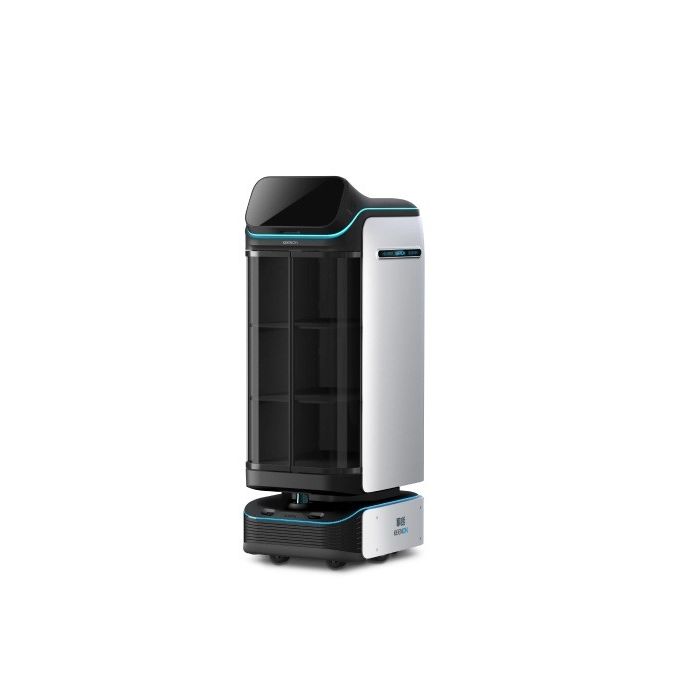
Keenon DINERBOT T3: The Healthcare and Premium Dining Enclosed Delivery Robot
The T3 occupies a specific and well-defined position in the KEENON product ecosystem: it is the platform that serves the intersection of food service and healthcare delivery, where the delivery robot must meet both the operational throughput requirements of commercial food service and the infection control, access control, and contamination prevention requirements of healthcare-adjacent environments.
The Healthcare Context That Shaped the T3
Keenon's 100-Hospital COVID-19 Deployment
When COVID-19 required Chinese hospitals and quarantine centers to minimize contact between medical staff and infected patients, Keenon deployed delivery robots to over 100 hospitals and quarantine centers, confirmed in Keenon's official company history. This deployment required robots that could deliver meals, medications, and supplies to isolation rooms without requiring staff to enter patient areas for routine deliveries.
The specific operational requirements of that deployment, contactless delivery, enclosed contents to prevent airborne contamination risk, access-controlled opening to prevent unauthorized retrieval, and cleanable interior surfaces for cross-contamination prevention between patients, are precisely the design requirements that the T3 addresses. The T3 is, in an operational sense, the product that emerged from Keenon's direct learning from hospital and quarantine center delivery during the period when infection control was the most visible operational requirement in the service robot market.
The Robot Report's 2020 coverage of Keenon's COVID-19 response documented the company's disinfection robot deployed in hospitals using UV-C lamps, noting that Keenon's Director of Global Sales described effective results against 99.9 percent of bacteria. The T3's induction UV disinfection lamp directly applies this validated disinfection technology to the food delivery context, extending the same pathogen-reduction approach from dedicated disinfection robots into the delivery robot that carries food and supplies to patients and residents.
The Peer-Reviewed Case for UV Disinfection
A 2025 Journal of Field Robotics systematic review on UV-C disinfection robots, published in Wiley Online Library, documents the expanding use of ultraviolet disinfection robots across hospitals, schools, public transportation, and high-traffic areas since COVID-19. The review confirms that UV-C disinfection at appropriate irradiance levels and exposure times achieves effective bacterial reduction in healthcare settings, validating the disinfection approach that the T3's induction lamp employs between delivery cycles.
For healthcare facility procurement managers evaluating the T3, this peer-reviewed literature provides an independent scientific basis for the UV disinfection lamp's effectiveness that goes beyond Keenon's own marketing claims.
Design for Healthcare and Premium Service
The Enclosed Cabin as an Infection Control Design Decision
The T3's enclosed cabin is not merely a presentation feature. In healthcare delivery contexts, the physical enclosure of items in transit addresses a specific contamination pathway that open-tray delivery cannot prevent: airborne and contact contamination during the journey from kitchen to patient room.
In a hospital or aged care facility, a delivery robot traveling through shared corridors passes through spaces occupied by patients with diverse health conditions, including active infections. An open tray of food passing through these spaces is exposed to the ambient air of every corridor it traverses. An enclosed cabin with automatically opening doors at the destination maintains the sealed environment of the food from kitchen dispatch to patient receipt, reducing the exposure of the food to the ambient contamination of shared spaces.
This design rationale is the same as that behind the covered tray systems used in hospital meal delivery: the cover is not for temperature retention alone but for contamination prevention during transit. The T3's enclosed cabin provides a more complete version of this protection than a simple cover, because the entire cabin is sealed rather than having an exposed base tray beneath a cover.
Automatic Doors: The Contactless Delivery Mechanism
The T3's step-activated automatic doors provide fully contactless delivery: a person standing in the specified activation zone in front of the compartment causes the door to open without any physical contact with the robot or its exterior surfaces. This contactless mechanism was designed for the post-COVID awareness that physical contact with shared surfaces in service environments creates contamination risk, but it has broader operational value for delivery in any context where touch surfaces are a hygiene consideration.
The password-protected opening mode adds access control to the contactless delivery: the compartment door opens only when the correct PIN is entered, ensuring that a supply delivered for a specific patient or room can only be retrieved by the person who knows that room's delivery PIN. For pharmaceutical supply delivery in aged care, this controlled access prevents accidental or unauthorized retrieval of medications intended for a specific resident.
Specifications: What Procurement Managers Need to Know
Verified Key Specifications
Confirmed across multiple international distributor listings (Robot Warehouse, Useabot, ChipSilicon, AutomationPro):
Cabin volume: 180 liters
Door activation: Step-activated (contactless) + password-protected (access-controlled)
Internal layer heights: Adjustable to 23 cm (9.06"), 38 cm (14.96"), or 69 cm (27.17")
Disinfection: Induction UV lamp (within enclosed cabin, activated between delivery cycles)
Navigation: KEENON CORE TECHNOLOGY SLAM + LiDAR + 3D perception
Obstacle avoidance: 3D perception with instant response
Chassis: Tri-patent design with vehicle-grade CAE-simulated suspension
Fleet coordination: Patented multi-robot dispatching algorithms
Interior maintenance: All compartment parts fully detachable for cleaning
The Three-Layer Height System for Healthcare Supply Diversity
The T3's three adjustable layer heights (23 cm, 38 cm, 69 cm) are not arbitrary: they correspond to the main height categories of items that hospital and aged care food service and supply delivery routinely involves:
The 23-centimeter layer accommodates standard meal trays, dinner plates, soup bowls, and flat-profile food service items. This is the default meal delivery height for standard hospital and aged care plated meal service.
The 38-centimeter layer accommodates beverage service in cups or glasses, medications in blister packs or dispensing cups, dressing supplies in medium-profile packaging, and covered meal service with elevated cloches for temperature retention.
The 69-centimeter tall compartment (with layers removed or set to maximum height) accommodates IV bags, infusion equipment, large pharmaceutical packages, multi-item supply deliveries, and tall items that would not fit in the standard layer configurations.
This height flexibility means the same T3 unit can be configured for the specific supply profile of any individual delivery run across the day: a standard lunch meal service at 23 centimeters, an afternoon medication round at 38 centimeters, an evening supplies restocking at 69 centimeters.
Deployment Contexts: A Procurement Guide
Hospital and Healthcare Facility Food Service
The T3's primary healthcare deployment context is hospital and healthcare facility food service: delivering patient meals from the central kitchen to ward delivery points or individual room delivery, where the enclosed cabin maintains food hygiene across the journey and the UV lamp disinfects the cabin between patients' meal cycles.
Keenon's official timeline confirms the medical delivery robots M1 and M2 were launched separately for dedicated hospital supply delivery, while the T3 is positioned at the intersection of food service and healthcare. This positioning makes the T3 appropriate for hospital cafeterias serving ambulatory patients, aged care facility dining service, healthcare private hospitals with food as a service quality differentiator, and rehabilitation centers where meal presentation quality contributes to patient well-being.
For healthcare procurement managers, the T3's advantage over the dedicated medical delivery platforms is its dual applicability: the same unit that delivers patient meals during service periods can deliver supplies during off-peak hours, using the same enclosed cabin with password protection for controlled access to specific deliveries.
Aged Care Facility Dining and Amenity Delivery
Australian aged care facilities specifically, as documented by HIT Equipment International's identification of aged care as a T3 target market, represent a deployment context where the combination of infection control standards, resident vulnerability to contamination, access control for medication management, and the desire to free care staff from transport tasks creates a compelling case for the T3 over open-tray alternatives.
The Aged Care Quality and Safety Commission's quality standards require demonstrable hygiene management in food service, and the T3's enclosed cabin with UV disinfection between cycles provides an auditable hygiene practice for the delivery phase that open trays cannot document equivalently.
Large Restaurant Multi-Course Service
The T3's documented positioning for "big restaurants and hotel dining halls" reflects the second major deployment context: large-format food service where the enclosed delivery creates service theater for multi-course dining, maintains dish temperature by limiting exposure to ambient air during transit, and enables multi-table course delivery without the contents of any compartment being visible to other tables' guests during the robot's navigation of the dining room.
For restaurants where multi-course progression is part of the dining experience, the T3's enclosed compartments enable course delivery to be a staged reveal rather than an open display during transit, which is a meaningful service quality consideration in premium casual and fine casual dining operations.
Hotel Room Service as an Alternative to the BUTLERBOT W3
Within Keenon's own product lineup, the T3 and the BUTLERBOT W3 both serve hotel delivery, but for different hotel environments:
The BUTLERBOT W3 is the dedicated hotel room service robot, with enclosed compartments designed for room-to-room multi-floor delivery via elevator integration. It is the right choice when the delivery journey requires autonomous multi-floor navigation through hotel corridors and elevators to individual guest rooms.
The T3 is better suited for hotel dining room and F&B service where the delivery stays within the dining areas and restaurant floors rather than navigating to individual rooms. A hotel property with both a restaurant operation and in-room dining might deploy the T3 for the restaurant and the BUTLERBOT W3 for in-room delivery, using different platforms optimized for their specific deployment contexts within the same property.
Advantages Over Open-Tray Delivery Robots
UV disinfection between cycles for healthcare-grade inter-delivery sanitation: The induction UV lamp activates between delivery cycles within the closed cabin, reducing microbial load on interior surfaces in a way that open-tray cleaning protocols cannot replicate during active service periods.
Step-activated contactless doors reduce surface contact in shared spaces: The touchless opening mechanism addresses the persistent post-COVID awareness that physical contact with shared surfaces in service environments carries contamination risk, providing a delivery experience that requires zero touch from recipient to robot.
Password access control for medication and sensitive supply delivery: The PIN-required opening mode enables controlled access delivery where only the specific intended recipient can retrieve their delivery, which is operationally necessary for pharmaceutical supply delivery in aged care and clinical settings.
Fully detachable interior for professional hygiene cleaning: All internal T3 compartment components detach for thorough cleaning between service cycles, meeting the hygiene audit requirements of healthcare facility inspections and food service regulatory compliance.
180-liter capacity for high-volume healthcare round efficiency: The large enclosed volume enables the T3 to carry a full ward's meal delivery or a complete supply restocking round in a single robot trip, reducing the number of trips per shift and the associated time cost relative to smaller-capacity enclosed delivery options.
Summary
The Keenon DINERBOT T3 is the most operationally qualified enclosed delivery robot in KEENON's commercial portfolio for the healthcare, aged care, and premium dining segments where open-tray delivery creates genuine hygiene, access control, and contamination management limitations. Its design reflects Keenon's direct learning from deploying delivery robots to over 100 hospitals and quarantine centers during COVID-19, translated into a commercial product that serves both the food service operational requirements of large restaurants and hotel dining halls and the infection control, access control, and contamination prevention requirements of healthcare and aged care facility deployment. The 180-liter cabin, step-activated and password-secured doors, adjustable three-height layer system, induction UV disinfection lamp, fully detachable cleaning components, and KEENON CORE TECHNOLOGY navigation make the T3 the enclosed delivery robot most fully specified for the buyers whose deployment requirements go beyond what open-tray platforms can provide.
Frequently Asked Questions (FAQ)
What makes the DINERBOT T3 suitable for hospital and healthcare environments?
The DINERBOT T3 is appropriate for healthcare delivery contexts for four specific reasons rooted in its design. The 180-liter fully enclosed cabin prevents airborne and contact contamination of food and supplies during transit through shared hospital corridors. The induction UV disinfection lamp activates between delivery cycles to reduce microbial load on interior surfaces, validated by peer-reviewed research on UV-C effectiveness in healthcare settings. The password-protected access control limits retrieval to authorized recipients, which is operationally necessary for controlled pharmaceutical supply delivery. And all internal compartment components are fully detachable for thorough cleaning, meeting the hygiene audit requirements of healthcare regulatory inspections.
How does the DINERBOT T3 UV disinfection lamp work?
The T3's induction UV disinfection lamp operates within the enclosed cabin during the periods between active delivery cycles. Ultraviolet-C (UV-C) light at wavelengths around 253.7 nanometers damages the DNA of bacteria, viruses, and fungi, rendering them unable to reproduce and effectively reducing the microbial load on exposed surfaces. Studies confirm effectiveness against 99.9 percent of bacteria at appropriate irradiance and exposure levels. In the T3's enclosed cabin, the lamp activates after a delivery cycle completes and the door closes, irradiating the interior surfaces before the next loading. This inter-cycle disinfection is the equivalent of the surface wiping step in manual delivery protocols, automated and consistently applied.
Is the DINERBOT T3 better than the BUTLERBOT W3 for hotel use?
The T3 and BUTLERBOT W3 serve different hotel delivery contexts. The BUTLERBOT W3 is specifically designed for in-room hotel delivery, with multi-floor elevator navigation, enclosed hygienic compartments, and password-protected individual compartment access for autonomous room-to-room delivery throughout a hotel building. The T3 is better suited for hotel restaurant and dining room service where the delivery stays within the restaurant floor environment. A comprehensive hotel deployment might use both platforms: T3 for dining room and restaurant F&B service, and BUTLERBOT W3 for in-room dining and amenity delivery to guest rooms.
Why did Keenon add an enclosed cabin to the T3 instead of using the standard T9 platform?
Keenon designed the T3's enclosed cabin in direct response to the healthcare and premium dining deployment requirements that open-tray platforms cannot address. For healthcare delivery, enclosed items in transit are protected from airborne contamination in shared corridors, and UV disinfection between cycles addresses cross-contamination between different patients' deliveries. For premium restaurant service, enclosed delivery enables multi-course progression as a staged reveal rather than visible transit, and password-protected compartments enable secure multi-recipient delivery in a single robot trip. The T3 was developed as a purpose-built platform for these specific deployment requirements rather than as an adaptation of the T9 design.
What is the DINERBOT T3's operating capacity and what environments does it suit?
The T3 has a 180-liter enclosed cabin with adjustable layers configurable to 23 cm, 38 cm, or 69 cm internal height. This volume accommodates multi-table course deliveries in large restaurant environments, complete ward meal rounds for a hospital delivery route, or mixed supply deliveries for aged care facility rounds. The T3 suits large restaurants and hotel dining halls where enclosed delivery improves service presentation, hospital and aged care facility food service where infection control standards require enclosed delivery, healthcare-adjacent environments where access-controlled supply delivery is required, and any venue where open-tray delivery creates hygiene concerns for operators or guests.
Specifications
- Dimensions(WxDxH): 49.6 x 62.3 x 135.1cm (19.53" x 24.53" x 53.19")
- Weight: 71kg (156lbs)
- Moving Speed: 0.1-1.0m/s(0.33-3.28ft/s)
- Battery Life*: Up to 12h
- Slope Angle: 5°
- Layer Size: 42.2 x 57.5cm (16.61" x 22.64")
- Total Load Capacity: 40kg (88lbs)
- Minimum Passage Width: 75cm (29.53")