Galbot G1 Wheeled Humanoid Robot
In stock
- BRAND:
- GALBOT
- MODEL:
- G1
- ORIGIN:
- China
- AVAILABILITY:
- SUBJECT TO AVAILABILITY
- SKU:
- Galbot-G1
Galbot G1 Wheeled Humanoid Robot
Galbot G1 Wheeled Humanoid Robot: Complete Guide
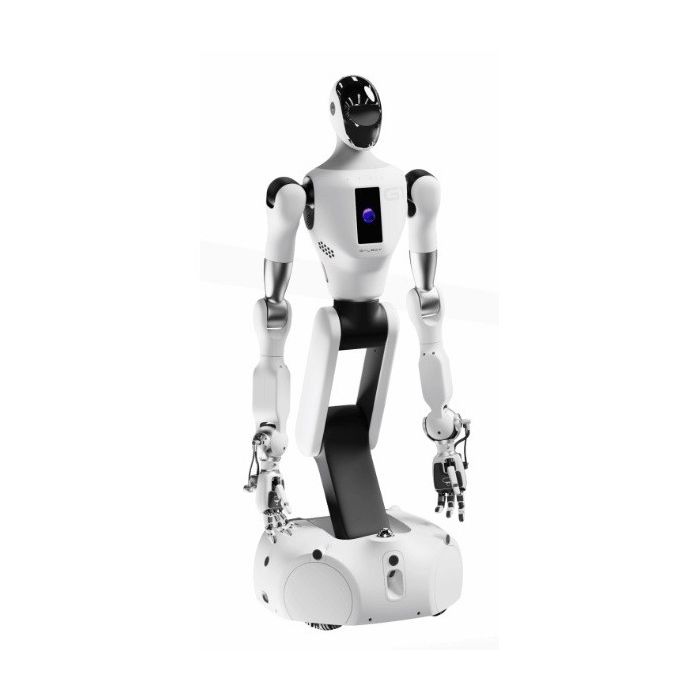
The G1 stands 173 centimeters tall, weighs 85 kilograms, and features 47 total degrees of freedom including a 12-degrees-of-freedom dexterous hand. The G1 entered national prominence in China when it appeared on the 2026 CCTV Spring Festival Gala — the world's most-watched television broadcast, reaching an estimated 679 million viewers — performing fully autonomous tasks including rolling walnuts in its palm, picking up glass fragments, handing objects to actors, and retrieving items from densely packed retail shelves, all without pre-programmed movement scripts. Two units listed on JD.com during the live broadcast sold out within minutes
Design and Physical Features
Human-Scale Form Factor
The G1's 173-centimeter height is functionally significant: it allows the robot to pass through standard commercial doorways, reach shelves positioned at heights designed for human workers, and operate in retail, hospital, and residential environments without requiring architectural modifications. The 190-centimeter arm span, combined with a torso lift range of 65 centimeters, gives the robot a maximum reach height of 240 centimeters — well above standard commercial shelving and sufficient for a wide range of industrial workstation heights.
The 85-kilogram construction reflects the use of substantial structural materials designed for commercial-grade durability. Units deployed in Beijing pharmacies operate 24 hours daily, and the industrial-grade wheeled base is built for the continuous wear of sustained commercial deployment rather than research demonstration cycles.
360-Degree Omnidirectional Wheeled Base
Rather than bipedal legs, the G1 uses a 360-degree omnidirectional wheeled chassis that allows the robot to move in any horizontal direction — including lateral and diagonal — without first reorienting its body. Foldable leg-like struts provide height adjustment and additional stability during manipulation tasks, and the wheeled base eliminates the fall risk that affects bipedal robots when they operate in environments with rugs, uneven flooring, or sudden disturbances during arm extension.
Galbot's product team makes the tradeoff explicit: the wheeled design prioritizes stability, battery endurance, and reliability for environments with flat or gently ramped surfaces — retail stores, warehouses, hospital corridors, and factory floors — over the terrain versatility of bipedal locomotion. The 10-hour battery runtime is a direct benefit of the wheeled approach: bipedal humanoid robots typically achieve two to four hours of runtime because of the energy demands of continuous balance computation and leg actuation; the G1's wheeled base enables energy to be directed primarily to arm manipulation and compute rather than postural maintenance.
47 Degrees of Freedom and Dexterous Hands
The G1 incorporates 47 total degrees of freedom including a 12-DOF dexterous hand. This degree of freedom count supports the full range of arm and wrist orientations required for complex manipulation tasks — reaching into tight spaces, grasping irregularly shaped objects, reorienting items during handling, and performing the kind of fine-motor operations demonstrated during the Spring Festival Gala. The 12-DOF hand provides multi-finger independent actuation comparable to human hand kinematics, enabling grasps from power grips on rigid containers through precision pinch grasps on small or delicate items.
Sensor System
The G1's perception system combines multiple RGB-D cameras for visual navigation (the robot navigates purely from visual inputs without LiDAR), tactile sensors integrated into the hands for contact force feedback during manipulation, and a four-microphone array for voice command reception and acoustic environment awareness. Cloud integration complements onboard processing for tasks requiring more intensive AI computation, and the wireless connectivity stack supports WiFi, Ethernet, and USB for operational management.
Technology and AI Architecture
AstraBrain: The Integrated AI System
The G1's intelligence is governed by AstraBrain, Galbot's proprietary end-to-end AI architecture. Galbot describes AstraBrain through the metaphor of a "brain-cerebellum-neural control" system, reflecting the layered hierarchy of its operations:
The "brain" layer handles high-level perception, scene understanding, and task planning — interpreting voice commands, recognizing objects, understanding spatial layout, and formulating the action sequences required to complete a task.
The "cerebellum" layer manages the real-time motor control that translates task plans into coordinated arm, hand, and body motion. This layer is responsible for the fine-grained stability adjustments demonstrated in tasks like rolling walnuts — where the force contact distribution across finger joints shifts continuously as the walnuts move, requiring millisecond-level torque adjustments to prevent slippage.
The "neural control" layer governs the physical actuation — coordinating joint-level commands across all 47 degrees of freedom with the timing precision required for fluid, human-like motion.
On the Spring Festival Gala stage, every action performed by the G1 was the result of AstraBrain's real-time autonomous decision-making rather than pre-written trajectory scripts — a distinction Galbot emphasizes as the defining proof of genuine embodied intelligence versus performance-optimized teleoperation.
GraspVLA: Foundation Model for Manipulation
GraspVLA, released in January 2025, is the embodied AI foundation model underpinning the G1's manipulation capabilities. Described by Galbot as the world's first end-to-end embodied grasping model trained on simulated synthetic data, GraspVLA achieves zero-shot generalization — the ability to handle new object types without additional training demonstrations. The model was pre-trained on Galbot's proprietary synthetic dataset generated through NVIDIA Isaac Sim, drawing on the physical interaction diversity of Professor Wang's DexGraspNet research.
The practical implication for deployment is that GraspVLA enables the G1 to handle the full product catalog of a retail store, pharmacy, or warehouse without requiring engineers to record demonstrations for each individual product type. In a scenario involving complex and densely stacked goods, the model does not need parameter adjustment for each product separately — it accurately grasps soft bags, hard boxes, bottles, glass containers, and plastic packaging using the same underlying learned skill.
GroceryVLA: Retail-Specific Model
GroceryVLA extends GraspVLA's manipulation capabilities with retail-specific intelligence for product recognition, shelf navigation, and inventory handling. The model enables the G1 to operate in the crowded, dynamic shelving environments of retail stores, recognizing and retrieving specific products from densely stacked shelves without knocking adjacent items. This model powers Galbot Store, the company's autonomous retail system.
TrackVLA: Navigation Foundation Model
TrackVLA is the G1's navigation intelligence layer. The system provides pure visual environment perception (without LiDAR), comprehension of natural-language navigation commands, zero-sample generalization in complex scenes, and following of highly dynamic targets. Critically, TrackVLA can resume tracking after temporary visual loss of a target — essential for following a person through crowded hospital corridors or retail aisles where line-of-sight may be temporarily interrupted.
NavFoM
NavFoM (Navigation Foundation Model) is Galbot's proprietary navigation AI that handles environment mapping, obstacle avoidance, and path planning across the diverse indoor environments where the G1 is deployed — retail store layouts, hospital corridors, warehouse aisles, and manufacturing floor pathways.
Sim2Real Training
All of Galbot's AI models are trained through the company's Sim2Real methodology: massive pre-training on large-scale high-quality synthetic datasets generated in NVIDIA Isaac Sim, followed by targeted fine-tuning with minimal real-world data. This pipeline enables Galbot to build training datasets at the hundreds-of-billions scale while maintaining the economic viability of model development. The result is a 10-billion-level training dataset that supports industrial-grade generalization across thousands of object types and environment configurations.
Technology and Specifications
Full Specifications at a Glance
| Specification | Value |
|---|---|
| Arm Span | 190 cm |
| Torso Lift Range | 65 cm |
| Maximum Reach Height | 240 cm |
| Total Degrees of Freedom | 47 |
| Hand Degrees of Freedom | 12 per hand |
| Grasping Success Rate | 95 to 97 percent |
| Object Types Handled | 5,000+ |
| Navigation System | Pure vision (no LiDAR) |
| Sensors | RGB-D cameras, tactile hand sensors, 4-mic array |
| Connectivity | WiFi, Ethernet, USB, cloud |
| AI System | AstraBrain (GraspVLA, GroceryVLA, TrackVLA, NavFoM) |
| Premium Compute | NVIDIA Jetson Thor (G1 Premium variant) |
| Deployment Speed | One day per new store environment |
Applications and Use Cases
Autonomous Retail — Galbot Store
Galbot Store is Galbot's autonomous retail concept: a fully robot-staffed commercial store where one or more G1 units serve all customer-facing functions — product retrieval, shelf restocking, transaction support, and customer guidance. As of late 2025, Galbot Store locations were operational in more than 30 cities across China. The G1's ability to deploy into a new retail environment within a single day, combined with its 10-hour operating endurance and zero-shot product generalization, makes fleet-scale retail deployment economically and operationally viable at a level not previously achievable with manipulation robots.
Pharmacy Operations
The G1 operates in more than 10 unmanned pharmacies across Beijing, handling medication sorting, dispensing, and customer service 24 hours a day. The pharmaceutical retrieval challenge at the World Humanoid Robot Games — where the G1 autonomously scanned six tall shelves, identified nine specific medications from hundreds of products, and delivered them in just over 10 minutes — provided independent competitive validation of the robot's accuracy in a high-stakes deployment context where dispensing errors carry real safety consequences.
Industrial Manufacturing
Galbot has secured deployment partnerships and thousands of units in cumulative orders from industrial manufacturers including CATL (battery production lines), Bosch (high-precision manufacturing through a joint venture), Toyota, Hyundai, BAIC Group, SAIC Motor, Zeekr, and Great Wall Motor. The G1's 5,000-object-type handling capability and factory-grade reliability address the material handling, loading and unloading, and assembly assistance tasks that require human-like dexterity within production environments designed for human workers.
Healthcare and Hospital Services
In collaboration with Xuanwu Hospital, one of Beijing's major medical centers, G1 robots assist in patient rooms, pharmacies, and hospital guidance systems. The TrackVLA navigation model's ability to follow patients or staff through crowded hospital corridors — and resume tracking after visual occlusion — enables practical guidance and delivery workflows in the dynamic, human-dense environment of an active hospital.
Warehouse Logistics
The G1 has sustained continuous 24/7 autonomous warehouse operations for over a year across multiple logistics deployments, handling inventory management, replenishment, packaging support, and delivery preparation. The 10-hour endurance means a G1 unit can sustain a full commercial shift with no charging interruption.
Advantages and Benefits
10-Hour Battery Life — Best-in-Class Humanoid Endurance: The G1's 10-hour runtime substantially exceeds the two to four hours typical of bipedal humanoid competitors, directly enabling full commercial shift operation in retail, healthcare, and manufacturing without mid-shift charging interruptions.
One-Day Store Deployment: The G1's ability to be operational in a new retail environment within a single day dramatically reduces the integration overhead for commercial operators, making economically viable fleet deployment across large store networks feasible.
Zero-Shot Generalization for New Products: GraspVLA's zero-shot generalization means the G1 can handle product types it has not been specifically trained on, eliminating the costly and time-consuming process of collecting and curating demonstrations for every new item in a product catalog.
95 to 97 Percent Grasping Success Across 5,000+ Object Types: This success rate, demonstrated in commercial deployments rather than laboratory conditions, provides the level of reliability that commercial operations require — particularly in pharmacy settings where handling accuracy is safety-critical.
Wheeled Stability Eliminates Fall Risk: The 360-degree omnidirectional wheeled base eliminates the primary safety concern associated with bipedal humanoid operation in shared human-robot spaces: an unexpected fall while carrying an item. For retail, healthcare, and residential applications, this stability is both a safety and a consumer confidence advantage.
AstraBrain Real-Time Autonomous Intelligence: Every G1 action at the Spring Festival Gala and in commercial deployments is generated by real-time AI decision-making rather than scripted trajectories, providing the flexibility to handle the natural variability of real-world environments rather than only executing within carefully controlled task parameters.
Comparison with Related Platforms
Galbot G1 vs. Unitree G1 (Bipedal): The Unitree G1 is a bipedal humanoid priced at approximately ¥84,900 (around $12,000 USD), offering bipedal locomotion with stair-climbing capability and athletic demonstrations. The Galbot G1 is priced substantially higher at approximately ¥699,700, reflecting its focus on commercial deployment readiness — the 10-hour battery, dexterous 12-DOF hands, and proven 24/7 commercial operations in pharmacies and retail stores. Unitree's G1 leads in price accessibility for research and entertainment; Galbot's G1 leads in commercial deployment endurance, autonomous retail-specific AI, and proven sustained operations in live customer-facing environments.
Galbot G1 vs. AgiBot G2: The AgiBot G2 is an industrial-grade wheeled humanoid focused on high-precision manufacturing assembly, with NVIDIA Jetson Thor compute at 2,070 TFLOPS, sub-millimeter force-control accuracy, and IP42/IP50 protection for factory environments. The Galbot G1 focuses more broadly on multi-environment commercial deployment spanning retail, healthcare, and manufacturing, with a retail-specific AI model (GroceryVLA) and deployment infrastructure (Galbot Store) that the G2 does not have. For high-precision industrial assembly, the G2's force-control accuracy is a strong advantage; for general commercial service across retail, pharmacy, and logistics, the G1's AI breadth and 10-hour runtime are more directly relevant.
Galbot G1 vs. Agility Robotics Digit: Agility Robotics Digit is a bipedal warehouse humanoid priced at approximately $250,000, deployed by Amazon for tote handling. Digit's bipedal locomotion enables stair access in facilities designed for human workers, while the G1's wheeled base limits it to flat or ramped surfaces. For tote handling in multi-floor distribution centers, Digit's bipedal access is an advantage. For retail service, pharmacy operations, and manufacturing floor deployment, the G1's superior dexterity, longer endurance, and retail-specific AI models are more directly applicable.
Frequently Asked Questions (FAQ)
What is the Galbot G1? The Galbot G1 is a wheeled semi-humanoid robot developed by Beijing-based Galaxy General Robot Co., Ltd. (Galbot). Standing 173 centimeters tall with a wheeled omnidirectional base, dual 7-DOF arms, and 12-DOF dexterous hands totaling 47 degrees of freedom, the G1 handles 5,000+ object types with a 95 to 97 percent grasping success rate. It runs up to 10 hours on a single charge and is powered by the AstraBrain AI system incorporating GraspVLA, GroceryVLA, TrackVLA, and NavFoM foundation models. It is deployed in autonomous retail stores across 30+ Chinese cities, Beijing pharmacies, hospital systems, and manufacturing lines at CATL, Bosch, and major automotive partners.
How does the Galbot G1 work? The G1 uses pure vision-based navigation (no LiDAR) guided by TrackVLA and NavFoM to move through environments on its 360-degree omnidirectional wheeled base. GraspVLA and GroceryVLA govern arm and hand manipulation, using RGB-D cameras and tactile hand sensors to identify objects and execute grasps with the appropriate force distribution for each object's material and shape. AstraBrain coordinates the full system in real time — interpreting voice commands, planning multi-step task sequences, and executing fine-motor operations across all 47 degrees of freedom. All AI models were trained on Galbot's Sim2Real pipeline: massive synthetic pre-training through NVIDIA Isaac Sim followed by minimal real-world fine-tuning.
What tasks can the Galbot G1 perform? Commercial deployment tasks include: medication sorting and dispensing in pharmacies, product retrieval and restocking in retail stores, inventory management and order picking in warehouses, material handling on manufacturing production lines, hospital patient room assistance, and customer guidance in service environments. Fine-motor demonstrations include folding clothes, picking up glass fragments, rolling walnuts in-hand, skewering sausages with two coordinated arms, pouring drinks, retrieving items from packed shelves, and handing objects to humans — all performed fully autonomously without pre-scripted trajectories.
What is the Galbot G1's price? The Galbot G1 is priced at approximately 699,700 yuan (roughly $87,000 to $91,000 USD) on JD.com and Chinese retail platforms. A G1 Premium variant with NVIDIA Jetson Thor compute is available at an additional premium for buyers requiring maximum autonomous operation capability. Enterprise pricing for manufacturing and logistics deployments is available through Galbot's enterprise sales channel and partner network.
Why does the Galbot G1 use wheels instead of legs? Galbot made the deliberate design choice to use a wheeled omnidirectional base for the G1 because the robot's target environments — retail stores, pharmacies, hospitals, warehouses, and factory floors — are predominantly flat-surface environments where the terrain advantages of bipedal locomotion provide no operational benefit, while the energy, stability, and reliability costs of bipedal balance control are significant. The wheeled design directly enables the G1's 10-hour battery runtime (versus two to four hours for bipedal humanoids), eliminates fall risk in human-shared spaces, and provides greater structural stability for precision arm operations. Environments with stairs can be addressed through elevators and ramps, which are standard in commercial and industrial facilities.
Summary
The Galbot G1 Wheeled Humanoid Robot represents one of the most commercially validated general-purpose manipulation robots available as of 2026, with a combination of technical capabilities — AstraBrain real-time autonomous AI, GraspVLA zero-shot grasping across 5,000+ object types, 10-hour battery life, 47 degrees of freedom, and one-day retail deployment — that directly addresses the practical requirements of commercial service environments. Its proven sustained operation in live autonomous retail stores across 30 Chinese cities, 24/7 pharmacy deployments, and production-line partnerships with CATL, Bosch, Toyota, and Hyundai establish a deployment track record that most robotics platforms at any price point cannot match. The 2026 Spring Festival Gala appearance — watched by approximately 679 million viewers, followed by a sellout on JD.com within minutes — cemented the G1's status as one of China's most recognizable and commercially credible humanoid robots. For enterprise buyers in retail, healthcare, logistics, and manufacturing seeking a commercially deployable general-purpose manipulation robot with proven real-world performance, the Galbot G1 is among the most substantively validated options in the current market.