Unitree H2-D Standard M Humanoid Robot
In stock
- BRAND:
- UNITREE ROBOTICS
- MODEL:
- H2-D-Standard-M
- PART #:
- H2-D-Standard-M
- ORIGIN:
- China
- Warranty:
- 12 MONTHS
- AVAILABILITY:
- SUBJECT TO AVAILABILITY
- SKU:
- Unitree-H2-D-Standard-M
Unitree-H2-D-Standard-M
Introduction and Overview
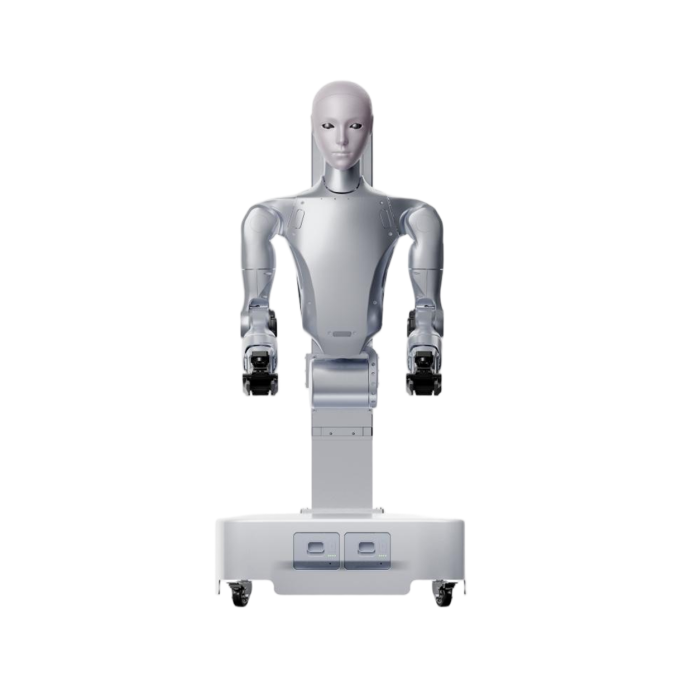
The Unitree H2-D Standard M Humanoid Robot is a stationary dual-arm manipulation workstation in the Unitree H2-D Standard tier, designed for fixed workcells rather than mobile deployment. As vendor-listed, it delivers 59 total degrees of freedom through two 7 degree of freedom arms fitted with WUJI Dexterous Hand 2 end effectors, a waist pitching from 0 to 115 degrees, a two axis head, and a distinctive 2 degree of freedom motorized column that combines 0.5 m of vertical travel with 90 degree base rotation, giving in-place Z-axis motion on a fixed footing. The platform belongs to the Unitree H2-D series inside the Unitree H2 Humanoid Robots range, part of the wider Unitree Humanoid Robots catalog and the parent Humanoid Robots category.
Standard and Ultimate Configurations
The H2-D range separates into stationary Standard machines and mobile Ultimate machines, with hand technology defining the variants inside each tier.
Unitree H2-D Standard M
This page's subject, the Standard M, keeps the WUJI Dexterous Hand 2 and full dual-arm upper body but anchors them to a fixed base, adding 90 degree column rotation that the mobile variants do not need.
Unitree H2-D Ultimate M
The Ultimate M shares the same hands and compute but rides a differential-drive chassis at up to 1.5 m/s with onboard battery power for roaming tasks.
Unitree H2-D Ultimate L
The Ultimate L is the mobile visuo-tactile flagship, using BrainCo Revo 3 U21VT hands that merge fingertip vision with palm-wide touch.
Unitree H2-D Ultimate K
The Ultimate K offers full-palm tactile sensing through the Revo 3 U21T hand, positioned between the force-only and visuo-tactile options.
Technology and Specifications
The Standard M spans 1200 to 1700 mm in height over a 576 × 620 mm footprint and weighs about 135 kg. Each WUJI Dexterous Hand 2 provides 20 active degrees of freedom with direct-drive rotary joints and back-drivable kinematics, controlled through MIT Force/Position Hybrid Control at 1000 Hz across all 20 axes. Vendor figures include fingertip peak force of at least 15 N, open and close cycling of at least 4 times per second, joint backlash under 1 degree, full opposition grasp, a minimum grasp diameter of zero, 16 to 58 V DC operation, and 1000BASE-T EtherNet. Two 1920 × 1080 RGB wrist cameras cover a 130 degree diagonal field of view each. Compute follows the H2-D pattern, an Intel Core i5 PC1 and Core i7 PC2, optional Jetson Thor PC3 and i7 or Orin NX PC4, and a binocular head with an 8-core CPU and 10 TOPS NPU. The software stack is Linux based with native ROS 2 support, open APIs for arms, audio, vision, and lighting, and smart OTA updates. The machine runs from external power in stationary operation, which removes battery management from continuous workcell duty.
| Attribute | Unitree H2-D Standard M |
|---|---|
| Total degrees of freedom | 59 |
| Arms | Dual 7 DOF |
| Waist | 1 DOF, 0° to 115° pitch |
| Column | 2 DOF, 0.5 m travel plus 90° rotation |
| Base | Fixed, in-place Z-axis rotation |
| Hands | WUJI Dexterous Hand 2, 20 DOF each |
| Hand control | 1000 Hz, MIT Force/Position Hybrid |
| Wrist cameras | 2 × RGB 1920 × 1080, 130° diagonal FOV |
| Dimensions | 1200 to 1700 × 576 × 620 mm |
| Weight | About 135 kg |
| Power | External supply for stationary operation |
| Software | Linux, native ROS 2, open APIs, OTA |
Applications and Use Cases
Fixed Workcell Automation
Mounted at a bench or line-side station, the robot performs repetitive dual-arm tasks such as kitting, sorting, and machine tending within its rotating, height-adjustable envelope.
Laboratory and Education
Continuous external power, ROS 2 support, and open APIs make it a dependable teaching and experimentation platform that never pauses for charging.
Teleoperation and Data Capture
The 1000 Hz back-drivable hands and dual wrist cameras suit telemanipulation rigs and large-scale demonstration data collection for learning-based control.
Advantages and Benefits
- Workstation stability: a fixed base with 90 degree column rotation delivers a repeatable, calibrated workspace that mobile platforms cannot match.
- Uninterrupted duty: external power eliminates battery swaps and charge windows for round-the-clock cell operation.
- High-bandwidth hands: 1000 Hz force and position control with under 1 degree backlash supports precise, compliant grasping.
- Open development stack: Linux, native ROS 2, and open arm, audio, vision, and lighting APIs shorten integration time.
- Upgrade path: shared architecture with mobile H2-D Ultimate variants protects software investment as needs grow.
Pricing and Availability
The Unitree H2-D Standard M is for sale through Robots International. Price and cost depend on compute options, hand configuration, fleet size, and destination, so individual quotations replace a fixed list price. Buyers should request a quotation to obtain current pricing, delivery terms, and integration guidance, and purchasing details are available on this page. The complete range appears in the Shop.
Frequently Asked Questions
What is Unitree-H2-D-Standard-M?
It is a stationary dual-arm humanoid workstation in the Unitree H2-D Standard tier, vendor-configured with WUJI Dexterous Hand 2 units, a rotating lift column, and 59 total degrees of freedom.
How does Unitree-H2-D-Standard-M work?
Dual Intel computers coordinate the arms, head, and column while each 20 DOF hand runs MIT Force/Position Hybrid Control at 1000 Hz, with two wrist cameras providing close-range vision.
Why is Unitree-H2-D-Standard-M important?
It packages humanoid-grade dexterity into a fixed workstation format, giving labs and factories dual-arm manipulation without the cost and complexity of a mobile base.
What are the benefits?
Users gain continuous externally powered operation, a stable calibrated workspace, high-frequency compliant hands, and an open ROS 2 software environment.
Does the Standard M move around a facility?
No, the base is fixed. It rotates in place on its Z axis and adjusts height by 0.5 m, while mobile tasks are served by the H2-D Ultimate variants.
What software does it support?
The vendor lists a Linux framework with native ROS 2, open APIs for arms, audio, vision, and lighting, and smart OTA updates.
Where can I buy Unitree-H2-D-Standard-M and what does it cost?
It is for sale through Robots International with worldwide delivery, customs support, and after-sales service. Cost varies by configuration and destination, so request a quotation, with details on this page.
Summary
The Unitree H2-D Standard M concentrates the H2-D platform's dexterity into a stationary, externally powered workstation, trading mobility for stability, uptime, and integration simplicity. For anyone specifying a fixed dual-arm humanoid cell, this page serves as the definitive reference point.