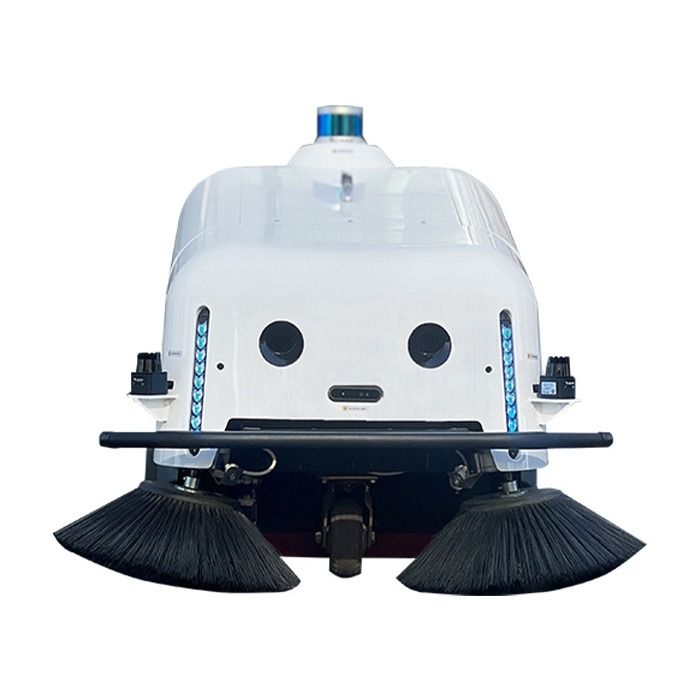
iTR W1 Commercial Outdoor Sweeper
In stock
- BRAND:
- ITR ROBOT
- MODEL:
- W1
- ORIGIN:
- China
- AVAILABILITY:
- SUBJECT TO AVAILABILITY
- SKU:
- ITR-W1
iTR W1 Commercial Outdoor Sweeper
iTR W1: The Large-Scale Commercial Outdoor Sweeper with 5,600 m²/h Cleaning Capacity
The W1 integrates three cleaning functions: sweeping, vacuuming, and ash reduction, complemented by dual side brushes for edge-to-edge coverage and an advanced dust control system. Its standing-drive design enables seamless switching between autonomous and manual operation, while self-charging, automatic water management, and 24/7 unmanned operation capability provide the operational independence that large-venue commercial facility managers require for unattended cleaning programs.
iTR's official product page at itrobotgroup.com/products_detail/5.html confirms the W1's core commercial position: "W1 is large-scale sweeping robot of iSweeper series, designed for the cleaning needs of large indoor and outdoor commercial scenes, equipped with sweeping, vacuuming, ash reduction and other functions." The same page documents the 1.55-meter cleaning width and 5,600 m²/h maximum working capacity as the W1's headline performance specifications.
Application environments confirmed by iTR include parks, factories, airports, commercial squares, campuses, and parking lots. Surface compatibility spans marble, granite, terrazzo, concrete, epoxy resin, tile, wood floor, asphalt, gravel, and other hard surfaces, covering the full range of outdoor and indoor commercial hard floor types that the W1's large-scale deployment contexts present.
The iSweeper Series: The W1's Position at the Top
Three-Platform Outdoor Sweeping Coverage
The iSweeper series currently includes three confirmed platforms, each addressing a different scale and operational context:
W1 (Large-Scale Commercial Outdoor Sweeper): The W1 is designed for the largest commercial outdoor venues requiring the highest throughput. Its 1.55-meter cleaning width and 5,600 m²/h capacity establish it as the highest-coverage-rate platform in the series, appropriate for large commercial properties, major industrial facilities, large campus environments, and substantial outdoor public spaces.
W2 (Medium-Scale Commercial Outdoor Sweeper): The W2 targets medium-scale commercial outdoor and indoor spaces with a 1.05-meter cleaning width. The W2 provides the mid-tier coverage appropriate for facilities where the W1's large scale exceeds the operational requirement.
OM1 (Outdoor Municipal Street Sweeper): The OM1 addresses municipal road cleaning with traffic light recognition and the full public road compliance features that distinguish it from the commercial venue W1 and W2. The OM1 has a 1.85-meter cleaning width but is specifically designed for the road environment rather than commercial venue deployment.
For commercial facility managers selecting between the W1 and W2, the primary decision criterion is the total floor area requiring cleaning per session. The W1's 5,600 m²/h capacity completes a 56,000-square-meter outdoor area (approximately the size of a large regional shopping center's full outdoor area including parking) in 10 hours of continuous operation. The W2's lower capacity is more appropriate for facilities where the cleaning area is substantially smaller.
Physical Design and Key Engineering Features
1.55-Meter Cleaning Width
The W1's 1.55-meter cleaning width is the primary mechanical specification driving its 5,600 m²/h throughput. Compared to the W2's 1.05-meter width, the W1's 1.55-meter width covers 47 percent more floor area per pass across the same length of cleaning route. For a large parking lot requiring coverage in a single overnight session, the wider pass width directly reduces the number of parallel passes required and therefore the total time required to complete the session.
The 1.55-meter width is also dimensionally appropriate for the road-width lanes and drive aisles of the outdoor commercial environments the W1 targets: parking lot drive aisles, campus pathway networks, airport road systems, and the access roads of industrial park facilities are typically 3 to 6 meters wide, making a 1.55-meter cleaning pass an efficient coverage unit that requires 2 to 4 passes per lane width rather than the 3 to 6 passes that narrower sweeping machines require.
Dual Side Brushes and Advanced Dust Control
The W1's dual side brushes collect debris from the edges of its cleaning path, ensuring that the full 1.55-meter working width receives effective sweeping coverage rather than leaving uncleaned strips along the brush perimeters. iTR's wholesale product page confirms: "its dual side brushes and advanced dust control system guarantee thorough edge-to-edge cleaning."
The advanced dust control system addresses the primary nuisance of dry outdoor sweeping: the generation of airborne particulate clouds during brush operation. Outdoor commercial sweeping without dust control can create visible dust clouds that disperse the collected material back into the environment rather than capturing it, reducing the effective cleaning outcome and creating air quality issues for nearby people. The dust control system suppresses particulate generation during sweeping, capturing fine dust alongside larger debris.
Standing-Drive Design: Automatic and Manual Mode Switching
The W1 incorporates a standing-drive design that enables seamless switching between autonomous operation and manual operator-driven operation. iTR's wholesale product listing confirms: "Its standing-drive design allows seamless switching between automatic and manual modes."
The standing-drive design means an operator can stand on the robot's platform and manually guide it in situations where autonomous operation is not appropriate: navigating through temporary obstacles, positioning the robot in areas excluded from its autonomous route, or retrieving the robot from a location where autonomous navigation has been interrupted. This manual override capability is a practical operational requirement for commercial deployment: facilities always have situations that require direct human control, and a robot with no manual operation mode creates management complications when those situations arise.
Technology and Operational Intelligence
Self-Charging and Automatic Water Management
The W1's self-charging capability enables it to return to its charging station autonomously when the battery level drops to a programmed threshold, recharge, and resume the cleaning session from the breakpoint where it stopped. This automated charge-resume capability is the prerequisite for multi-session cleaning programs that cover large areas across multiple charge cycles within a single scheduled cleaning window.
Automatic water management handles the W1's dust control water consumption without requiring manual refill between sessions when integrated with the appropriate water supply infrastructure. For facilities deploying the W1 on scheduled overnight cleaning programs, automatic water management removes the maintenance task that would otherwise require a staff member to attend to the robot's water supply mid-session.
Multi-Sensor Technology for Safe Dynamic Environment Operation
iTR's wholesale product page confirms: "Equipped with multi-sensor technology, it ensures safe and precise operation in dynamic environments." The multi-sensor approach provides the overlapping environmental detection coverage needed for the W1's outdoor deployment contexts, where the variety of obstacle types, sizes, and surface reflectivities requires multiple sensing modalities rather than single-sensor detection.
Outdoor environments present detection challenges that indoor environments do not: variable lighting from sunlight, shadows, and artificial lighting at different times of day; reflective surfaces from wet ground, vehicle bodywork, and glass facades; low-contrast obstacles like dark curb edges on dark asphalt; and moving obstacles including vehicles, cyclists, and pedestrians that must be tracked as they move rather than mapped as static objects.
Real-Time Monitoring and Digital Task Management
The W1 supports real-time monitoring and digital task management, enabling facility managers to track the robot's cleaning progress, coverage status, and operational health from a remote dashboard. iTR's wholesale product description confirms: "With real-time monitoring capabilities and digital task management, it represents the future of efficient outdoor maintenance."
Digital task management enables cleaning schedules to be configured for specific routes, times, and coverage zones, and real-time monitoring confirms that programmed cleaning sessions are executing as planned. For facility managers responsible for multiple commercial properties or for municipal authorities managing larger fleets, the digital management capability provides the operational oversight that manual inspection-based fleet management cannot deliver at scale.
Applications for the W1's Large-Scale Coverage Capability
Major Industrial Parks and Manufacturing Campuses
Industrial parks and large manufacturing facility campuses have extensive outdoor hard-surface areas including access roads, loading dock approaches, equipment laydown areas, and the grounds between buildings that require regular sweeping to manage the heavy debris accumulation that industrial activity produces. The W1's 5,600 m²/h capacity enables cleaning of a 100,000-square-meter industrial campus footprint in approximately 18 hours of continuous operation, a full overnight cleaning session, without requiring multiple robots working simultaneously.
Large Airport Ground Areas
Airports have extensive outdoor hard-surface areas beyond the terminal buildings themselves: service roads, aircraft ground support equipment zones, cargo handling areas, passenger pickup and dropoff curbs, and the road networks connecting terminal buildings. These areas receive the most intensive vehicle and foot traffic of any commercial property, generating debris from vehicles, aviation support equipment, and the millions of passengers who move through airport ground areas annually.
The W1's large cleaning width and 5,600 m²/h capacity enable comprehensive coverage of airport ground transportation areas during the low-traffic overnight periods that minimize operational interference with airport movement.
Commercial Plazas and Large Retail Property Grounds
Large-format retail properties with extensive parking lots, external walkways, service roads, and delivery areas represent the commercial property segment where the W1's large cleaning width most directly translates to cleaning program efficiency. A large regional shopping center with 50,000 square meters of outdoor hard surface requires approximately 9 hours of W1 operation per complete cleaning pass, fitting within a single overnight cleaning window.
University and Corporate Campuses
Large university campuses and major corporate headquarters campuses have extensive outdoor paved areas including pedestrian walkways, plazas, access roads, service areas, and parking facilities. The W1's ability to switch between autonomous operation for open areas and manual operation for narrower pedestrian pathways and building approaches makes it appropriate for the varied path widths and configurations of campus environments.
Comparison: iTR W1 vs. W2 vs. OM1
| Feature | W1 | W2 | OM1 |
|---|---|---|---|
| Series | iSweeper (large-scale) | iSweeper (medium-scale) | Outdoor Municipal |
| Cleaning Width | 1.55 m | 1.05 m | 1.85 m (OM1) |
| Max Capacity | 5,600 m²/h | Not published | Not published |
| Target Context | Large commercial venues | Medium commercial venues | Municipal public roads |
| Traffic Light Recognition | No | No | Yes |
| Standing-Drive Design | Yes | Not confirmed | Not confirmed |
| Primary Market | Industrial parks, airports, large plazas | Shopping centers, campuses, hotels | Municipal authorities |
Summary
The iTR W1 is the highest-throughput platform in iTR's iSweeper outdoor sweeping series, with a 1.55-meter cleaning width delivering 5,600 square meters per hour of maximum working capacity across parks, factories, airports, commercial plazas, campuses, and parking lots. Its dual side brushes and advanced dust control system provide edge-to-edge coverage with particulate suppression; its standing-drive design enables seamless autonomous-to-manual mode switching; self-charging and automatic water management support 24/7 unattended operation; and real-time monitoring with digital task management enables centralized fleet oversight without on-site supervision. As the large-scale flagship of iTR's commercial outdoor cleaning portfolio from a company with over a decade of autonomous driving technology development and confirmed international export operations, the W1 represents the most capable outdoor sweeping platform in iTR's range for large commercial facility operators requiring efficient, automated outdoor floor care.
Frequently Asked Questions (FAQ)
What is the iTR W1 Commercial Outdoor Sweeper?
The iTR W1 is the large-scale flagship of iTR Robot Technology Co., Ltd.'s iSweeper autonomous outdoor sweeping robot series. It is designed for the cleaning needs of large indoor and outdoor commercial scenes, integrating sweeping, vacuuming, and ash reduction functions. Key specifications: 1.55-meter cleaning width, 5,600 m²/h maximum working capacity, dual side brushes with advanced dust control, standing-drive design for automatic and manual mode switching, self-charging and automatic water management for 24/7 unattended operation, and real-time monitoring with digital task management. Application environments include parks, factories, airports, commercial squares, campuses, and parking lots.
How does the W1's 5,600 m²/h capacity translate to practical cleaning coverage?
At 5,600 square meters per hour maximum working capacity, the iTR W1 covers approximately 56,000 square meters in a 10-hour overnight cleaning session. For reference: a large regional shopping center's full outdoor area (parking, access roads, service areas) typically covers 40,000 to 80,000 square meters; a large industrial park facility campus covers 50,000 to 150,000 square meters; a major airport's external vehicle and service road area covers tens of thousands of square meters. The W1's capacity enables complete single-session coverage of most large commercial property outdoor areas without requiring multiple simultaneous robots.
What is the standing-drive design and why does it matter?
The standing-drive design allows an operator to stand on the W1's platform and manually drive the machine, enabling seamless switching between the robot's autonomous cleaning mode and direct human-controlled operation. This capability matters for commercial deployment because real facilities always have situations requiring manual control: navigating through temporary obstacles, recovering from navigation interruptions, cleaning areas excluded from the autonomous route, or repositioning the robot for a new task. A robot with no manual operation mode creates practical management challenges in these situations. The standing-drive design provides the operational flexibility that commercial facilities require.
How does the W1 differ from the W2 and OM1?
The W1 (1.55-meter cleaning width, 5,600 m²/h) is the large-scale commercial outdoor sweeper for the largest commercial venue cleaning requirements. The W2 (1.05-meter cleaning width) is the medium-scale commercial outdoor sweeper for smaller venue and facility cleaning requirements. The OM1 is the outdoor municipal street sweeper with traffic light recognition, designed specifically for public road environments where traffic compliance is required. The W1 and W2 serve private commercial venues; the OM1 serves municipal public road networks.
Frequently Asked Questions (FAQ)
What is the iTR All-Terrain Remote Control Transport Vehicle?
The iTR All-Terrain Remote Control Transport Vehicle is an electrically powered, remotely operated cargo transport robot for agricultural, horticultural, and industrial environments. Specifications: dual 2,400W brushless motors (4,800W total), independent suspension, 290mm ground clearance, 150kg payload, 4.6km/h speed, 48V/20.3Ah battery with 5-hour continuous runtime, double reducer brake system, and 4.00-10 off-road wheels. Application environments: mountains, hills, orchards, greenhouses, farmlands, warehouses, mud roads, concrete floors. Weather-resistant design with ergonomic remote control.
How does the 290mm ground clearance help in agricultural environments?
The 290mm ground clearance is the vertical distance between the vehicle's lowest point and the ground surface. At 290mm, the vehicle can pass over rocks, tree roots, irrigation channel edges, drainage infrastructure, and the terrain irregularities that characterize real orchard hillsides and farm paths without the underbody contacts that damage standard utility vehicles with 150-200mm clearance in these environments. In practical terms, it extends the range of terrain the vehicle can navigate reliably from prepared agricultural tracks to the natural terrain surfaces of orchard rows and hillside farmland.
Why is remote control operation important for sloped terrain transport?
Remote control operation separates the vehicle operator from the physical risks of slope operation with a loaded cargo payload. When a 150kg-loaded vehicle navigates a steep orchard hillside, the gradient and load combination creates vehicle stability demands that place an on-board operator at risk in the event of the vehicle's stability limits being exceeded. Remote control operation allows the operator to direct the vehicle from a safe position away from the vehicle's path, observing the terrain ahead and controlling the vehicle without occupying the most exposed position in a slope accident scenario. This safety benefit is specific to slope and rough terrain transport where on-board operation creates meaningful physical risk.
What battery system does the iTR transport vehicle use and how long does it last?
The iTR transport vehicle uses a 48-volt, 20.3-ampere-hour lithium battery system. The 48V system provides the voltage appropriate for the dual 2,400W motor power requirements at the vehicle's 4.6km/h operating speed. At full operational load, the 20.3Ah capacity delivers 5 hours of continuous runtime. For typical agricultural operations where the vehicle makes multiple loaded and unloaded transport runs per hour, the 5-hour runtime covers the standard working portion of an agricultural day, enabling a full morning or afternoon transport operation session on a single charge.
- Dimensions: 1.86 × 1.55 × 1.4 m / 73 × 61 × 50 in
- Sweeping width: 155 cm / 61 in
- Max productivity: 5,580 m²/h / 60,062 ft²/h
- Maximum speed: 1 m/s
- Trash tray: 100 L / 21 gal
- Clean water tank: 70 L / 15 gal
- Gradeability: 12°
- Charging mode: Manual/automatic
- Weight: 484 kg / 1,067 lb
- Battery capacity: 240 Ah
- Rated voltage: 48 V
- Charging time: 6 h
- Runtime: 6.5 h
- Operating temperature: 0°C to 40°C
- Storage temperature: -20°C to 50°C