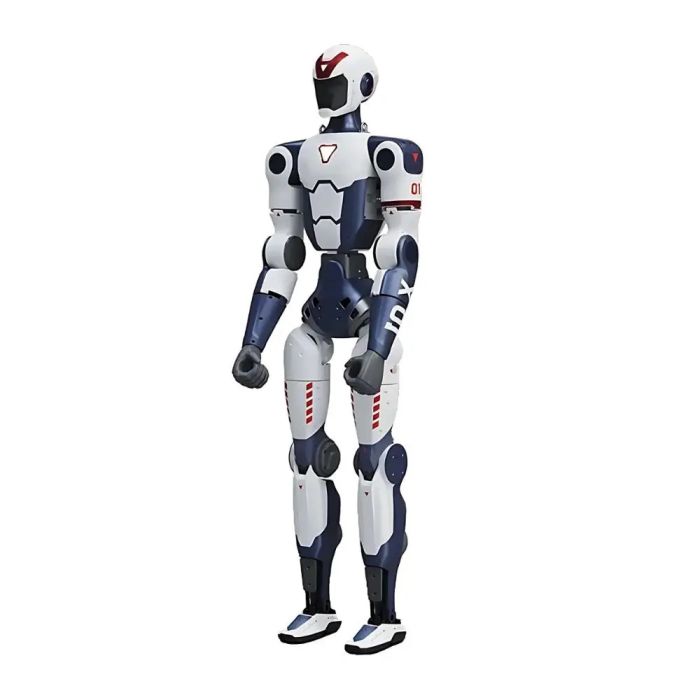
Unitree R1 Edu Pro B Humanoid Robot (R1 EDU U4)
In stock
- BRAND:
- UNITREE ROBOTICS
- MODEL:
- R1 EDU PRO B
- PART #:
- R1 EDU U4
- ORIGIN:
- China
- Warranty:
- 12 MONTHS
- AVAILABILITY:
- SUBJECT TO AVAILABILITY
- SKU:
- Unitree-Robotics-R1-EDU-U4
Unitree R1 EDU U4
At the exact moment a robot's hand closes on an object, its cameras go blind to the only thing that now matters. The fingers occlude the contact, the object disappears behind the grip, and every question the next hundred milliseconds will decide — is it slipping, is it crushing, is it seated square — happens where no lens can see. Humans solve this with skin; the Unitree R1 EDU U4 solves it the same way. As the Pro B configuration of the compact R1 line, the U4 takes the family's Dex3-1 three-finger dexterous hands and gives each one an array of 33 touch sensors distributed across the finger contact surfaces — sixty-six sensing points in total that map pressure spatially, in real time, exactly where vision fails. The result is a research humanoid with the full perceptual loop of physical work: stereo cameras to find the object, up to 40 degrees of freedom to reach and shape a grasp around it, and now tactile feedback to hold it — detecting slip before it becomes a drop, modulating force between eggshell and wrench, confirming contact geometry no image could reveal. An onboard NVIDIA Jetson Orin at 100 TOPS gives the sensor stream somewhere serious to go, running the GPU-accelerated tactile and vision-language models this research consumes, and the platform underneath remains everything the R1 EDU line promises: roughly 121 centimetres and 25 kilograms of dynamic, portable, fully open hardware, programmable from behaviour level to joint level over ROS 2.
The Unitree R1 EDU U4 is available for purchase internationally through this page, with delivery, customs clearance and after-sales support arranged for buyers across Europe, the Americas, the Middle East, Asia-Pacific and worldwide.
Background
Touch is the frontier the field just reached
Manipulation research spent its first era on geometry — where to place fingers — because that was what cameras could answer. Its current era is about contact, because that is where real tasks succeed or fail: inserting a connector, buttoning, handling deformables, working in clutter where the hand hides the work. Tactile sensing is the enabling hardware of that era, and it has mostly lived on bench-mounted research hands costing more than entire robots. Unitree's move with the U4 is characteristic of the company that keeps collapsing this field's price floors: put the tactile array on the volume platform. Sixty-six sensing points on a compact, athletic, SDK-open humanoid brings contact-rich manipulation — force-aware grasping, slip-recovery learning, tactile-conditioned policies — into laboratories that could never have bought their way into it before.
One trim up, one sense more
The R1 EDU ladder assigns each rung a question. The U2 Smart answers can it think and move — full articulation and compute, no hands. The U3 Pro A answers can it grasp — the Dex3-1 pair on the open platform. The U4 Pro B answers can it feel: identical frame, identical kinematics, identical Orin compute and identical hands, plus the tactile arrays that turn every grip into data. That sameness is the design's quiet strength — code, curricula, simulation models and spare parts flow across trims, so a lab running U3s adds a U4 for its tactile projects without learning a new machine, and a tactile-first programme buys the U4 knowing everything below it in the ladder is already included. Above sit the five-finger configurations for anthropomorphic work; the U4 is where the sense of touch enters the family.
Technical Specifications
| Parameter | Unitree R1 EDU U4 (Pro B) |
|---|---|
| Type | compact research humanoid — tactile-sensing trim of the R1 EDU line |
| Height / weight | ~121 cm / ~25 kg |
| Hands | 2 × Unitree Dex3-1 three-finger dexterous hands |
| Tactile sensing | 33 touch sensors per hand (66 total), arrayed across finger contact surfaces; spatial pressure mapping during manipulation |
| Degrees of freedom | up to 40 with hands (26-DOF body: 6 per leg, 5 per arm, 2 waist, 2 head) |
| Compute | NVIDIA Jetson Orin — 100 TOPS, GPU-accelerated tactile/vision model deployment |
| Perception | humanoid binocular (stereo) camera + hand tactile arrays |
| Development | full high- and low-level secondary development; ROS 2, Python, C++; robot models and simulation support |
| Safety tooling | protective debug gantry included (EDU Pro standard) |
| Connectivity | Wi-Fi 6, Bluetooth 5.2 (platform standard) |
| Battery | 48 V lithium; up to ~2 h per charge (platform figure) |
| Trim position | above U3 Pro A (same hands, no tactile arrays); below five-finger configurations |
| Warranty | 12-month whole-device coverage (EDU line standard) |
Sensor specifications, accessories and exact platform figures are confirmed against Unitree's current datasheet at quotation.
What does tactile sensing unlock that vision cannot?
The physics of holding. Consider what the 66 sensing points report that no camera ever will: the pressure distribution across a grip, revealing whether an object sits stable or teeters on two contacts; the micro-shear signature of incipient slip, arriving tens of milliseconds before the object visibly moves — time enough for a controller to tighten; the force ceiling that separates holding a tomato from pulping it; the contact confirmation that says a peg has bottomed in its hole when the hand blocks every sightline. Research-wise, that stream is training data for the field's most active directions — tactile-conditioned reinforcement learning, slip-recovery policies, force-aware imitation from teleoperated demonstrations, multimodal models that fuse sight and touch — and the U4's architecture closes the loop locally: sensors to Orin to fingers at control rate, no tether, no lab-bench pretence. On the teaching side it is equally direct: force control, grasp stability and contact modelling stop being lecture slides and become experiments a student runs before lunch.
Who is the Unitree R1 EDU U4 for?
For manipulation laboratories whose research has reached contact — slip, force, insertion, deformables — and needs pressure data at the fingertips rather than inferred from motor current; for embodied-AI groups training tactile-conditioned and multimodal policies, with the Orin running them onboard; for teleoperation and imitation-learning programmes, where recorded demonstrations gain the force dimension that makes them transferable; for departments running graduated fleets — U2s teaching locomotion, U3s teaching grasping, the U4 carrying the tactile thesis projects — on one shared platform and codebase; and for developers building the contact-aware skills the humanoid industry will deploy next. Programmes not yet asking force questions save the difference at the U3; programmes needing anthropomorphic five-finger geometry look one rung higher.
What is the Unitree R1 EDU U4 used for?
- Tactile manipulation research: pressure-mapped grasping, slip detection and force-controlled holding studies.
- Contact-rich task learning: insertion, assembly and deformable-object policies trained on touch data.
- Multimodal AI development: fusing stereo vision with tactile arrays in models run on onboard Orin compute.
- Force-aware demonstration collection: teleoperated datasets enriched with per-contact pressure signals.
- Advanced coursework: force control, grasp stability and haptics teaching on research hardware.
- Skill development for deployment: building the contact-sensitive behaviours working humanoids will need.
Pricing and Availability
The Unitree R1 EDU U4 is available for purchase and international delivery through this page, from single tactile-research units to mixed R1 EDU fleets, with the U3 quoted alongside where a hands-without-tactile complement fits the programme and higher configurations where five-finger work is on the map. As R1 deliveries proceed in phases and configurations are set at order, price, cost and lead time are confirmed by individual quotation; delivery, customs clearance and after-sales support are arranged worldwide. Purchase enquiries, datasheets and availability details for the R1 EDU U4 are available on this page.
Frequently Asked Questions
What is the Unitree R1 EDU U4?
The Pro B configuration of Unitree's compact R1 humanoid — the family's tactile trim: Dex3-1 three-finger hands carrying 33 touch sensors each, on a roughly 121-centimetre, 25-kilogram open research platform with up to 40 degrees of freedom and 100 TOPS of Jetson Orin compute.
What do the touch sensors actually measure?
Contact pressure, spatially, across the finger surfaces as the hand works — the distribution of a grip, the onset of slip, the force applied to an object — the physical signals that occur precisely where cameras are occluded by the hand itself.
How does the U4 differ from the U3?
By the arrays alone: frame, kinematics, Dex3-1 hands, Orin compute and SDK are identical, and the U4 adds the 66 tactile sensing points — making it the choice when research questions involve force, slip and contact rather than grasp geometry alone.
Can it run tactile AI models onboard?
Yes — the 100 TOPS Jetson Orin is specified for exactly that: GPU-accelerated deployment of tactile-conditioned and multimodal policies, closing the sensor-to-finger loop on the robot at control rates rather than over a tether.
Is the platform still fully open?
Completely — high- and low-level secondary development over ROS 2, Python and C++, with robot models and simulation support, extends to the tactile stream, so researchers work from raw sensor data to whole-body behaviour on one stack.
Where does it sit in the R1 EDU ladder?
Third rung of the Pro tier's logic: U2 delivers the open platform without hands, U3 adds dexterous grasping, U4 adds the sense of touch — with five-finger anthropomorphic configurations above it for programmes that need human hand geometry.
Where can I buy the Unitree R1 EDU U4 and what does it cost?
The R1 EDU U4 is available through this page, with delivery, customs clearance and after-sales support arranged for buyers worldwide. Because cost varies with configuration, accessories and quantity — and adjacent trims may suit some programmes better — buyers should request an individual quotation. All purchasing details are available on this page.
Summary
The Unitree R1 EDU U4 gives a research humanoid the sense its cameras can never supply: sixty-six points of pressure-mapping skin on articulated fingers, wired to 100 TOPS of onboard intelligence, on the same open, athletic, fleet-priced platform as every rung below it. It is the trim for the moment manipulation research grows up — when the question stops being where to put the fingers and becomes what they feel once they arrive — and it puts that frontier, until recently the preserve of six-figure bench hands, inside an ordinary laboratory budget. Vision finds the object; the U4 is how the robot finally holds on. For the labs ready to work by touch, this page is the starting point.