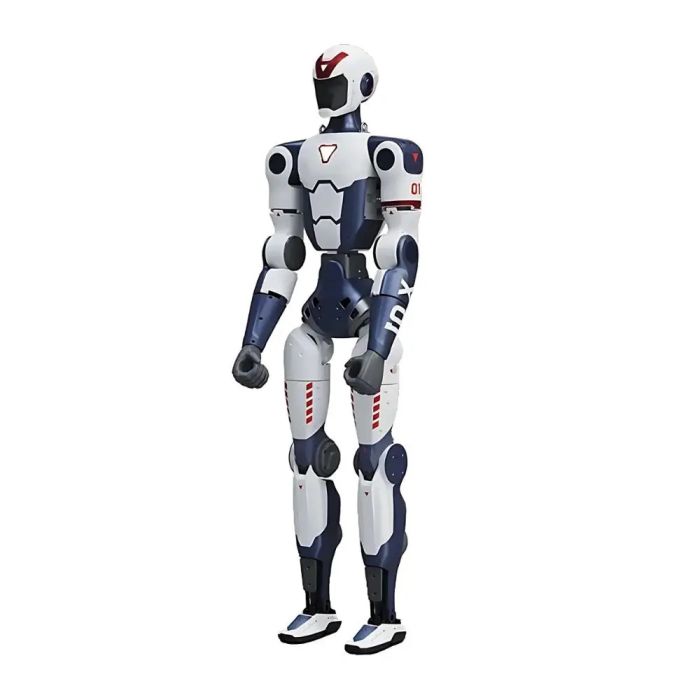
Unitree R1 Edu Pro D Humanoid Robot with BrainCo Revo 2 Touch Dexterous Hands (R1 EDU U6)
In stock
- BRAND:
- UNITREE ROBOTICS
- MODEL:
- R1 EDU PRO D
- PART #:
- R1 EDU U6
- ORIGIN:
- China
- Warranty:
- 12 MONTHS
- AVAILABILITY:
- ALLOW 2-4 WEEKS FOR DELIVERY
- SKU:
- Unitree Robotics-R1-EDU-U6
Unitree R1 EDU U6
Every equipment ladder has a rung whose real product is finality. Below it, each trim is a bet on which capabilities a programme will need; at the top, the bet disappears — the machine simply has everything its platform can carry, and the only question it leaves open is what to research first. The Unitree R1 EDU U6 is that rung. Designated Pro D, it is the flagship configuration of the R1 family: the compact humanoid that broke the field's price floor, delivered here in its most complete form — the five-finger anthropomorphic branch of the Pro tier at its fullest hand configuration, on the same roughly 1.21-metre, 25-kilogram body whose dynamics run from sprinting and spinning to handstands and cartwheels. Nothing in the family's capability set sits above it. The dexterity ceiling is the U6's own: human-shaped hands in the tier's top fit-out, for the tool-use, bimanual and human-demonstration research the anthropomorphic branch exists for. The intelligence ceiling ships inside: onboard AI compute in the Pro tier's 100 TOPS class running learned policies at the edge, stereo binocular vision, and the platform's multimodal voice-and-image AI. And the openness is total, as everywhere in the EDU line — high- and low-level secondary development across ROS 2, Python and C++, robot models and simulation workflows, the full documentation and ecosystem behind it. For the institutions that buy once and buy up, the U6 is the R1 with no next trim to want.
The Unitree R1 EDU U6 is available for purchase internationally through this page, with delivery, customs clearance and after-sales support arranged for buyers across Europe, the Americas, the Middle East, Asia-Pacific and worldwide.
Background
What "top of the ladder" means on this ladder
The R1 EDU tier is organised as an ascent through research capability: the U2 Smart opens the platform (full articulation, compute, SDK, no hands); the U3 and U4 form the three-finger branch (Dex3-1 grasping, then tactile arrays for contact science); the U5 and U6 form the five-finger branch (anthropomorphic dexterity, with the U6 as its senior configuration). Reading the ladder from the top clarifies the U6's role: it is not a specialist trim but a superset — the configuration whose capability envelope contains every question the rungs below were designed for, from locomotion and perception through grasping to human-hand dexterity, on one machine. That breadth is precisely what certain buyers need. A department equipping a single flagship rather than a fleet, a grant with one capital line, a corporate lab benchmarking the platform's ceiling, a demonstration programme that must show the family's best — for all of them, the D-trim's economics beat discovering, mid-programme, that the research outgrew the hardware.
The flagship of the price revolution
The U6's significance doubles because of whose flagship it is. The R1 arrived as the machine that made humanoid research affordable — a full dynamic biped launched below the previous entry points of the entire field, from the company whose volume engineering keeps resetting robotics' cost curves. The Pro D applies that same arithmetic at the top: a maximally configured, five-fingered, edge-AI research humanoid at a fraction of what comparable capability cost the discipline only recently. Institutions that once budgeted a single hand's worth of funds for an entire platform now specify the family ceiling — and because every trim shares the frame, SDK, simulation models, batteries, chargers, controllers and gantry ecosystem, a U6 flagship slots naturally above U2 teaching fleets and U3 grasp benches as the machine the best projects graduate onto.
Technical Specifications
| Parameter | Unitree R1 EDU U6 (Pro D) |
|---|---|
| Type | flagship configuration of the R1 EDU compact research humanoid ladder |
| Height / weight | ~1.21 m / ~25 kg including battery |
| Hands | five-finger dexterous hand pair — the Pro tier's fullest anthropomorphic configuration |
| Body architecture | 26-DOF core — 6 per leg, 5 per arm, 2 waist, 2 head; total DOF at the family maximum with hand articulation |
| Arm payload | ~2–3 kg per arm across published EDU listings |
| Dynamics | high-agility platform — running, spinning, shadowboxing, handstands, cartwheels demonstrated |
| Compute | onboard AI compute, Pro-tier 100 TOPS class, for edge deployment of learned policies |
| Perception | humanoid binocular (stereo) camera; multimodal voice and image AI |
| Development | complete high- and low-level secondary development; ROS 2, Python, C++; robot models and simulation support |
| Safety tooling | protective debug gantry ecosystem (EDU Pro standard) |
| Connectivity | Wi-Fi 6, Bluetooth 5.2 (platform standard) |
| Battery | 48 V lithium; up to ~2 h per charge (platform figure); spare-battery ecosystem |
| Trim position | ladder ceiling — above U5 (Pro C) in the five-finger branch; no higher R1 configuration |
| Warranty | 12-month whole-device coverage (EDU line standard) |
The Pro D hand configuration's exact articulation and sensor fit, along with precise platform figures, are confirmed against Unitree's current configuration sheet at quotation.
When is the top trim the rational buy?
When the cost of capability gaps exceeds the cost of capability. Research programmes are poor at predicting their own trajectories — the locomotion lab drifts into manipulation, the grasping bench discovers its thesis needs human-hand transfer — and mid-grant hardware upgrades cost twice: once in money, once in months. The U6 prices that risk out. Its envelope covers the family's entire research surface, so the platform never becomes the reason a direction closes; its role as the ladder's superset makes it the natural shared flagship in multi-group departments, where one maximally configured machine serves rotating projects that individually would justify different trims; and its position makes it the benchmarking reference — the configuration against which the R1 platform's actual ceiling is measured, which is exactly what corporate evaluation labs and integrators piloting the family need to test. Add the demonstration calculus — funders, ministries and visiting partners see the best the line offers — and the D-trim's premium over its siblings reads less like indulgence than like insurance with a warranty attached.
Who is the Unitree R1 EDU U6 for?
For departments and institutes buying one flagship rather than a fleet, where a single machine must keep every research door open; for embodied-AI groups whose work spans the full stack — locomotion, perception, grasping, anthropomorphic dexterity, demonstration learning — and refuses to be trimmed to a trim; for shared facilities and national labs provisioning a reference platform for rotating users; for corporate R&D and integrators benchmarking the R1 family at its ceiling before fleet decisions; for flagship-led programmes where the U6 crowns U2 teaching fleets and U3/U4 benches as the graduation machine; and for demonstration and evaluation contexts where the family's best foot is the one that must go forward. Programmes with a settled, narrower research question remain better served — and better priced — at the rung built for it, which is the ladder's entire design.
What is the Unitree R1 EDU U6 used for?
- Full-stack embodied-AI research: locomotion, perception, grasping and anthropomorphic dexterity on one platform.
- Human-demonstration learning at the ceiling: imitation pipelines exploiting the family's fullest hand configuration.
- Shared-facility flagship duty: reference hardware serving rotating research groups and projects.
- Platform benchmarking: evaluating the R1 family's maximum capability ahead of fleet or deployment decisions.
- Advanced tool-use and bimanual research: human-designed instruments operated in the tier's top configuration.
- Flagship demonstration: the family's best configuration for funders, partners and public programmes.
Pricing and Availability
The Unitree R1 EDU U6 is available for purchase and international delivery through this page, as a single flagship, as the crown of a mixed R1 EDU fleet, or in multi-unit programmes for shared facilities — with the full accessory ecosystem of spare batteries, chargers, controllers and protective gantries provisioned alongside, and lower trims quoted where a graduated fleet serves the budget better. As R1 deliveries proceed in phases and Pro-tier configurations are set at order, price, cost and lead time are confirmed by individual quotation; delivery, customs clearance and after-sales support are arranged worldwide. Purchase enquiries, datasheets and availability details for the R1 EDU U6 are available on this page.
Frequently Asked Questions
What is the Unitree R1 EDU U6?
The Pro D configuration and flagship of Unitree's compact R1 research humanoid — the roughly 1.21-metre, 25-kilogram open platform in its most complete form, carrying the Pro tier's fullest five-finger dexterous-hand configuration with the family's top compute and perception fit.
How does it differ from the U5?
Both belong to the five-finger anthropomorphic branch of the Pro tier; the U6 is that branch's senior configuration — the fullest hand fit-out the family offers — with the exact articulation and sensor differences confirmed against Unitree's configuration sheet at quotation.
Is there any R1 capability the U6 lacks?
No — that is its definition: the U6 sits at the top of the ladder as a superset of the family's research envelope, from the U2's open platform through the Pro trims' manipulation hardware, with no higher R1 configuration above it.
Why buy the flagship instead of a cheaper trim?
To retire capability risk: research directions drift, and the U6's full envelope means the hardware never forecloses one — the rational choice for single-flagship departments, shared facilities, benchmarking labs and programmes that cannot afford a mid-grant upgrade cycle.
Does it integrate with lower R1 trims?
Perfectly — frame, SDK, ROS 2 stack, simulation models and the entire accessory ecosystem are shared family-wide, so a U6 flagship runs the same codebase and parts shelf as U2 teaching fleets and U3/U4 research benches beneath it.
How open is the platform?
Completely, as across the EDU line: high- and low-level secondary development in ROS 2, Python and C++, robot models with simulation support for sim-to-real workflows, and Unitree's development manuals, technical support and ecosystem access — extending to the flagship hands.
Where can I buy the Unitree R1 EDU U6 and what does it cost?
The R1 EDU U6 is available through this page, with delivery, customs clearance and after-sales support arranged for buyers worldwide. Because cost varies with configuration, accessories and quantity — and a graduated fleet sometimes serves better than a single flagship — buyers should request an individual quotation. All purchasing details are available on this page.
Summary
The Unitree R1 EDU U6 is the R1 ladder resolved into one machine: the platform that democratised humanoid research, configured to its own ceiling — five-fingered, edge-intelligent, stereo-eyed, wide open, and dynamically proven from sprint to handstand — with nothing above it to upgrade toward. It exists for the buyers whose real requirement is finality: the flagship department, the shared facility, the benchmark lab, the programme whose next research question is unknown by design. Below it, four rungs answer four questions; the U6 answers all of them and waits for the fifth. The top of the most important ladder in compact humanoids is taking orders — and this page is the starting point.