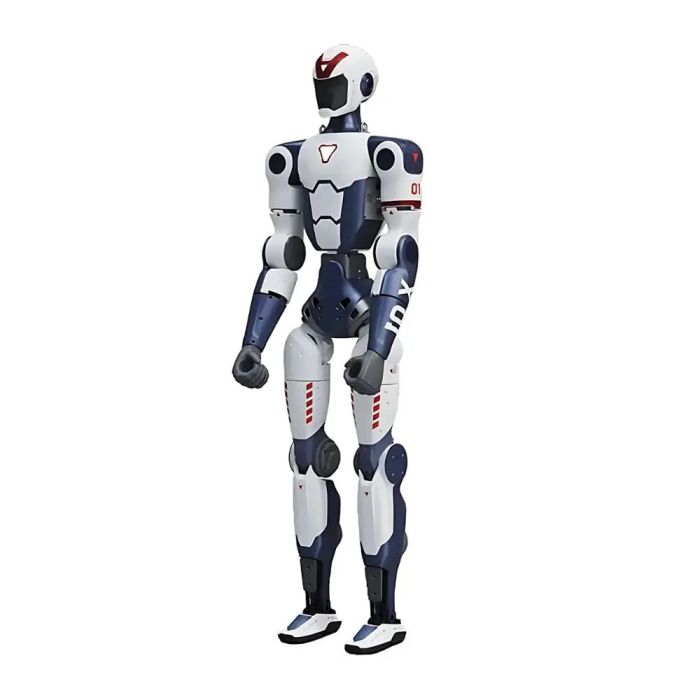
Unitree R1 Edu Pro C Humanoid Robot (R1 EDU U5)
In stock
- BRAND:
- UNITREE ROBOTICS
- MODEL:
- R1 EDU PRO C
- PART #:
- R1 EDU U5
- ORIGIN:
- China
- Warranty:
- 12 MONTHS
- AVAILABILITY:
- SUBJECT TO AVAILABILITY
- SKU:
- Unitree-Robotics-R1-EDU-U5
Unitree R1 EDU U5
Every object your laboratory will ever hand a robot was designed for the same device: five fingers and an opposable thumb. Scissors, doorknobs, spray bottles, screwdrivers, keyboards, zippers — the manufactured world is one vast standard built around the human hand, and a robot equipped with anything else meets that world in translation. The Unitree R1 EDU U5 is the rung of the R1 ladder built to skip the translation. As the Pro C configuration, it pairs the compact platform's proven body — roughly 1.21 metres and 25 kilograms of genuinely dynamic biped, the machine whose promotional reel runs from shadowboxing to handstands to cartwheels — with five-finger dexterous hands, giving researchers anthropomorphic manipulation on hardware an ordinary institution can own. The geometry is the research enabler: five-fingered morphology is what lets a robot operate human tools as designed rather than as adapted, and — increasingly decisive in the imitation-learning era — what lets policies trained on human demonstration video transfer to robot hands that match the demonstrator's. Around the hands, the U5 carries the full EDU privilege set: onboard AI compute for running learned policies at the edge, binocular stereo vision, the platform's multimodal voice-and-image intelligence, and unrestricted high- and low-level secondary development across ROS 2, Python and C++, with simulation workflows feeding the physical machine. Below it on the ladder, the Pro A and B trims carry three-finger hands for grasp and tactile research; the U5 is where the R1's hands become human-shaped.
The Unitree R1 EDU U5 is available for purchase internationally through this page, with delivery, customs clearance and after-sales support arranged for buyers across Europe, the Americas, the Middle East, Asia-Pacific and worldwide.
Background
Why five fingers is a research decision, not a styling one
Three-finger hands are superb grasping instruments — stable, robust, simpler to control — and they anchor the R1's Pro A and B trims for exactly those virtues. But a growing share of manipulation science needs the hand to be human in shape, for two hard reasons. First, tool compatibility: trigger grips, pinch-and-slide fasteners, in-hand pen and utensil work and countless bimanual household tasks assume finger counts and thumb opposition that non-anthropomorphic hands can only approximate, so research into real-world assistance, service and dexterity increasingly specifies the morphology outright. Second, data: the imitation-learning pipelines now driving the field train on human video and teleoperated human demonstrations, and the smaller the gap between demonstrator hand and robot hand, the cleaner the transfer — five fingers on the robot turns the entire corpus of human manual behaviour into usable training signal. The U5 exists to put that capability at the R1's famously accessible altitude, on the same open body its cheaper siblings share.
The ladder above and below
Unitree's R1 EDU tier reads as a menu of research questions. The U2 Smart is the platform question — articulation, compute, openness, no hands. The Pro trims then split by end-effector: U3 (Pro A) fields the Dex3-1 three-finger pair for grasp research, U4 (Pro B) adds per-finger tactile arrays for contact science, and the U5 (Pro C) opens the five-finger, anthropomorphic branch, with the U6 (Pro D) crowning it above. Because every rung shares the frame, kinematic core, SDK, simulation models and accessory ecosystem — batteries, chargers, controllers, the protective gantry — mixed fleets are the norm rather than the exception: locomotion classes on U2s, grasp benches on U3s, and the human-hand thesis projects on a U5, all maintained as one platform. The R1's founding achievement frames the whole tier: this is the machine that dropped full humanoid research below the price of the field's previous entry points, and the Pro C extends that collapse to anthropomorphic dexterity.
Technical Specifications
| Parameter | Unitree R1 EDU U5 (Pro C) |
|---|---|
| Type | compact research humanoid — five-finger dexterous-hand trim of the R1 EDU line |
| Height / weight | ~1.21 m / ~25 kg including battery |
| Hands | five-finger dexterous hand pair (Pro-tier anthropomorphic configuration) |
| Body architecture | 26-DOF core — 6 per leg, 5 per arm, 2 waist, 2 head; total DOF rises with hand articulation |
| Arm payload | ~2–3 kg per arm across published EDU listings |
| Dynamics | high-agility platform — running, spinning, shadowboxing, handstands and cartwheels demonstrated |
| Compute | onboard AI compute for edge deployment of learned policies (Pro-tier 100 TOPS class) |
| Perception | humanoid binocular (stereo) camera; multimodal voice and image AI |
| Development | full high- and low-level secondary development; ROS 2, Python, C++; robot models and simulation support |
| Connectivity | Wi-Fi 6, Bluetooth 5.2 (platform standard) |
| Battery | 48 V lithium; up to ~2 h per charge (platform figure) |
| Trim position | above U3/U4 three-finger configurations; below U6 (Pro D) |
| Warranty | 12-month whole-device coverage (EDU line standard) |
Hand model, finger articulation and sensor fit for the Pro C configuration, along with exact platform figures, are confirmed against Unitree's current configuration sheet at quotation.
What does human hand geometry unlock?
The library of everything people already know how to do. Robotics' bottleneck has shifted from hardware to demonstrations — learned manipulation is only as good as the examples it trains on — and the largest demonstration corpus on earth is humanity's own recorded manual behaviour: cooking videos, assembly footage, teleoperated sessions, motion-captured tasks. An anthropomorphic hand is the adapter that plugs a robot into that library; retargeting human finger trajectories onto matching morphology is a mapping problem, while retargeting them onto a claw is a research project. The second unlock is the tool shelf: a five-fingered platform evaluates against the actual instruments of service, care and light work — the spray trigger, the jar lid, the door lever, the pen — making the U5 the natural testbed for assistance and household-task research where "can it use what humans use" is the whole question. And the third is interaction: handovers, gestures and collaborative manipulation read differently, to both algorithms and human study participants, when the hand across the table is shaped like their own.
Who is the Unitree R1 EDU U5 for?
For imitation-learning and embodied-AI groups whose pipelines train on human demonstration data and need matching morphology at the end of the arm; for laboratories researching tool use, bimanual coordination and household or service tasks against real human-designed objects; for human-robot interaction programmes studying handover, gesture and collaboration with an anthropomorphic partner; for departments running graduated R1 fleets, where the U5 carries the dexterity thesis work above U2 locomotion classes and U3/U4 grasp benches on one shared platform; and for developers building the human-hand skills the deployment market will want next. Programmes whose questions centre on grasp robustness or tactile contact are often better served — and better priced — one or two rungs down; programmes wanting the tier's fullest five-finger configuration look to the U6 above.
What is the Unitree R1 EDU U5 used for?
- Anthropomorphic manipulation research: five-finger dexterity, in-hand skills and thumb-opposition studies.
- Human-demonstration learning: imitation and video-to-robot pipelines exploiting matched hand morphology.
- Tool-use research: operating human-designed instruments — triggers, levers, lids, utensils — as designed.
- Bimanual task development: two-handed coordination on household, service and assembly problems.
- Human-robot interaction studies: handover, gesture and collaborative manipulation with human-shaped hands.
- Advanced coursework and theses: dexterity-track teaching above the locomotion and grasping curriculum.
Pricing and Availability
The Unitree R1 EDU U5 is available for purchase and international delivery through this page, from single research units to mixed R1 EDU fleets, with adjacent trims quoted alongside — the U3 and U4 where three-finger grasp or tactile work leads, the U6 where the tier's top five-finger configuration is the target — and platform accessories, spare batteries, controllers and gantries provisioned to requirement. As R1 deliveries proceed in phases and Pro-tier hand configurations are set at order, price, cost and lead time are confirmed by individual quotation; delivery, customs clearance and after-sales support are arranged worldwide. Purchase enquiries, datasheets and availability details for the R1 EDU U5 are available on this page.
Frequently Asked Questions
What is the Unitree R1 EDU U5?
The Pro C configuration of Unitree's compact R1 humanoid — the trim equipping the roughly 1.21-metre, 25-kilogram open research platform with five-finger dexterous hands for anthropomorphic manipulation, tool-use and human-demonstration-learning research.
Why choose five fingers over the three-finger trims?
When the research needs human hand geometry: operating human-designed tools as designed, transferring policies learned from human demonstrations onto matching morphology, and interaction studies where an anthropomorphic hand changes the science — the questions the U3 and U4's Dex3-1 hands, excellent grasping instruments, don't target.
How capable is the platform underneath?
Fully R1: a 26-DOF body core with two-axis neck, stereo vision, multimodal voice-and-image AI, onboard compute for edge policy deployment, and dynamics proven publicly in running, handstands and cartwheels — control headroom that makes daily research operation forgiving.
Is it fully programmable?
Completely — the EDU designation opens high- and low-level secondary development across ROS 2, Python and C++, with robot models and simulation support for train-in-sim, deploy-on-hardware workflows extending to the hands.
Where does it sit against the U6?
One rung below the tier's ceiling: both belong to the five-finger branch of the Pro tier, with the U6 (Pro D) carrying the fullest hand configuration — the choice between them follows sensor and articulation needs, confirmed against the configuration sheet at quotation.
Can it join an existing R1 fleet?
Seamlessly — every EDU trim shares the frame, SDK, simulation models and accessory ecosystem, so a U5 slots beside U2, U3 and U4 units under one codebase, one maintenance routine and one parts shelf.
Where can I buy the Unitree R1 EDU U5 and what does it cost?
The R1 EDU U5 is available through this page, with delivery, customs clearance and after-sales support arranged for buyers worldwide. Because cost varies with hand configuration, accessories and quantity — and adjacent trims may fit some programmes better — buyers should request an individual quotation. All purchasing details are available on this page.
Summary
The Unitree R1 EDU U5 hands a research humanoid the interface the whole manufactured world was built around: five fingers and a thumb, on the compact, athletic, wide-open platform that already reset the price of entry to the field. It is the trim for the era's defining bet — that robots will learn manual work from humanity's own demonstrations, provided their hands can follow along — and for every lab whose test objects come from a hardware store rather than a grasp benchmark. Below it, the ladder teaches walking, grasping and touch; at the U5, the R1 picks up the tools. For programmes ready to research in the world's native hand, this page is the starting point.