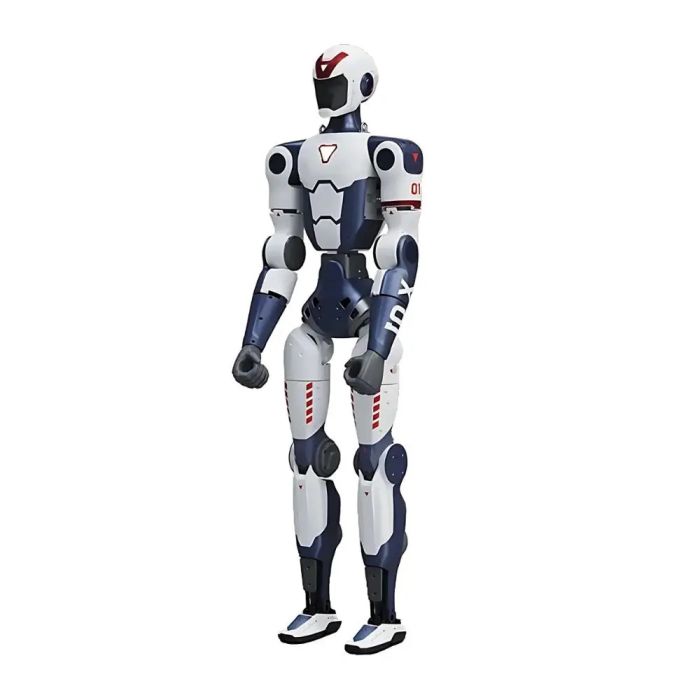
Unitree R1 Edu Smart Humanoid Robot (R1 EDU U2)
In stock
- BRAND:
- UNITREE ROBOTICS
- MODEL:
- R1 EDU SMART
- PART #:
- R1 EDU U2
- ORIGIN:
- China
- Warranty:
- 12 MONTHS
- AVAILABILITY:
- ALLOW 2-4 WEEKS FOR DELIVERY
- SKU:
- Unitree-Robotics-R1-EDU-U2
Unitree R1 EDU U2
Every robotics lab shopping for a humanoid hits the same fork in the price list: the hands. Dexterous fingers double the invoice, dominate the maintenance log — and sit idle through the first year of any locomotion, perception or control curriculum. The Unitree R1 EDU U2 is the trim built for buyers who see that fork clearly. As the Smart configuration of Unitree's compact R1 line, the U2 takes everything a research programme needs before manipulation research begins and delivers it complete: the platform's articulation upgraded to 26 degrees of freedom — six per leg, five per arm, a two-axis waist and, exclusive above the entry trims, a two-axis neck that lets the robot actually look around its world; onboard intelligence raised to a 100 TOPS compute expansion dock with AI algorithm support, enough to run modern perception and policy models without a tethered workstation; humanoid binocular camera vision for depth-aware navigation and interaction; and the full EDU development privilege — high- and low-level secondary development, robot models and simulation interfaces with Isaac Sim support, ROS, Python and C++ workflows, and Unitree's documentation and ecosystem behind it. All of it rides the R1 body that made this class famous: roughly 1.2 metres and 25 kilograms of genuinely athletic hardware — the platform demonstrated front-flipping and cartwheeling — light enough for two people to lift, priced to put bipedal research within institutional reach, and covered by a 12-month whole-device warranty. Hands can come later, on the Pro trims above; the U2 is where the R1 becomes a laboratory.
The Unitree R1 EDU U2 is available for purchase internationally through this page, with delivery, customs clearance and after-sales support arranged for buyers across Europe, the Americas, the Middle East, Asia-Pacific and worldwide.
Background
The R1 ladder, read correctly
Unitree — the Hangzhou manufacturer whose volume engineering repeatedly resets the price of legged robotics — structures the R1 family as a staircase rather than a lineup. The consumer rungs, R1 Air and Basic, deliver the walking, dancing, app-driven humanoid experience; the EDU rungs open the machine to its owner. The EDU Standard begins the development story; the U2 Smart completes the platform half of it — full 26-DOF articulation with the head axes, the 100 TOPS dock, simulation tooling, unrestricted SDK access; and the Pro trims above (U3 through U6) then add what manipulation research eventually demands: three-finger Dex3-1 hands, tactile arrays, five-finger options. Read as a ladder, the U2's position is the rational first purchase for most institutions — every dollar goes into compute, articulation and openness that a curriculum uses from day one, while the hands, the costliest and most specialised addition, remain an upgrade decision informed by actual research direction rather than a speculative line item.
Small body, serious physics
The compact humanoid class earns its place in education precisely because it keeps the hard problems and discards the dangerous ones. At the R1's scale, bipedal balance, whole-body coordination, footstep planning and disturbance recovery are all fully present — the platform's public acrobatics prove the control headroom — but a stumbling robot is a two-person lift and a bent bracket, not an incident report. The U2's additions sharpen the science: the two-axis neck turns perception from a fixed gaze into active looking — gaze control, visual tracking and attention research all require it — while the binocular camera supplies the stereo depth that navigation and interaction stacks train on, and the 100 TOPS dock means the models students build actually run onboard, closing the loop between simulation (Isaac Sim interfaces included) and the physical machine on the bench.
Technical Specifications
| Parameter | Unitree R1 EDU U2 (Smart) |
|---|---|
| Type | compact education/research humanoid — Smart trim of the R1 EDU line |
| Platform | Unitree R1: ~1.2 m class, ~25 kg class; high-dynamic (front flip and cartwheel demonstrated) |
| Degrees of freedom | 26 total — 6 per leg, 5 per arm, 2 waist, 2 head (neck axes exclusive above entry trims) |
| Arm payload | up to 2 kg per arm |
| Compute | 100 TOPS AI expansion dock with algorithm support |
| Perception | humanoid binocular (stereo) camera |
| Development | high- and low-level secondary development; robot models and simulation interfaces; Isaac Sim support; ROS, Python, C++ |
| Connectivity | Wi-Fi 6, Bluetooth 5.2 (platform standard) |
| Battery | 48 V lithium; runtime up to ~2 h per charge (platform figure) |
| Support | development manuals, technical support and ecosystem access; 12-month whole-device warranty |
| Trim ladder | above R1 Air/Basic and EDU Standard; below EDU Pro U3–U6 (dexterous-hand and tactile configurations) |
| Availability | phased deliveries under way |
Platform dimensions and endurance figures vary slightly across published listings and are confirmed against Unitree's current datasheet at quotation.
Why buy the brain before the hands?
Because research programmes consume compute daily and dexterity occasionally. The first year of any humanoid curriculum — locomotion control, reinforcement-learned gaits, SLAM and navigation, human-robot interaction, sim-to-real transfer — exercises exactly the systems the U2 maximises: joints, sensors, onboard inference and open interfaces. Dexterous hands, meanwhile, are the most fragile, most expensive and most maintenance-hungry components on any humanoid, and buying them before the manipulation research agenda exists means paying to store risk. The U2's economics respect that sequence: full platform capability now, with the Pro trims' Dex3-1 and tactile options available when — and if — the programme's direction demands them, on the same body, same SDK and same institutional knowledge. For teaching fleets the logic compounds: three U2 machines cost in the region of one hand-equipped flagship, and thirty students learn locomotion on three robots far faster than on one.
Who is the Unitree R1 EDU U2 for?
For university robotics and AI departments building humanoid coursework and research on a platform whose openness spans joystick demos to low-level joint control; for graduate labs in locomotion, perception and embodied AI, where the 100 TOPS dock and Isaac Sim pipeline carry modern learned-control workflows end to end; for engineering schools and advanced STEM programmes wanting real bipedal hardware at fleet-viable pricing; for developers and startups validating humanoid software on the most widely adopted compact platform in the field; and for institutions planning ahead — the U2 is the natural base camp from which the Pro trims' manipulation hardware becomes a later, evidence-based upgrade. Buyers whose research is manipulation-first should start at the U3 or above; buyers wanting a larger frame will find Unitree's G1 family one shelf up.
What is the Unitree R1 EDU U2 used for?
- University teaching: humanoid robotics coursework from control fundamentals to embodied-AI projects.
- Locomotion research: gait learning, balance and dynamic-motion studies on an acrobatics-proven platform.
- Perception and navigation: stereo-vision, SLAM and active-gaze research using the two-axis neck.
- Onboard AI deployment: running perception and policy models on the 100 TOPS expansion dock.
- Simulation-to-real workflows: Isaac Sim development transferred to physical hardware through the provided models and interfaces.
- Fleet-based education: multi-robot labs where per-unit cost decides how many students get hardware time.
Pricing and Availability
The Unitree R1 EDU U2 is available for purchase and international delivery through this page, from single laboratory units to multi-robot teaching fleets, with the surrounding R1 trims — Air and Basic below, the Pro U3-to-U6 configurations above — quoted alongside where a mixed fleet or an upgrade path fits the programme. As deliveries proceed in phases, price, cost, configuration and lead time are confirmed by individual quotation; delivery, customs clearance and after-sales support are arranged worldwide. Purchase enquiries, datasheets and availability details for the R1 EDU U2 are available on this page.
Frequently Asked Questions
What is the Unitree R1 EDU U2?
The Smart trim of Unitree's compact R1 humanoid for education and research: a roughly 1.2-metre, 25-kilogram-class platform upgraded to 26 degrees of freedom with a two-axis neck, a 100 TOPS AI compute dock, binocular vision and full secondary-development access.
How does the U2 differ from the R1 Air and Basic?
The consumer trims are closed experiences; the U2 is an open platform — adding the neck axes, the 100 TOPS dock, simulation interfaces and unrestricted high- and low-level programming that turn the same athletic body into a development machine.
How does it differ from the R1 EDU Pro trims?
By what sits at the wrists: the Pro configurations (U3 upward) add dexterous three-finger hands, tactile sensor arrays and five-finger options for manipulation research, while the U2 delivers the complete platform — articulation, compute, vision, SDK — without the hand hardware most first-year programmes don't yet need.
What can students actually program?
Everything from high-level behaviours to low-level joint control, through ROS, Python and C++, with Unitree's robot models and simulation interfaces — including Isaac Sim support — enabling full sim-to-real development pipelines on the 100 TOPS onboard compute.
How strong and how capable is the hardware?
Each arm handles up to 2 kilograms, the 26 joints span legs, arms, waist and head, and the underlying R1 platform's dynamics are proven publicly in front flips and cartwheels — control headroom that makes everyday research operation forgiving.
What support does it come with?
Unitree's development manuals, technical support and ecosystem access, plus a 12-month warranty on the entire device — with deliveries running in phases and lead times confirmed at quotation.
Where can I buy the Unitree R1 EDU U2 and what does it cost?
The R1 EDU U2 is available through this page, with delivery, customs clearance and after-sales support arranged for buyers worldwide. Because cost varies with configuration, accessories and quantity — and the trim ladder offers alternatives on either side — buyers should request an individual quotation. All purchasing details are available on this page.
Summary
The Unitree R1 EDU U2 is the humanoid trim that spends the budget in the right order: full 26-joint articulation with a head that looks, a 100 TOPS brain that runs real models onboard, stereo eyes, simulation-to-hardware tooling and a wide-open SDK — everything a robotics programme uses on day one — on the athletic, affordable R1 body, with the expensive hands deferred to the Pro rungs until research actually reaches for them. For universities it is the fleet-builder; for labs, the rational base camp; for the field, further proof that Unitree's ladder keeps lowering the step onto it. The sweet spot of the R1 line is taking orders — and this page is the starting point.