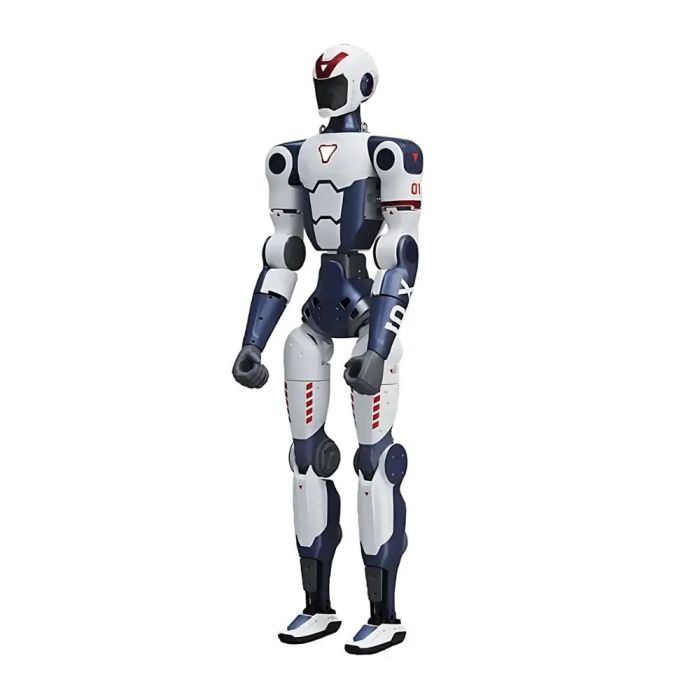
Unitree R1 Edu Standard Humanoid Robot (R1 EDU U1)
In stock
- BRAND:
- UNITREE ROBOTICS
- MODEL:
- R1 EDU STANDARD
- PART #:
- R1 EDU U1
- ORIGIN:
- China
- Warranty:
- 12 MONTHS
- AVAILABILITY:
- ALLOW 2-4 WEEKS FOR DELIVERY
- SKU:
- Unitree-Robotics-R1-EDU-U1
Unitree R1 EDU U1
The most important line on this trim's spec sheet has no number attached. It reads, in effect: permission granted. The Unitree R1 EDU U1 — the Standard configuration of the R1 family — is where Unitree's compact humanoid stops being a product you operate and becomes a platform you program, and that boundary, not any sensor or joint count, is what the EDU badge actually sells. The consumer R1 trims walk, dance and converse impressively, but their software is a sealed appliance; the U1 hands over the keys — a Linux-based open SDK on the robot's own compute, secondary development from behaviour scripting down toward the control stack, robot models and simulation interfaces with Isaac Sim workflows, so code proven virtually deploys onto the physical machine on the bench. The hardware under the permission is the real R1: roughly 1.21 metres and 25 kilograms of the biped whose promo reel runs from sprints to cartwheels, articulated through 24 degrees of freedom — six per leg, five per arm, a two-axis waist — with a humanoid binocular camera for stereo perception, two kilograms of payload per arm, a quick-release smart battery and clean internal cable routing built for laboratory handling. A built-in 40 TOPS AI expansion dock gives student models a place to run onboard, and a 12-month whole-device warranty backs the fleet math that is this trim's second superpower: at the ladder's lowest open rung, the U1 is the configuration that turns one budget line into several robots — and several robots into hardware time for every student in the room.
The Unitree R1 EDU U1 is available for purchase internationally through this page, with delivery, customs clearance and after-sales support arranged for buyers across Europe, the Americas, the Middle East, Asia-Pacific and worldwide.
Background
The line between owning a robot and owning access
Humanoid vendors draw their moats in software, and Unitree draws its openly: the R1 Air and Basic serve owners who want the experience, while the EDU tier serves owners who want the machine — and the U1 is the least expensive crossing of that line in the family, and arguably in the field. What crosses with you is substantial. The open control interfaces span joints and sensors; the SDK lives on the robot's own Linux compute rather than a mandatory external rig; simulation continuity means a course can begin in Isaac Sim weeks before hardware arrives and land its projects on the physical platform without translation; and Unitree's development manuals, technical support and ecosystem — the largest installed research base in compact humanoids — come with the badge. For a teaching department, that turns the U1 into infrastructure: the same machine runs a first-year gait lab, a third-year perception project and a graduate control thesis, differing only in how deep each reaches into the stack it is permitted to touch.
First rung by design, not by compromise
Reading the U1 as "the cheap one" misses its engineering logic. Its 24-DOF architecture is the family's core — the exact leg, arm and waist kinematics every higher trim shares — so locomotion work done here transfers upward untouched; what the ladder adds above is peripheral: the U2's two-axis neck and 100 TOPS dock for active-perception research, the Pro trims' hands for manipulation. The 40 TOPS dock is likewise a deliberate floor, not a token: ample for the perception, navigation and learned-gait workloads that dominate early curricula, with the heavier vision-language stacks waiting one rung up for the programmes that reach them. Even the omissions teach: a headless, handless biped focuses students on the discipline's foundation — balance, gait, whole-body control — before the seductions of grasping arrive. The U1 is not the ladder minus features; it is the ladder's load-bearing rung.
Technical Specifications
| Parameter | Unitree R1 EDU U1 (Standard) |
|---|---|
| Type | entry configuration of the R1 EDU open research humanoid line |
| Height / weight | ~1.21 m / ~25 kg including battery |
| Degrees of freedom | 24 total — 6 per leg, 2 waist, 5 per arm; no head articulation |
| Arm payload | up to 2 kg per arm |
| Compute | built-in AI expansion dock, 40 TOPS, with AI development support |
| Perception | humanoid binocular (stereo) camera |
| Development | secondary development via Linux-based open SDK; open joint and sensor interfaces; robot models and simulation interfaces; Isaac Sim workflows |
| Dynamics | full R1 platform agility (running, spinning, handstands, cartwheels demonstrated on the family) |
| Serviceability | quick-release smart battery; clean internal cable routing |
| Connectivity | Wi-Fi 6, Bluetooth 5.2 (platform standard) |
| Battery | 48 V lithium; roughly one to two hours per charge across published listings |
| Trim position | base of the EDU ladder — below U2 Smart (adds 2-DOF head, 100 TOPS) and the Pro hand trims |
| Warranty | 12-month whole-device coverage |
Exact platform figures and configuration contents are confirmed against Unitree's current datasheet at quotation.
What does the entry trim's arithmetic look like for a classroom?
Divide any robotics budget by the number of hands that need hardware time, and the U1 usually wins the ladder. A teaching lab's binding constraint is rarely peak capability — it is robot-hours per student, the difference between a cohort that watched a humanoid and one that programmed it. At the Standard trim's position, the budget that buys one hand-equipped flagship buys a small U1 fleet, and the fleet changes the pedagogy: parallel lab groups, students iterating instead of queueing, a spare absorbing the inevitable hard landing without halting the course. The shared-architecture guarantee protects the investment's ceiling — every controller, curriculum module and simulation asset built on U1s runs on the trims above, so the department that later adds a U2 for perception work or a U3 for a manipulation track extends its fleet rather than replacing it. And because the SDK, parts shelf, batteries and gantry ecosystem are family-wide, the marginal cost of each additional rung is learning nothing new.
Who is the Unitree R1 EDU U1 for?
For universities and colleges standing up humanoid coursework, where fleet count decides pedagogy and the U1 maximises robots per grant; for high-school and vocational programmes at the advanced end, bringing genuine research hardware — not a toy — into reach of a departmental budget; for research groups whose questions live in locomotion, balance and whole-body control, the U1's exact home territory, with compute and openness to match; for developers and startups wanting the cheapest legitimate target for R1-family software; and for any institution planning the graduated ladder deliberately — U1 fleets at the base, specialised trims added as research directions declare themselves. Programmes that know on day one they need active head-driven perception start at the U2; programmes that need hands, at the Pro tier — and the U1 remains the right training floor beneath both.
What is the Unitree R1 EDU U1 used for?
- Humanoid teaching fleets: parallel hands-on coursework where robot-hours per student set the class size.
- Locomotion and control research: gait learning, balance and whole-body studies on the family's core kinematics.
- Simulation-to-real education: Isaac Sim curricula deployed onto physical hardware through the provided models.
- Onboard AI projects: perception and policy work sized to the 40 TOPS development dock.
- SDK and software development: building against the R1 family's open interfaces at the lowest entry cost.
- Foundation training for the ladder: the base rung beneath departments' U2 perception and Pro-tier manipulation work.
Pricing and Availability
The Unitree R1 EDU U1 is available for purchase and international delivery through this page, from a single starter unit to multi-robot classroom fleets, with spare batteries, chargers, remote controllers and protective gantries provisioned alongside and higher trims quoted where a graduated fleet is the plan. As R1 deliveries proceed in phases, price, cost, configuration and lead time are confirmed by individual quotation; delivery, customs clearance and after-sales support are arranged worldwide. Purchase enquiries, datasheets and availability details for the R1 EDU U1 are available on this page.
Frequently Asked Questions
What is the Unitree R1 EDU U1?
The Standard configuration of Unitree's compact R1 humanoid and the entry point of the open EDU tier: a roughly 1.21-metre, 25-kilogram biped with 24 degrees of freedom, a 40 TOPS AI dock, stereo vision and full secondary-development access through a Linux-based open SDK.
How does it differ from the consumer R1 Air and Basic?
By permission: the consumer trims are closed experiences, while the U1's EDU badge opens the platform — joint- and sensor-level interfaces, onboard SDK, simulation models and Isaac Sim workflows — turning the same athletic hardware into a programmable research machine.
How does it differ from the U2 Smart?
The U2 adds a two-axis head (26 DOF total) and raises the dock to 100 TOPS; the U1 keeps the shared 24-DOF body core and 40 TOPS — the right floor for locomotion-centred teaching and research, at the ladder's most fleet-friendly position.
Is 40 TOPS enough for real AI work?
For the workloads the trim targets, yes: learned gaits, classical and neural perception, navigation and student model deployment all fit comfortably onboard, with the 100 TOPS rung one step up for programmes that grow into heavier stacks.
Does work done on the U1 transfer up the ladder?
Directly — the 24-DOF body architecture, SDK, simulation assets and accessory ecosystem are shared family-wide, so controllers and curricula built on U1 fleets run on the U2 and Pro trims without translation.
What makes it suitable for classroom fleets?
Its position and its build: the lowest open rung stretches budgets into multiple robots, while the quick-release smart battery, tidy internal routing, gantry compatibility and 12-month warranty are designed for the handling — and mishandling — of teaching environments.
Where can I buy the Unitree R1 EDU U1 and what does it cost?
The R1 EDU U1 is available through this page, with delivery, customs clearance and after-sales support arranged for buyers worldwide. Because cost varies with fleet size, accessories and configuration — and higher trims may suit some programmes better — buyers should request an individual quotation. All purchasing details are available on this page.
Summary
The Unitree R1 EDU U1 is the cheapest sentence in robotics that reads permission granted: the real R1 — the biped that cartwheeled the price floor out of humanoid research — with its platform unlocked, its SDK onboard, its simulation pipeline open and its 24-joint core identical to every trim above it. It exists so that classrooms buy fleets instead of showpieces, so that locomotion is learned on the architecture manipulation will later inherit, and so that the ladder's first step costs a department decision rather than a capital campaign. Five rungs rise above it; every one of them runs the code written here. The open door to the R1 family is taking orders — and this page is the starting point.