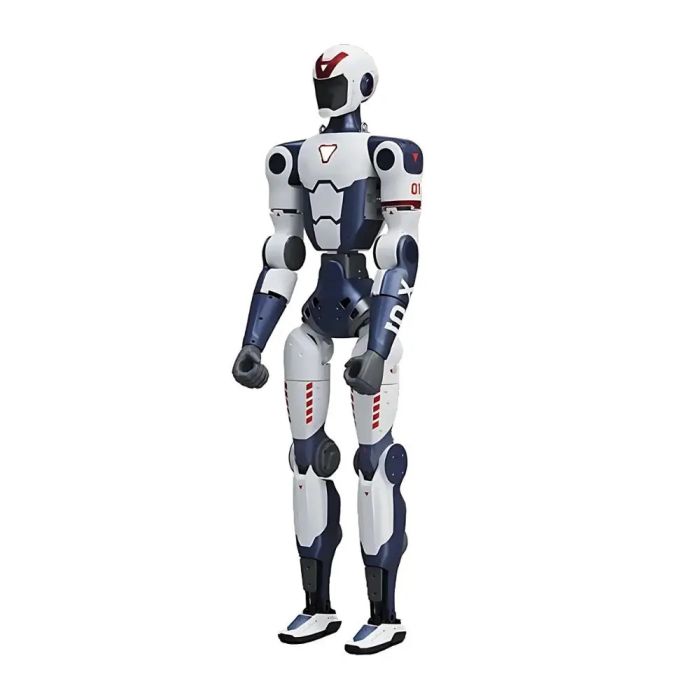
Unitree R1 Edu Pro A Humanoid Robot (R1 EDU U3)
In stock
- BRAND:
- UNITREE ROBOTICS
- MODEL:
- EDU PRO A
- PART #:
- R1 EDU U3
- ORIGIN:
- China
- Warranty:
- 12 MONTHS
- AVAILABILITY:
- SUBJECT TO AVAILABILITY
- SKU:
- Unitree-Robotics-R1-EDU-U3
Unitree R1 EDU U3
Walking was the humanoid field's first mountain; grasping is its Everest. A robot that only travels can be scripted around failure, but a robot that touches — closes fingers on a cup, reorients a tool, hands an object to a person — must solve contact physics, force, slip and intent in real time, which is why manipulation now consumes most of embodied AI's research effort and why the hardware to study it has historically cost like a mid-range car per hand. The Unitree R1 EDU U3 collapses that barrier. As the Pro A configuration of the compact R1 line, it is the first rung of the ladder to ship with dexterous hands: two Unitree Dex3-1 three-finger hands, each articulated for genuine in-hand work, lifting the machine's total to as many as 40 degrees of freedom and turning the platform from a walker into a worker. Behind the fingers sits the compute manipulation demands — an NVIDIA Jetson Orin delivering 100 TOPS onboard, enough for the vision-language-action and grasp-learning models the field now runs — fed by binocular stereo vision and opened completely to its owner: high- and low-level secondary development across ROS 2, Python and C++, simulation workflows for training before touching, and an included protective debug gantry that lets new controllers fail safely while they learn. All of it stands on the R1 body whose athletic pedigree — the flips and cartwheels are on record — means the dynamics beneath the hands never limit the science above them, in a roughly 1.2-metre, two-person-portable frame priced for laboratories rather than launch events.
The Unitree R1 EDU U3 is available for purchase internationally through this page, with delivery, customs clearance and after-sales support arranged for buyers across Europe, the Americas, the Middle East, Asia-Pacific and worldwide.
Background
Where the U3 sits, and why it exists
Unitree builds the R1 family as a graduated instrument: consumer trims at the base, the open EDU Standard and Smart above them, and the Pro configurations — U3 through U6 — crowning the line with manipulation hardware. Within the Pro tier itself the U3 is the foundation: it carries the Dex3-1 three-finger hands without the tactile arrays of the U4 above it (whose 33 touch sensors per hand serve pressure-mapping research specifically) and without the five-finger hand options of the highest trims. That placement is deliberate. A large share of manipulation research — grasp synthesis, pick-and-place learning, tool use, bimanual coordination, teleoperated demonstration collection — runs fully on articulated three-finger hardware, and the U3 delivers exactly that scope at the tier's most accessible position, on the same frame, SDK and simulation stack as every trim above it. Programmes that later need tactile sensing or anthropomorphic fingers upgrade within a family they already know.
The whole loop on one bench
What distinguishes a manipulation platform from a pair of hands on a stand is the loop: eyes to brain to fingers to feedback, mounted on a body that can carry the task to where objects actually are. The U3 closes that loop in one purchase. Stereo vision supplies depth-registered scenes; the 100 TOPS Orin runs perception and policy inference onboard rather than over a tether; the Dex3-1s execute; and the bipedal base adds the dimension tabletop rigs cannot — approach, stance, reach and whole-body coordination, the "loco-manipulation" problem the field regards as the road to genuinely useful humanoids. The included gantry makes the loop safe to iterate: early controllers run suspended, failures cost nothing, and the graduation from bracket to free-standing operation becomes part of the curriculum itself.
Technical Specifications
| Parameter | Unitree R1 EDU U3 (Pro A) |
|---|---|
| Type | compact research humanoid — first dexterous-hand trim of the R1 EDU line |
| Platform | Unitree R1: ~1.2 m class frame, research-portable weight class; high-dynamic (flips and cartwheels demonstrated) |
| Hands | 2 × Unitree Dex3-1 three-finger dexterous hands, included |
| Degrees of freedom | up to 40 total with hands (26-DOF body architecture: 6 per leg, 5 per arm, 2 waist, 2 head) |
| Compute | NVIDIA Jetson Orin — 100 TOPS onboard |
| Perception | humanoid binocular (stereo) camera |
| Development | full high- and low-level secondary development; ROS 2, Python, C++; robot models and simulation support |
| Safety tooling | protective debug gantry (bracket) included |
| Connectivity | Wi-Fi 6, Bluetooth 5.2 (platform standard) |
| Battery | 48 V lithium; up to ~2 h per charge (platform figure) |
| Trim position | above U2 Smart (no hands); below U4 Pro B (adds 33 tactile sensors per hand) and five-finger configurations |
| Warranty | 12-month whole-device coverage (manufacturer standard for the EDU line) |
Hand options, accessories and exact platform figures are confirmed against Unitree's current datasheet at quotation.
What does manipulation research actually need — and does the U3 have it?
Four things, and yes. Articulated contact: grasp research is worthless on parallel grippers; the Dex3-1's independently driven fingers support the multi-contact, reorientation and compliant-grip studies that define the field. Onboard inference: modern manipulation runs learned policies — often large vision-conditioned models — and 100 TOPS of Orin means those policies execute on the robot at control rates, keeping the sim-to-real gap honest. A body under the arms: reaching a shelf, bracing a stance and coordinating torso with grip are the problems separating humanoid manipulation from arm-on-a-table work, and the R1's dynamic base supplies them natively. Iteration without fear: the gantry converts crashes from budget events into data points. What the U3 deliberately omits — tactile arrays, five-finger anthropomorphism — is precisely what a programme should buy only when its research questions demand it, one trim up, on the same platform.
Who is the Unitree R1 EDU U3 for?
For university laboratories opening a manipulation research line, where the U3 is close to the category's minimum viable purchase: hands, compute, vision, body and SDK in one crate at the tier's entry position; for embodied-AI groups collecting demonstration data and training grasp and task policies, with simulation workflows feeding the physical loop; for teaching programmes graduating students from locomotion (a U2 fleet's territory) to manipulation coursework on identical infrastructure; for developers building humanoid manipulation software against the field's most widely deployed compact platform; and for institutions running the full ladder — U2s for the crowd, U3s for the manipulation bench, a U4 when tactile questions arrive. Buyers whose work centres on touch-sensing from day one should start at the U4; buyers not yet ready for hands, at the U2.
What is the Unitree R1 EDU U3 used for?
- Grasping and manipulation research: multi-finger grasp synthesis, in-hand reorientation and tool-use studies.
- Loco-manipulation development: whole-body coordination of stance, reach and grip on a dynamic biped.
- Policy learning: training and deploying vision-conditioned manipulation models on 100 TOPS onboard compute.
- Demonstration data collection: teleoperated and scripted task recordings for imitation learning.
- Advanced coursework: manipulation and embodied-AI teaching above the locomotion curriculum.
- Human-robot interaction studies: handover, assistance and collaborative-task research with articulated hands.
Pricing and Availability
The Unitree R1 EDU U3 is available for purchase and international delivery through this page, from single laboratory units to multi-robot programmes, with adjacent trims quoted alongside — the U2 Smart where a hands-free fleet complements the manipulation bench, the U4 Pro B where tactile sensing is on the research map. As R1 deliveries proceed in phases and hand configurations are set at order, price, cost and lead time are confirmed by individual quotation; delivery, customs clearance and after-sales support are arranged worldwide. Purchase enquiries, datasheets and availability details for the R1 EDU U3 are available on this page.
Frequently Asked Questions
What is the Unitree R1 EDU U3?
The Pro A configuration of Unitree's compact R1 humanoid — the first trim in the family equipped with dexterous hands: two Dex3-1 three-finger hands on the open EDU platform, with up to 40 total degrees of freedom, NVIDIA Jetson Orin compute at 100 TOPS and full secondary development.
What are the Dex3-1 hands capable of?
They are Unitree's articulated three-finger dexterous hands, built for genuine manipulation research — multi-contact grasping, object reorientation, bimanual coordination and tool handling — rather than simple open-close gripping.
How does the U3 differ from the U2 Smart below it?
By the hands and their consequences: the U2 delivers the full open platform — 26-DOF body, 100 TOPS-class compute, stereo vision, SDK — for locomotion and perception work, while the U3 adds the Dex3-1 pair, raising articulation toward 40 DOF and opening manipulation research entirely.
How does it differ from the U4 above it?
The U4 (Pro B) carries the same frame, hands and compute but adds 33 touch sensors per hand for spatial contact-pressure mapping; the U3 is the choice when grasp geometry and policy learning lead the agenda and tactile arrays can wait.
Is it safe to run experimental controllers on it?
That is what the included protective debug gantry is for: new manipulation and locomotion controllers run suspended in the bracket, so failures during development cost data rather than hardware, before graduating to free-standing operation.
What software stack does it support?
Full high- and low-level secondary development through ROS 2, Python and C++, with robot models and simulation support enabling train-in-sim, deploy-on-robot workflows — all executing on the onboard 100 TOPS Jetson Orin.
Where can I buy the Unitree R1 EDU U3 and what does it cost?
The R1 EDU U3 is available through this page, with delivery, customs clearance and after-sales support arranged for buyers worldwide. Because cost varies with configuration, accessories and quantity — and adjacent trims may suit some programmes better — buyers should request an individual quotation. All purchasing details are available on this page.
Summary
The Unitree R1 EDU U3 puts the field's hardest problem within a laboratory budget: two articulated Dex3-1 hands on a dynamic, open, 100-TOPS humanoid, with stereo eyes, a full ROS 2 stack, simulation-to-hardware tooling and a crash-proof gantry to learn in — the complete eye-brain-finger-body loop that manipulation research actually requires, at the entry position of the Pro tier. Below it, the U2 teaches walking; above it, the U4 adds touch; the U3 is where the R1 starts changing the world by picking it up. For the labs, programmes and developers ready to close the loop, this page is the starting point.