Keenon BUTLERBOT W3 Private and Multi-Floor Service Robot with 5 Year Warranty
In stock
- BRAND:
- KEENON
- MODEL:
- BUTLERBOT W3
- ORIGIN:
- China
- Warranty:
- 60 MONTHS
- AVAILABILITY:
- ALLOW 2-4 WEEKS FOR DELIVERY
- SKU:
- KEENON-W3
Keenon BUTLERBOT W3: The Multi-Floor Hotel Room Service Robot
The BUTLERBOT W3 became one of the most publicly recognized products in Keenon's international portfolio following the company's 2023 strategic cooperation agreement with Wyndham Hotel Group, one of the world's largest hotel chains with properties in over 95 countries. Wyndham's commitment to deploying BUTLERBOT W3 units across its portfolio established the platform's credibility in global hospitality procurement discussions at a level that individual property deployments cannot replicate.
The Hospitality Context: Why Hotels Need a Dedicated Robot
The Operational Economics of Late-Night Room Service
Room service is one of the highest-labor-cost functions in a full-service hotel. Orders arrive unpredictably throughout the day and night, requiring dedicated staff availability during periods of low overall activity. The late-night hours between 10 PM and 6 AM present the most acute challenge: guest demand for room service continues, but the volume is insufficient to justify full-shift staffing at daytime wage rates. Hotels that maintain full room service coverage during overnight hours pay labor premiums; hotels that reduce overnight hours sacrifice service quality that premium guests expect.
The Contactless and Privacy Requirements
Post-COVID hospitality operations permanently elevated guest expectations for contactless service options. Guests who request room service increasingly prefer a delivery model where a staff member does not enter their room during delivery, particularly late at night when personal privacy and security concerns are at their highest.
The BUTLERBOT W3's enclosed, individually lockable compartment system addresses this requirement directly. Each compartment has automatic doors that open only for the specific room that requested the delivery, with each guest receiving a unique PIN code or phone notification to open their compartment. Neither the robot nor any human staff member enters the guest's room; the guest opens their compartment at the door threshold, collects their order, and the robot proceeds to the next delivery.
Design and Physical Characteristics
Dimensions and Physical Profile
The BUTLERBOT W3's dimensions are confirmed across multiple distributor specifications as 45.9 by 54.9 by 108.1 centimeters (18.07 by 21.61 by 42.56 inches, approximately), with a total weight of 48 kilograms (106 pounds) including battery. The robot's height of approximately 108 centimeters positions the top compartment at a comfortable standing access height for most hotel guests, avoiding the need to bend to an awkward level for item collection.
The IPROS specification document notes the total internal storage capacity as 90 liters across all compartments, a volume sufficient for a typical room service order including main course, beverage, and side dishes plus serving accessories, with room for multiple simultaneous orders across different compartments for different rooms.
Compartment System: Two, Three, or Four Configurations
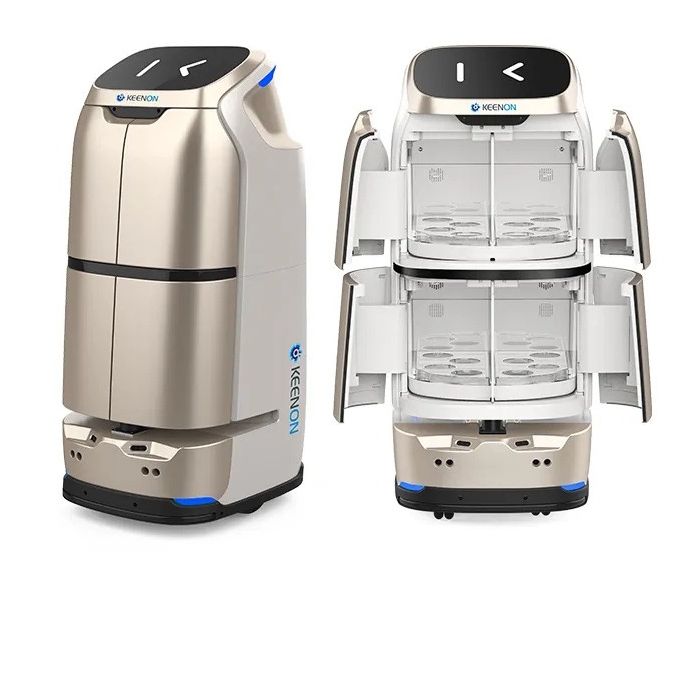
The W3's defining physical feature is its configurable enclosed compartment system. The robot is available in two-, three-, or four-compartment configurations, with each compartment independently accessible via automatic doors. Each compartment functions as a sealed, individual delivery unit, maintaining the privacy and food safety of each order independently of the others.
Compartment dimensions, per the IPROS specification: each shelf is approximately 390 by 385 by 300 millimeters (W by D by H), providing space for a standard room service tray including covering cloche, beverage glass, and standard serving items. Ventilation within each compartment maintains appropriate temperature conditions during the delivery journey from the hotel kitchen to the guest floor and room.
The ability to load up to four separate orders for four separate rooms simultaneously is the throughput feature that most directly determines the operational economics of the W3. A robot that can complete four room service deliveries in a single trip from the kitchen reduces the number of trips required per shift by a factor of four compared to single-delivery systems, and reduces the total number of robot units required to cover a given hotel's room service volume.
The 11.6-inch Touchscreen Interface
The W3 includes an 11.6-inch touchscreen at 1080p HD resolution as its primary guest interaction interface. This screen provides navigational guidance to guests for compartment selection and code entry, displays delivery status information, and enables the hotel to present branded content and service information during the robot's operation. The screen is also used for staff loading interface during kitchen dispatch, where the loading sequence and compartment assignment are confirmed.
Technology and Specifications
Complete Verified Specifications
Based on confirmed specifications from IPROS, Keen Robotic, AutomationPro, and multiple international distributors:
Dimensions: 45.9 × 54.9 × 108.1 cm (18.07" × 21.61" × 42.56") Weight: 48 kg (106 lbs) Load Capacity: 20 kg total (10 kg per layer/compartment in two-compartment configurations; the four-compartment variant distributes weight across four independent units) Cruise Speed: 0.1 to 0.8 meters per second (approximately 0.33 to 2.6 feet per second) Maximum Speed: Up to 1.0 meter per second (3.28 feet per second) per RobotATTA specifications Minimum Passage Width: 700 mm (70 centimeters, approximately 27.6 inches) per RobotATTA; other sources indicate the robot requires aisle widths of approximately 70 centimeters or more for reliable navigation Battery Life: 9 to 12 hours operating per charge Charging Time: Approximately 5 to 6.5 hours (varying by source) Battery Working Life: 20,000 hours total battery cycle lifespan Display: 11.6-inch 1080p HD touchscreen Navigation: Laser SLAM and Visual SLAM (VSLAM) fusion Obstacle Avoidance: 120-degree wide-angle dual stereo vision cameras Elevator Control: Automatic elevator call, boarding, and disembarkation Connectivity: IoT platform integration with real-time operational data Compartments: 2, 3, or 4 configuration options, each independently accessible
Laser and Visual SLAM Navigation
The BUTLERBOT W3 uses a fusion of Laser SLAM (LiDAR-based Simultaneous Localization and Mapping) and Visual SLAM for positioning and navigation. Laser SLAM provides precise distance measurements to surrounding structures, building a geometric map of the hotel environment including corridors, elevator lobbies, and room door positions. Visual SLAM supplements the laser navigation with visual feature recognition, particularly valuable in the visually varied corridor environments of hotels where decorative elements, artwork, and wall textures provide distinctive visual landmarks for positioning.
The fusion of both navigation modalities provides robustness to the environments encountered in hotel deployment: corridors with highly polished or mirrored surfaces that can challenge pure laser systems, areas with variable lighting from ambient and decorative fixtures, and elevator lobbies where the robot must precisely align with elevator entrances and doors.
Elevator Control System
The autonomous elevator integration is the most operationally critical technology feature for multi-floor hotel deployment. The W3's elevator control system communicates with the hotel's elevator IoT interface to call an elevator, receive notification when the elevator arrives at the robot's current floor, board the elevator, select the destination floor, wait while the elevator travels, disembark at the destination floor, and navigate to the guest room door.
This autonomous elevator operation must handle real-world complexities including other hotel guests who may enter or exit the elevator during the robot's journey, elevator door timing that differs from floor to floor, and the positioning precision required to align the robot's body with the elevator car during boarding and disembarkation. The BUTLERBOT W3's elevator control system, described by IPROS as "IoT functionality (automatically able to board and disembark from elevators)," handles these complexities without requiring a dedicated human escort.
KEENON Platform: Cloud Management and IoT Monitoring
The BUTLERBOT W3 connects to the KEENON Platform, the company's cloud-based robot management and monitoring system. Through this platform, hotel operations teams can monitor the real-time operational status of every deployed W3 unit: current location within the hotel, current task and destination, battery level, delivery completion confirmation, and historical operational trajectory data.
Useabot's product documentation describes the operational implication: "From the KEENON Platform, users can obtain the digital trajectory of robot operation and IoT operation data at any time, truly realizing unmanned intelligent distribution." For hotel general managers and F&B directors, the cloud platform provides service quality assurance data, operational analytics for staffing optimization, and the ability to identify and address operational issues without requiring staff to physically check on the robot.
Obstacle Avoidance: 120-Degree Wide-Angle Dual Stereo Vision
The 120-degree wide-angle dual stereo vision camera system provides the obstacle detection coverage needed for hotel corridor navigation, where other guests, housekeeping carts, luggage trolleys, and service equipment regularly create dynamic obstacles between the kitchen and guest floors. The stereo vision provides depth perception for more accurate obstacle size and distance assessment than single-camera systems, and the 120-degree coverage addresses obstacles approaching from oblique angles that forward-only sensors would miss.
Applications and Use Cases
In-Room Dining Service
The BUTLERBOT W3's primary and most commercially documented application is hotel in-room dining delivery. Guests order room service through the hotel's existing ordering channels (in-room telephone, hotel app, or front desk), the kitchen prepares the order and loads it into an appropriate compartment on the robot, and the robot navigates autonomously from the kitchen to the guest's floor and room, calls the guest via the hotel's notification system, and opens the compartment for contactless collection.
The four-compartment configuration enables the robot to load and deliver orders for four separate rooms in a single trip, dramatically increasing the throughput efficiency compared to single-order delivery trips. For a hotel with 200 rooms and a peak evening room service period of 150 orders between 7 PM and 11 PM, a two-robot fleet with four-compartment configurations can theoretically process 37 round trips to cover this volume, compared to 150 trips for a single-order manual delivery system.
Amenity and Supply Delivery
Beyond in-room dining, the W3's enclosed compartment system is well suited for the delivery of guest amenities including extra towels, toiletries, pillow selections, charging cables, and other items that guests request during their stay. The contactless compartment delivery model for amenities reduces the need for housekeeping staff to make unscheduled room visits for small item requests, allowing housekeeping to focus on their planned room service schedules.
Package and Parcel Delivery
Hotels that receive packages and parcels for guests can use the W3 as a secure last-mile delivery platform from the front desk receiving area to individual rooms. The individually lockable compartments provide an appropriate security level for parcel delivery, with each guest receiving their specific compartment access notification while other compartments remain locked.
Hospital and Healthcare In-Patient Delivery
While hotels are the primary documented deployment context, the BUTLERBOT W3's specifications are appropriate for hospital and healthcare in-patient food delivery as well. Hospital patient meal delivery faces the same core operational requirements as hotel room service: private compartments for hygiene and dietary privacy, multi-floor navigation, and autonomous operation without requiring clinical staff to redirect time from patient care to meal transport.
Advantages and Benefits
Contactless enclosed compartments for privacy and hygiene: The automatically opening, individually lockable compartments enable fully contactless delivery where neither the robot nor any staff member enters the guest room, addressing the post-COVID hospitality expectation for contactless service options.
Four simultaneous deliveries in a single trip: The four-compartment configuration multiplies delivery throughput by enabling up to four separate room orders in a single robot trip, reducing trip frequency and robot unit requirements for a given hotel's service volume.
Autonomous elevator operation for genuine multi-floor independence: The elevator IoT integration enables the W3 to operate completely independently across all hotel floors without requiring human escort, which is the operational prerequisite for economically viable multi-floor robot deployment.
9 to 12-hour battery covering full overnight shifts: The battery endurance covers a complete overnight service period from late evening through early morning, which is the service window where robot deployment provides the greatest labor cost relief relative to human staffing.
Wyndham Hotel Group deployment validation: The strategic cooperation agreement with one of the world's largest hotel chains provides procurement-grade deployment evidence that individual property case studies cannot match.
KEENON Platform real-time IoT monitoring: Cloud-based operational monitoring enables hotel management teams to maintain service quality oversight across all deployed W3 units without requiring physical supervision, enabling genuinely unmanned intelligent distribution.
Comparison with Other Hotel Service Robots
BUTLERBOT W3 vs. DINERBOT T9 Pro
The T9 Pro is Keenon's multi-environment delivery robot that addresses both restaurant and hotel service roles. The key difference from the W3 is the enclosure system: the T9 Pro uses open trays for carrying items, while the W3 uses enclosed, individually lockable compartments. For hotel in-room dining where food privacy, hygiene, and late-night personal security are important to guests, the W3's enclosed compartments provide a qualitatively different service experience. The T9 Pro is more appropriate for hotel restaurant service and daylight-hours in-room delivery where open tray delivery is acceptable; the W3 is more appropriate for privacy-sensitive in-room delivery, particularly overnight.
BUTLERBOT W3 vs. Aethon TUG
Aethon's TUG autonomous mobile robot is deployed in hospital environments for materials transport and has been used in some hotel properties for laundry and supply transport. The TUG is a larger, heavier platform designed for high-payload materials logistics rather than room service delivery. The W3's enclosed compartment design, guest-facing touchscreen interface, and food hygiene-oriented construction make it more appropriate for guest-facing delivery contexts where appearance, noise, and food safety are primary considerations.
Summary
The Keenon BUTLERBOT W3 is the most purpose-built commercially deployed hotel room service robot available to international hospitality buyers in 2026. Its enclosed, individually lockable four-compartment system enables contactless, private delivery to up to four rooms in a single trip. Its autonomous elevator control system handles complete multi-floor operation without human escort. Its 9 to 12-hour battery endurance covers overnight service windows where robot deployment provides the greatest labor cost advantage over human staffing. Its 48-kilogram compact form factor navigates hotel corridors as narrow as 70 centimeters. And its Wyndham Hotel Group deployment across a globally recognized hotel brand provides the procurement-grade reference evidence that hotel operators need when evaluating a technology investment of this nature. For hotel operations managers evaluating autonomous room service delivery at full-service and luxury properties, the BUTLERBOT W3 is the most comprehensively validated and purpose-designed platform currently available from an internationally established manufacturer.
What is the Keenon BUTLERBOT W3?
The Keenon BUTLERBOT W3 is a purpose-built autonomous hotel service robot developed by KEENON Robotics Co., Ltd. for private, hygienic, and multi-floor delivery in hospitality environments. Key specifications: 45.9 × 54.9 × 108.1 cm body, 48 kg weight, 20 kg total load capacity across configurable compartments, 0.1 to 0.8 m/s cruise speed (up to 1 m/s maximum), 9-to-12 hour battery life, 11.6-inch 1080p touchscreen, Laser + Visual SLAM navigation, automatic elevator control, and two-, three-, or four-compartment configuration options with individually lockable automatic doors. A strategic cooperation agreement with Wyndham Hotel Group validates its commercial deployment in global hospitality.
How does the BUTLERBOT W3 navigate between hotel floors?
The BUTLERBOT W3 uses an elevator IoT control system that communicates with the hotel's elevator infrastructure. When the robot has a delivery assignment to a different floor, it navigates autonomously to the elevator lobby, calls the elevator using the IoT interface, waits for the elevator door to open, boards the elevator car, selects the destination floor, waits during travel, disembark at the destination floor, and navigates to the guest room. The entire multi-floor journey requires no human escort or manual intervention. The robot uses Laser SLAM and Visual SLAM fusion to navigate hotel corridors on each floor, with 120-degree wide-angle dual stereo vision cameras for dynamic obstacle avoidance.
Why is the BUTLERBOT W3 particularly suitable for late-night hotel service?
The W3's 9-to-12 hour battery endurance covers a complete overnight service period without requiring recharging, and its autonomous operation has no shift cost premium at any hour, making it economically equivalent for a 2 AM delivery as a 2 PM delivery. The contactless enclosed compartment system addresses the privacy and security concerns that guests have about late-night room service, where conventional delivery requires a staff member to interact at the guest's door at potentially sensitive hours. The cloud management system enables hotel operations teams to monitor service quality overnight without requiring a supervisor physically present on each floor.
What is the difference between the BUTLERBOT W3's two-, three-, and four-compartment configurations?
All three configurations share the same chassis, navigation system, and battery, with the compartment count representing the number of individually accessible, lockable delivery units built into the robot. A two-compartment W3 serves two separate rooms in a single trip; a four-compartment W3 serves four separate rooms. Each compartment has automatic doors, independent locking with guest PIN or notification access, and internal ventilation for food maintenance. Hotels with higher room service volume per shift benefit from the four-compartment configuration's throughput multiplier, while hotels with smaller properties or more limited service volume may find the two-compartment configuration sufficient for their needs.
Specifications
- Dimensions(WxDxH): 45.9 x 54.9 x 108.1 cm (18.07" x 21.61" x 42.56")
- Weight: 48kg (106lbs)
- Max. Moving Speed: 0.8m/s (2.63ft/s)
- Battery Life*: Up to 12h
- Charging Time**: 6.5h
- Slope Angle: 7°
- Total Load Capacity: 20kg (44lbs)
- Minimum Passage Width: 70cm (27.56")
Keenon BUTLERBOT W3 cross-floor hotel service robot
Official Keenon source highlights
- Built for hotel room service, privacy-sensitive delivery and multi-floor operation.
- Supports elevator riding, access-control gate integration and remote robot calling.
- Closed compartments help protect delivered items during unattended service.
Source-backed specifications
| Weight | 48 kg with battery |
|---|---|
| Load capacity | 20 kg / 90L |
| Number of compartments | 2/3/4 adjustable |
| Compartment size | 390 x 385 x 300 mm |
| Maximum speed | 0.8 m/s |
| Battery life | 9-12h |
| Charging time | 6.5h |
| Screen size | 11.6-inch |
| Maximum climbing angle | 7 degrees |
| Obstacle avoidance | Dual stereo vision and collision-sensing bar |
| Positioning and navigation | Laser, IMU, encoder and multi-sensors |
Updated from the official Keenon Drive product materials supplied for this catalogue refresh.